Async-First Meeting Rules for Engineering Teams

Engineers lose an average of 11.5 hours per week to meetings and the refocus penalty that follows them. UC Irvine's Gloria Mark (the 23-minute refocus study, updated 2023) now puts the post-interruption cost for knowledge workers at 23 minutes and 15 seconds per context switch. Four meetings a day is literally three hours of lost focus time on top of the meetings themselves. Your Google Calendar tells you 6 hours; the real cost is closer to 9.
This is a playbook for cutting meeting load in half on an engineering team without losing the alignment that the meetings were (theoretically) providing. It's async-first, not async-only — some meetings are still the right tool, and pretending otherwise is how async cultures themselves fail.
The problem: the default meeting is the cheapest meeting to schedule
Booking a 30-minute meeting with 5 engineers costs the booker 2 minutes. It costs the attendees 2.5 hours — half an hour each, plus the refocus tax. This asymmetry is why calendars are full. Nobody accounts for the receiver-side cost.
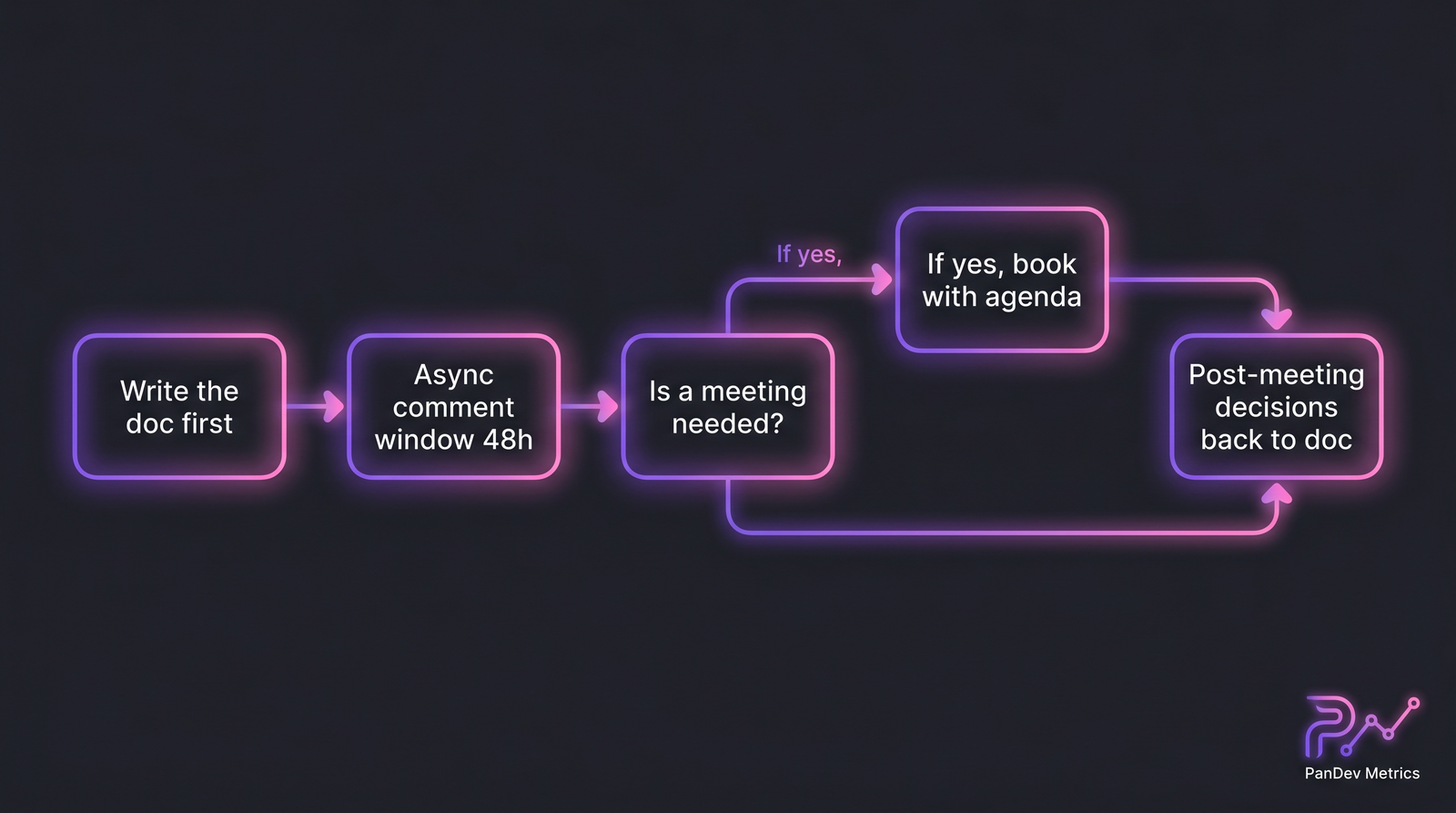 The async-first decision loop. Most proposed meetings die at the "is this meeting needed?" question once the 48h async window closes.
Microsoft Research's 2022 Work Trend Index surveyed 30,000 knowledge workers — engineers were in the highest-meeting-load quartile, averaging 19 meetings per week. The DORA 2024 State of DevOps report linked "meeting density" inversely to deployment frequency: teams in the top meeting-load quartile deployed 32% less frequently than teams in the bottom quartile, controlling for team size and stack.
The framework: 7 rules
Rule 1 — Write the doc before you book the meeting
If you can't articulate the discussion topic in a 1-page doc, you're not ready to meet. The doc becomes the pre-read, the agenda, and the note-taking surface all at once.
Amazon's "six-page narrative" practice is the famous version, but a lightweight 1-pager works for most engineering discussions:
# {Topic}

## What decision are we making?
{one paragraph}

## Context
{what led here, what we've tried}

## Options
1. Option A — pro / con
2. Option B — pro / con
3. Option C — pro / con

## My recommendation
{which option, why}

## What I need from you
{comments by Thursday / attend Friday meeting / async approval}
Half the time, writing this reveals the decision can be made without a meeting at all.
Rule 2 — Give 48 hours of async comment time before deciding to meet
Post the doc. Set a 48-hour async window where anyone can comment, ask questions, propose edits. Most team decisions resolve in the comment thread.
The contrarian rule: if the comment thread resolves the decision, cancel the meeting. Don't meet to "formalize" a decision that's already been made. This is the #1 thing teams forget — they schedule the meeting before posting the doc, and then hold it even when async already settled the question.
Rule 3 — Default stand-up to async
Daily stand-ups are the highest-volume meeting category. Most of them should be async updates in Slack or a dedicated tool.
| Stand-up format | Time cost per week (6-person team) | Information density |
|---|---|---|
| 15-min daily sync | 7.5 hours (6 × 15 × 5) | Low (verbal, rarely captured) |
| 5-min async Slack thread | 30 min (6 × 5 × 1 thread) | High (searchable) |
| Weekly 30-min sync + daily async | 3 hours (6 × 30 × 1) | High |
A weekly 30-min sync for dynamics (blockers, morale, strategy) plus daily async updates covers what a daily sync did, at 40% of the time cost. We've seen this switch land well in teams from 4 to 40 engineers.
Rule 4 — Default planning to async, review to sync
Planning can be async with a structured doc. Retrospectives benefit from synchronous video — the emotional texture matters, and "async retro" has a bad track record.
| Meeting type | Default mode | Why |
|---|---|---|
| Stand-up | Async | Status updates are readable |
| Sprint planning | Async + 30-min confirmation sync | Estimates are individual work |
| Backlog grooming | Async | Comments on tickets beat talking |
| Retro | Sync | Emotional signal, psych safety |
| 1:1 | Sync | Relationship-first |
| Design review | Doc + async + optional sync | Most resolve in comments |
| Incident response | Sync | Latency matters |
| All-hands | Sync (with recording) | Shared experience, Q&A |
Not everything should be async. Retros, 1:1s, and incident response are sync-first for good reasons. Flattening everything to async is how cultures lose connection.
Rule 5 — Shrink meeting sizes, not meeting lengths
A common mistake: "let's make all meetings 25 minutes instead of 30." This ignores that meeting cost scales with attendees, not minutes. Cutting a 30-minute 8-person meeting to 25 minutes saves 40 person-minutes. Cutting it to 30 minutes with 4 attendees saves 120 person-minutes.
Rule: any meeting with more than 8 attendees defaults to doc + async. In-person only if urgent and unresolved.
Rule 6 — Respect focus-block time zones
Mandatory no-meeting windows. 9:30am-11:30am local and 2pm-4pm local are good defaults — our own focus-time data shows these windows produce the highest-quality coding output when uninterrupted.
Managers should protect these windows harder than engineers do. A meeting booked at 10am "because it was the only time everyone was free" usually means the booker didn't try the 8am or 4pm slots.
Rule 7 — Write down the decision, not the discussion
If a meeting happens, the artifact is the decision, not a transcript. Three sentences:
- Decision: we will do X
- Rationale: because of Y
- Next steps: person A does Z by date D
Post to the doc and to the async channel. Nobody needs the 25-minute discussion recap; they need to know what was decided and what happens next.
Common mistakes
| Mistake | Why it hurts | Fix |
|---|---|---|
| "Recurring meeting" on autopilot | Cost compounds, no review | Quarterly audit; kill if no specific decision |
| Agenda = "sync up" | No concrete decision, no outcome | Agenda must be a question or decision |
| 8+ attendees routinely | Cost explodes | Doc + async for > 8 |
| Meetings during focus blocks | Double-costs productivity | Protected 2h blocks, 2x/day |
| No-doc meetings | Attendees unprepared | Doc posted ≥24h before |
| Async-only retro | Flattens emotional signal | Keep retros sync |
| 30-min default slot | Fills the time available | 15-min default; book up if needed |
The checklist
- Doc posted ≥ 24h before any meeting with a decision at stake
- 48h async window before calling a meeting
- Daily stand-up is async, weekly sync is 30 min
- No meetings during 9:30-11:30 and 14:00-16:00 local focus blocks
- Any meeting with >8 attendees justified in writing
- Decision + rationale + next steps written after every meeting
- Recurring meetings audited quarterly
How to measure if it's working
Track per engineer, weekly:
- Meeting hours — target under 7/week for ICs, 15/week for EMs
- Focus time blocks ≥ 45 min — target ≥ 10 per week
- Context switches per day — target under 4 (anything over 6 correlates with burnout per our focus-time post)
PanDev Metrics surfaces all three via IDE heartbeat data combined with calendar integration — coding sessions, meeting blocks from calendar, and the focus-time windows between them. Teams switching to async-first see the focus-time distribution shift visibly within 4-6 weeks. The metric to watch is mean focus block length; when it rises from ~18 minutes to ~42 minutes, the new cadence is working.
Honest limit: meeting load is a leading indicator of delivery capacity, not a cause of it. A team that cuts meetings but doesn't change what it's working on won't magically ship faster. Our data can tell you whether you're spending more time coding; it can't tell you whether the coding is on the right thing.
When this framework doesn't fit
- Very early-stage startups (<10 people) — the coordination cost of async docs exceeds the cost of 10 meetings a week. Stay sync until ~12 people.
- Fully co-located offices — in-person hallway conversations are effectively sync and free; forcing docs can feel bureaucratic. Adopt selectively.
- Crisis incident response — obvious, but worth stating. When prod is down, sync Slack + video beats docs.
- Sales / customer-facing roles — their calendar constraints differ fundamentally; this playbook is for engineers, not the whole company.