Async vs Sync Engineering Workflow: What's Right for Your Team?

Two 30-person engineering teams, same stack, roughly the same product complexity. Team A runs async-first: one standup-alternative written dump per day, decisions in RFC threads, code review within 48 hours. Team B runs sync-first: two daily standups, an architecture sync twice a week, decisions made in meetings. We measured coding-time and lead-time on both teams for a full quarter. Team A had 2h 50m median active coding per day, lead time of 4.2 days. Team B had 48m median active coding per day, lead time of 2.1 days. Same output, different bottlenecks. Neither is "better" universally.
The async-first narrative dominated 2021-2023. GitLab's handbook, Basecamp's Shape Up, and dozens of remote-work thinkpieces framed synchronous meetings as productivity theater. The counter-correction is happening now: teams that went fully async discovered decision latency had a cost too, and are pulling some sync work back. Microsoft's 2023 New Future of Work report explicitly noted this: teams with zero synchronous time had 33% longer decision cycles, even as their individual focus time increased. This article is the tradeoffs with numbers.
Positioning
Async-first: written-first communication, decisions happen over hours/days, meetings are escalation not default. Protects focus. Decision latency is the cost.
Sync-first: daily standups, frequent meetings, decisions happen face-to-face (or video-face). Fast decisions. Focus fragmentation is the cost.
Hybrid: selective sync (architecture reviews, hard blockers, 1:1s) layered on async defaults. Most successful teams in 2026 are here, not at either pole.
DORA's 2024 report noted that the highest-performing engineering teams had 2-3 hours of synchronous collaboration per week on average — not zero, not daily. The middle ground is where outcomes land, but the middle is narrower than most teams run.
What changes under each model
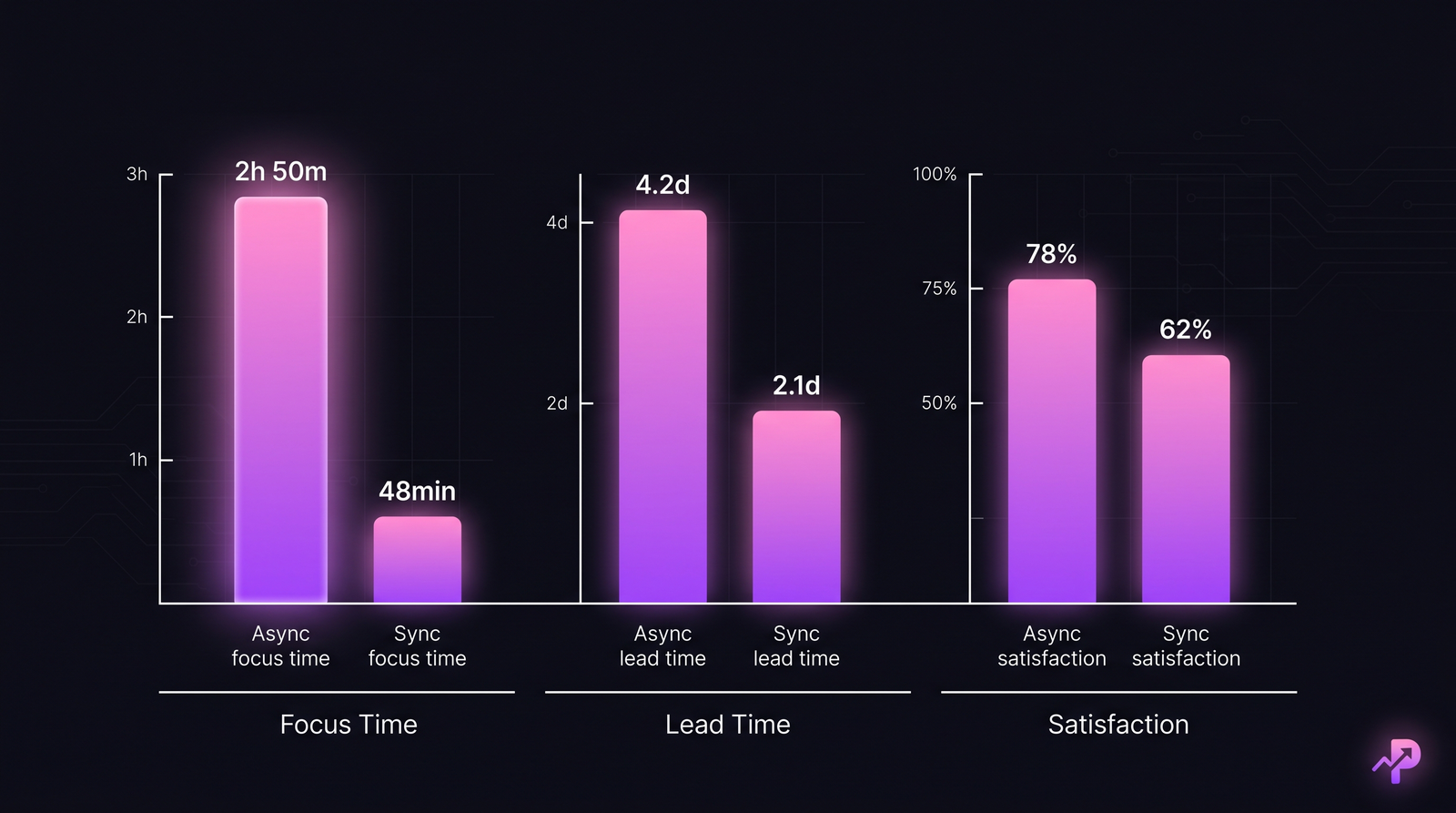 Three axes that move in different directions under async vs sync. Focus time and satisfaction go up async; decision speed goes up sync. The satisfaction numbers above are from our customer segment and shouldn't be read as industry-wide.
Focus time
| Workflow | Median daily active coding | P25-P75 range |
|---|---|---|
| Async-first (fully async teams) | 2h 50m | 2h 10m - 3h 30m |
| Hybrid (async default + 2-3 weekly sync) | 2h 15m | 1h 40m - 2h 50m |
| Sync-first (daily standup + 2-4 weekly meetings) | 48m | 25m - 1h 20m |
Our own IDE heartbeat data from ~100 customers confirms this distribution. The delta between sync-first and async-first is over 2 hours of median daily coding time — equivalent to 2.5-3× the raw focus capacity.
Decision speed
Async kills focus-theft but slows decisions. UC Irvine's Gloria Mark — the researcher behind the famous "23 minutes to refocus" finding — published a 2022 follow-up study on decision latency in knowledge work. Her finding: decisions made async took a median 2.4 days vs 4.1 hours for sync equivalents. For decisions that block downstream work, that latency compounds.
The failure mode is specific: async works for decisions that benefit from reflection. It fails for decisions where one blocker can stop five people. A missing architectural call in a sync-team gets decided in the 30-minute meeting tomorrow. The same call in an async-team waits for the document author's timezone to come online, then waits for the two deciders to read it, then waits for comments, then waits for the author to iterate. Healthy: 2 days. Pathological: 2 weeks.
Onboarding speed
Async-first is brutal for new hires. A senior engineer joining a remote async team takes 40-60% longer to ramp to full productivity according to our onboarding data (caveat: small sample, 28 hires tracked). The missing piece is peripheral learning — overhearing how decisions are made, catching context in hallway conversations. Documentation doesn't substitute. Sync teams get this for free.
Hybrid teams tend to deliberately add sync back for the first 90 days of new hires. "Onboarding buddy with 2 sync 30-minute sessions per week" is the pattern we see working.
Meeting load
| Workflow | Total meeting hours per engineer per week |
|---|---|
| Fully async | 0.5-1.5h (just 1:1s) |
| Hybrid | 3-5h |
| Sync-first | 8-14h |
| Meeting-heavy (bad sync) | 15-25h |
The meeting-heavy category is more common than teams admit. We've seen engineers with 18 hours of standing meetings per week. That's nearly half the working week, before any coding.
Distributed team feasibility
Timezone spread matters more than anyone admits in the async/sync debate.
| Timezone spread | Practical workflow |
|---|---|
| ±3 hours (single region) | Either works. Sync is cheap. |
| ±6 hours (e.g. Europe + US East) | Hybrid mandatory. Pure sync means engineers working 10 PM. |
| ±9+ hours (truly global) | Async-first or fail. Sync becomes rotating-cruelty. |
The 2024 Stack Overflow Developer Survey showed that remote engineers working across 8+ timezone spreads report 42% higher "decision-blocking" frustration than those within 3-hour spreads. The async/sync choice is often made for you by geography.
The feature matrix
| Dimension | Async-first | Sync-first | Hybrid |
|---|---|---|---|
| Protects focus time | Strong | Weak | Medium |
| Fast decision-making | Weak | Strong | Medium |
| Onboarding for new hires | Hard | Easy | Medium |
| Scales across timezones | Easy | Hard | Medium |
| Scales across headcount | Medium | Hard (meeting bloat) | Strong |
| Requires strong writing culture | Yes (mandatory) | No | Yes |
| Meeting fatigue | Low | High | Medium |
| Captures decision history | Strong (documents) | Weak (in heads) | Medium |
| Mentoring junior engineers | Hard | Easy | Medium |
No row is universal. Your team's weighting of these dimensions decides the right answer.
When each actually works
Choose async-first if:
- Timezone spread exceeds 6 hours
- Team has strong writing culture (every engineer can write a 1-page decision doc)
- Most work is individual-contributor coding with clear scope
- Decision latency of 1-3 days is acceptable for most calls
- Team is 80% senior (seniors need less mentoring)
Choose sync-first if:
- Everyone is co-located or within 3 timezones
- You're building something that requires tight coordination (founding team, critical incident work)
- Team has many juniors who need close mentoring
- Decisions need to happen within hours
- Your team is under 8 people (meeting overhead stays low)
Choose hybrid if:
- You're 15-100 engineers across 2-3 timezones
- You have some juniors and some seniors
- You can define 2-3 specific sync rituals (architecture review, 1:1s, incident calls) and keep everything else async
What PanDev Metrics shows about this
Our IDE heartbeat data differentiates between coding time and meeting/context-switch time. Teams that self-report as "async-first" but still have sub-1-hour median daily coding time are almost always running sync-in-disguise — Slack messages that demand within-15-minutes responses function as synchronous interrupts, regardless of the medium.
The honest finding from our data: the label teams give their workflow predicts focus time less well than the actual Slack response-time expectation. Teams expecting 2-minute Slack replies have sync-style focus profiles even if they call themselves async. Teams expecting 4-hour Slack replies look async in our data, regardless of official process.
One caveat: we see IDE activity, not meeting load directly. Our meeting-time numbers in this article are triangulated from "gap time" in IDE data plus customer calendar integration data. That integration is opt-in and covers roughly 30% of our customer base — the meeting-hours tables above are that sub-sample plus public industry reports.
The contrarian claim
The async-first movement was mostly right about meetings and mostly wrong about documentation. Written-first works when the writing quality is high and the reading discipline is real. For most teams, it isn't. We see more documents than anyone reads; async-first becomes "everyone's ignored in a different timezone". The teams that succeed with async aren't just writing more — they're reading more, and ruthlessly culling meetings that could have been decisions-with-deadlines in writing.
Honest limit: we don't control for team composition when measuring focus-time vs workflow style. Teams that self-select into async-first probably already have seniors who can focus. Teams running sync-first often have juniors who need it. The workflow and the team shape each other, and we can't cleanly separate cause from effect in our data.
Related reading
- Focus Time: Why 2 Hours of Uninterrupted Code Equals 6 Hours of Interrupted Code
- Remote vs Office Developers: What Thousands of Hours of Real Data Say
- The 40% Productivity Tax of Context Switching
If your team is stuck in async vs sync debates, measure first: what's your actual median focus time, and how long do decisions take? The answer is rarely what anyone guessed.