11 Best Pluralsight Flow Alternatives in 2026 (with pricing)

Pluralsight Flow has had three names. It launched as GitPrime in 2015, was acquired by Pluralsight in 2019 and rebranded to Pluralsight Flow, then in 2024 was sold to Appfire as part of a broader divestiture. Customer experience tracked the rebrands: support response slowed, product roadmap stalled, and at least three of our customers reported their Flow renewal conversations went sideways in the post-Appfire transition.
If you're searching "Pluralsight Flow alternative" or still searching "GitPrime alternative" out of muscle memory, you're probably asking one of two questions. Either: is the platform still being meaningfully developed, or am I paying for legacy code? Or: my renewal is up and I want to evaluate the landscape honestly before signing again.
This piece answers both. We have a separate PanDev vs Pluralsight Flow head-to-head; this is the broader market view.
The legacy-platform problem
GitPrime/Flow pioneered a category. In 2015, no one else was rendering engineering activity from Git events into manager-facing dashboards. By 2018, "GitPrime" was the default reference in any "engineering analytics" conversation. The product worked well for what it was built for: helping engineering managers see commit patterns, code review delays, and team-level cycle time.
Then the category caught up. LinearB, Swarmia, Code Climate Velocity, Jellyfish, and PanDev Metrics all entered with newer architectures and broader data ingestion. The 2024 DORA State of DevOps Report noted that DORA-focused tooling shipped substantial functional improvements over the 2022-2024 window. Flow's release cadence visibly didn't match.
Two specific signals teams report:
- No IDE-level data ingestion. Flow remains Git-and-tracker only, where the broader category has split between PR-event tools and IDE-telemetry tools.
- Slowed integration roadmap. Newer Git providers, AI assistants, and tracker variants take longer to land.
- Pricing rigidity post-Appfire. Multi-year discounts that existed under Pluralsight reportedly tightened.
The contrarian observation: Flow isn't broken. For a team that already uses it and gets value from cycle-time charts, it still delivers those cycle-time charts. The question is renewal-economics, not "the product stopped working".
When teams outgrow Pluralsight Flow
Three patterns:
-
AI-assisted development changed the activity baseline. A 2024 Stack Overflow Developer Survey reported 76% of professional developers used or planned to use AI coding tools. Flow's Git-event approach can't distinguish AI-assisted commits from pure-human ones. Our research on Cursor users coding 65% more than VS Code users was only possible because IDE-level telemetry could identify AI-tool usage. Flow can't see this.
-
Senior engineers look idle on Flow. Microsoft Research (Forsgren, Storey, et al., 2020) showed self-reported productivity correlates poorly with PR cycle time alone. The metric that matters is uninterrupted coding time. Flow shows the wrong picture for senior IC contributors.
-
Procurement asks "what's the modernization story". Hard to answer when the product changed corporate parents twice and the public roadmap is thin.
The 5 alternatives that actually compete
| Alternative | Best fit | Annual cost (50 devs) | On-prem | IDE telemetry | AI-tool detection |
|---|---|---|---|---|---|
| PanDev Metrics | Mid-market wanting IDE + Git + DORA | On request | Yes (Docker/K8s) | Yes | Yes |
| LinearB | Workflow-automation focus | $30K-$60K | No | No | Partial |
| Swarmia | Opinionated workflow guidance | $25K-$45K | No | No | No |
| Code Climate Velocity | Teams already on Code Climate Quality | $20K-$45K | Limited | No | No |
| Haystack | Lightweight DORA-only | $10K-$25K | No | No | No |
The Flow successor question splits into two camps. If your reason for leaving is "the product stopped evolving", you want the platform showing the strongest current investment, which by our read is PanDev Metrics on the IDE-data side and LinearB on the workflow-automation side. If your reason is "renewal price doesn't justify what we use", Haystack at the lightweight end and PanDev Metrics on the full-stack end have the price advantage.
Five evaluation criteria for the Flow replacement
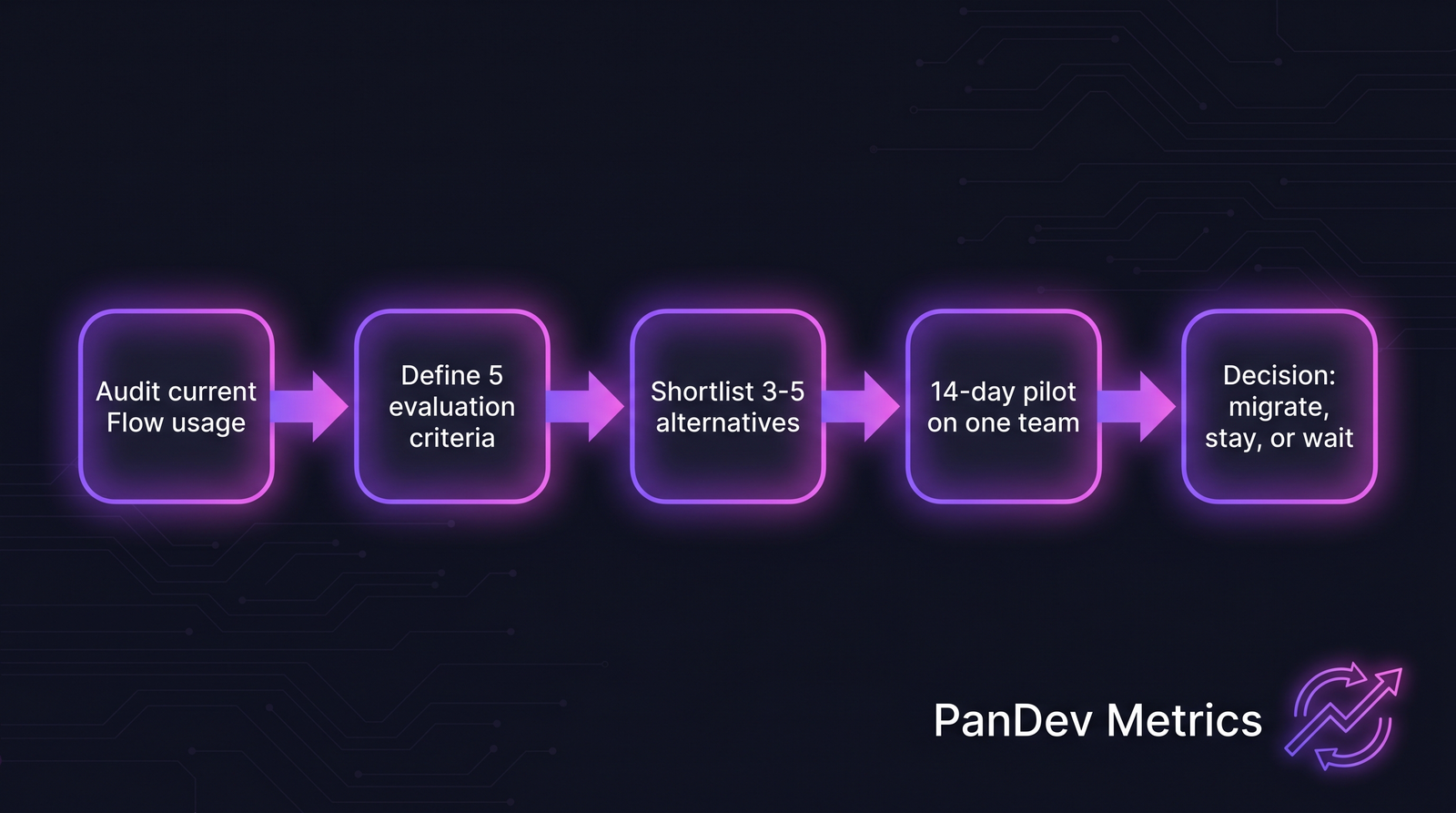 A 14-day pilot on one team beats a 6-month committee evaluation. Most teams know within two sprints whether the new tool surfaces signal they actually act on.
1. AI coding tool visibility
This is the load-bearing 2026 criterion that wasn't on the 2022 evaluation matrix. If your team uses Cursor, GitHub Copilot, Claude Code, or Codeium (and per the 2024 Stack Overflow survey roughly three-quarters of professional teams do), you need to see how AI-assisted work changes activity patterns. PanDev Metrics' IDE plugins identify the editor (VS Code, JetBrains, Cursor) and the active extensions, which means AI Copilot effect measurements are possible. PR-event-only tools (Flow, LinearB, Swarmia, Velocity, Haystack) don't have this signal.
2. Time-to-value vs. consulting hours
Flow's onboarding involves Jira/tracker mapping and dashboard configuration. PanDev Metrics has documented GitLab setup in 15 minutes, GitHub similar. LinearB and Swarmia clock 1-2 weeks. Code Climate Velocity needs more, similar to Flow. Haystack is fastest of the lot.
3. On-prem availability
Flow is cloud-only. CNCF's 2024 annual survey reported 44% of regulated-workload operators required on-prem developer tooling for at least one category. PanDev Metrics ships Docker and Helm; the others on this list are SaaS-only or self-hosted with implementation lift. For fintech, telecom, govtech, this single criterion eliminates four of the five alternatives.
4. What the EM actually opens daily
Be honest about which Flow dashboards your engineering managers open every day vs. once-a-quarter. The dashboards opened daily are usually 2-3: cycle time, PR review delays, deployment frequency. The dashboards opened quarterly are the strategic-investment views nobody reads in between.
If the daily 2-3 are all your team uses, you're a candidate for Haystack (cheaper, focused) or PanDev Metrics (same scope at lower price plus IDE depth). If the quarterly views matter, LinearB, Swarmia, or Code Climate Velocity. If you genuinely need portfolio-level investment allocation, neither Flow nor any of these fits. That's Jellyfish or Faros AI territory.
5. The exit cost from Flow
This one's specific to this transition: how much custom configuration sits in your Flow tenant? Custom dashboards, saved queries, integration mappings. The migration window is a real cost, separate from the new tool's setup cost.
A team we worked with ran 200+ saved Flow queries: six months of accumulated configuration. Their Flow renewal was a $80K conversation, but the migration window cost was an additional 8 weeks of EM time. The right answer for them was a 14-day pilot of PanDev Metrics on one team while they kept Flow running, then expanding only after the daily-use queries were mapped to the new tool. Most teams skip this step and regret it.
Pricing reality
| Plan tier | Pluralsight Flow (reported) | PanDev Metrics | LinearB | Haystack |
|---|---|---|---|---|
| Entry (10-25 devs) | $25-35/dev/mo | On request | $25-30/dev/mo | $15-20/dev/mo |
| Mid (50-150 devs) | $30-45/dev/mo | On request | $30-40/dev/mo | $20-30/dev/mo |
| Enterprise (200+) | Custom | Custom | Custom | Custom |
| Min seats | 25 | 5 | 25 | 10 |
| Multi-year discount | Tightened post-Appfire | Standard | Standard | Available |
For 50 engineers, Flow lands around $20K-$30K/year. Haystack sits well below that, and PanDev Metrics is quoted per team on request. In the cases we've seen, the price gap covers an internal tool migration project with budget left over.
Honest limits
We are PanDev Metrics. We're listed as the first alternative because that's the angle of this post; the broader market is real and we've tried to represent it honestly. We don't claim to do everything Flow does on workflow automation as deeply as LinearB, and we don't have a portfolio investment view at Jellyfish's depth. Our IDE dataset is B2B-focused, primarily KZ/UZ/RU and select EU/US/SG deployments. Solo developers and OSS-only contributors aren't in it, so behavior in those segments may differ.
We've seen this migration pattern enough times to flag the most common mistake: assuming the new tool is a like-for-like Flow replacement and discovering, three months in, that the dashboards your EMs opened daily aren't replicated. Run the 14-day pilot. The savings are real but only if the new tool surfaces the signal your team actually uses.
The decision in one sentence
If you used Flow primarily for cycle time and DORA basics, almost any of these wins on price; if you used Flow's broader analytics and now want IDE-level signal that Flow never had, PanDev Metrics is the most direct upgrade path; if you want the same shape as Flow but with active product investment, LinearB or Swarmia are the contemporary peers.