Best WakaTime Alternative in 2026: When Solo Tracking Hits Team Reality

WakaTime ships the best personal coding tracker on the market. 500K+ users, plugins for 40+ editors, and a year-end "Wrapped" recap that the community actually waits for. The Premium plan is $9/month, a fair price for a single developer who wants to know "how much did I code today?". The trouble starts the day a team lead opens that same dashboard and asks a different question: how is my team performing, what is delivery costing, where is the bottleneck?
That question is not what WakaTime was built to answer. It is also exactly the question Google sends our way when somebody types "wakatime alternative" in 2026.
Where WakaTime is genuinely strong
Skip this section if you've used the tool. Stay if you're evaluating from scratch.
- IDE coverage is unmatched. 40+ editor plugins, including weird ones (Vim, Sublime, Emacs spacemacs, Kakoune). If you have a polyglot dev who lives in three editors a week, WakaTime will see all three. No other tracker comes close.
- Heartbeat-based time, not self-report. WakaTime invented the public format for IDE heartbeat telemetry. The accuracy of "active coding time" beats any timesheet tool by an order of magnitude. Microsoft Research's 2023 DevEx paper put self-report error margins at 30-50%, while heartbeat telemetry sits inside ±2 minutes per day.
- Personal yearly review is a moat. "WakaTime Wrapped" is a tradition. No B2B competitor has a marketing artifact developers actively share to their friends.
- Open-source plugin SDK. A solo developer can ship their own editor plugin in an afternoon.
If your goal is "I want to know how I personally spend my coding hours," stop reading and just install WakaTime. This article is for the next problem.
When WakaTime stops scaling
We see the inflection point in our own customer pipeline. Teams that picked WakaTime for personal use start hitting the same walls around 5-15 engineers.
| Symptom | Why WakaTime can't fix it |
|---|---|
| "Who actually worked 160 billable hours this month?" | Team plan exists, but no audit-grade rollups, no manager view, no per-tenant data isolation |
| "What did this feature cost us?" | No hourly rate × time math, no cost-per-feature, no project P&L |
| "Where is our deployment bottleneck?" | No DORA metrics. No PR data. No CI/CD ingestion |
| "Show me a CTO weekly dashboard" | No org-level view. Each user sees only themselves |
| "We need on-prem because of compliance" | Cloud-only. No Docker/K8s package |
| "Track Jira task time, not just file time" | No task-tracker integration |
A 2024 DORA State of DevOps report tied delivery performance to four metrics. WakaTime measures none of them. If your job description includes those metrics, you have already outgrown the tool.
This matches what the broader market does. The 2024 Stack Overflow Developer Survey shows 68% of professional respondents use Git-integrated analytics tools at the team level, separate from personal time trackers. The category split exists because the questions are different.
The five real WakaTime alternatives in 2026
Not every alternative replaces WakaTime. Most replace the job WakaTime can't do. We grouped them by what they actually solve.
| Tool | Replaces WakaTime for | What it adds | Pricing (2026) |
|---|---|---|---|
| Toggl Track / Harvest | Manual timesheet teams | Project billing, invoicing | $9-22/user/month |
| Hubstaff / Time Doctor | Outsourcing & staff-aug | Screenshot proof, payroll | $7-20/user/month |
| Swarmia | Git-based team analytics | DORA, PR analytics | ~$25/user/month |
| LinearB | Engineering performance ops | DORA + workflow automation | $30-50/user/month |
| PanDev Metrics | Full engineering intelligence | IDE + Git + tasks + DORA + cost, on-prem option | On request |
Pricing rows reflect public list prices and reseller quotes we've seen in customer migrations through Q1 2026. Enterprise discounts shift these numbers. Treat them as orientation, not negotiation anchors.
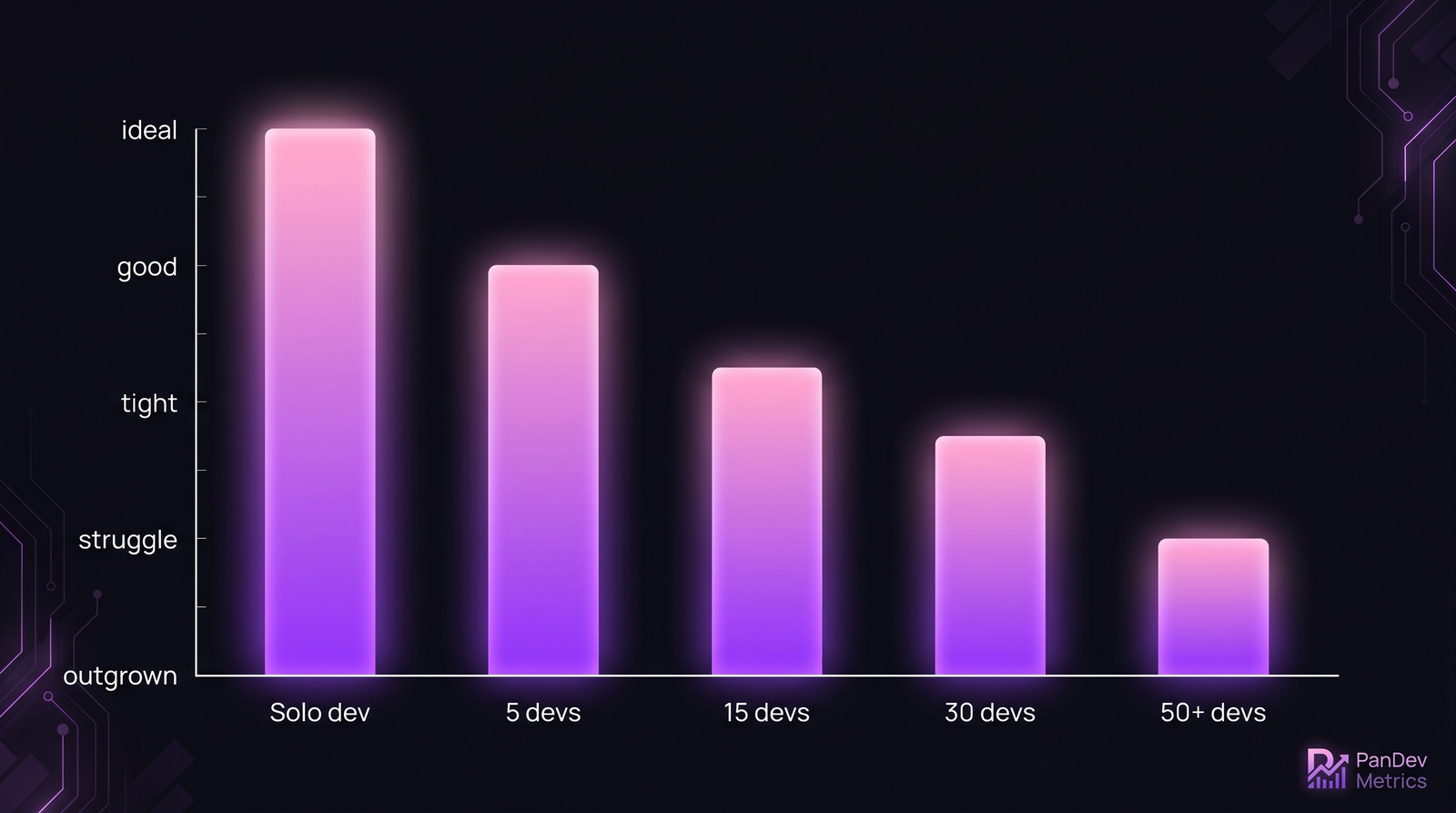 WakaTime stays useful per-developer regardless of team size. The team-level utility curve flattens hard around 15+ engineers, where you start needing rollups, cost math, and DORA.
Toggl Track and Harvest: for the timesheet people
If your real problem is invoicing clients, not engineering analytics, Toggl Track or Harvest are the honest answers. They have nothing to do with code activity. They are spreadsheet replacements that ask developers to start and stop a timer manually. The accuracy is worse than WakaTime by definition (self-report) but the billing-export flows are mature.
Pick one of these only if your team bills hours to clients and the bookkeeper is your primary internal customer.
Hubstaff and Time Doctor: surveillance-grade tracking
We name these for completeness because users searching "WakaTime team alternative" sometimes land on them. They take screenshots, track keyboard activity, watch URLs. In an IDE-native dev team they generate revolt within a week. In a 200-person staff-augmentation outsourcing operation where the client requires proof, they have a job. Different problem. Different tool.
For a more honest take on this category, see our piece on outsourcing companies proving 160 hours are actually 160 hours.
Swarmia: the Git-analytics replacement
Swarmia ignores the IDE entirely and builds the picture from Git events: commits, PRs, deployments. For a team that already runs on PR-driven workflows, this is enough to compute DORA and surface bottlenecks. It will not tell you how much time was spent coding versus reviewing versus reading documentation. That data lives in the IDE, and Swarmia chose not to ingest it. We covered Swarmia separately in our PanDev vs Swarmia comparison.
LinearB: the workflow-ops layer
LinearB takes Git data and bolts a workflow engine on top: gitStream automations, slack-bot reminders, custom rules. It is the most opinionated tool in the category. The price reflects the opinion. Worth evaluating if your real complaint is "PRs sit unmerged for days". Less worth it if you mostly want a dashboard.
PanDev Metrics: the multi-source approach
The platform we build at PanDev Metrics keeps WakaTime's heartbeat philosophy (IDE plugins for VS Code, JetBrains, Eclipse, Xcode, Visual Studio) and adds the four data sources WakaTime explicitly skipped: Git events, task trackers (Jira, ClickUp, Yandex Tracker), CI/CD deployments, and a financial layer that turns hours into cost-per-feature. The branch-name convention is the only setup tax: name branches like feature/TASK-324 and the rest is automatic. We are also the only tool in this list that ships a working on-prem Docker and Kubernetes package, which matters in regulated industries.
What to actually evaluate next
Spec-sheet shopping is a trap. The question is what data sources you need joined.
| Question you can't answer today | Data sources required | Tools that fit |
|---|---|---|
| How much time did this feature really cost? | IDE + Task tracker + Hourly rate | PanDev Metrics |
| Why did our deployment frequency drop in March? | Git + CI/CD + Deployments | Swarmia, LinearB, PanDev Metrics |
| Are my outsource hours real? | IDE + Git + audit log | PanDev Metrics, Hubstaff (proof-style) |
| Who's burning out? | IDE + after-hours + vacation | PanDev Metrics |
| What does each developer code per day, on what languages? | IDE only | WakaTime, PanDev Metrics |
| What did we invoice this client this month? | Self-report + project tag | Toggl, Harvest |
If your row is the last one, stay on WakaTime or pick a timesheet tool. If your row is anything else, WakaTime cannot get you there alone, and stacking it with three other tools costs more than picking a platform.
A practical filter we recommend: count the data sources you'd need to ingest manually next quarter. Two or fewer, keep WakaTime and add one tool. Three or more, consolidate.
The honest limit of this comparison
Our customer dataset skews B2B and Eastern Europe / Central Asia. We see a lot of fintech, telecom, agency, and product SaaS teams in the 10-150 engineer range. For a 1,000-engineer FAANG-class org or a 2-person bootstrapped indie shop, the trade-offs we listed shift. In particular, the WakaTime + Swarmia + Toggl stack we keep dismissing as "three tools" might actually be cheaper than a platform at the bottom of the market, and a platform at the top of the market (Jellyfish, Faros) might still beat anything here. We are not the right consolidation target for a $250K platform decision, and we say so in our Jellyfish comparison.
The contrarian read
The default advice ("personal trackers don't scale, get a team platform") is right but incomplete. The cleaner version: WakaTime's philosophy (heartbeat over self-report) is the right one, and the alternatives that copy that philosophy will outlast the alternatives that ignore it. A Git-only team analytics tool can give you a dashboard. It cannot give you the truth about coding time, because half of coding doesn't ever land in Git.
Pick the alternative that keeps the heartbeat and adds what you actually need around it. Pick the rest only when you have a budget reason to.