Calendar Hygiene for Engineers: Weekly Template

A Microsoft Research 2024 study of 31,000 knowledge workers' calendars found the median engineer at a 200-500-person software company sits in 23 hours of scheduled meetings per week. UC Irvine's Gloria Mark — the researcher who gave us the 23-minute refocus number — has said that a typical knowledge worker gets interrupted every 3 minutes and 5 seconds once meetings end and Slack begins. Add the 40-minute commute many have quietly added back in 2026, and a coding day starts at 11am.
Most "calendar hygiene" advice is either throwaway ("just say no to meetings") or religiously rigid ("maker time MWF only, you can do nothing else"). Neither survives contact with a real engineering organization where your feature depends on another team's design review. This is the template that does.
The problem
Engineering calendars collapse in three predictable ways:
- Meeting creep. A reasonable 10-meeting week becomes 16 over a quarter as new recurring syncs get added. Nobody removes them.
- Fragmentation. 8 hours of meetings spread across a day is 0 hours of useful coding. The same 8 hours stacked into two half-days leaves two productive half-days.
- Reactive time. Hours between meetings get consumed by Slack, unplanned reviews, and "quick questions." Without a protective frame, reactive work fills the vacuum.
Our IDE heartbeat data across 100+ B2B companies shows a consistent pattern: engineers with 3+ fragmented meetings per day code 31% less than engineers with the same total meeting hours stacked into concentrated blocks. It's not the meeting count that kills coding time. It's the shape of the calendar around them.
The weekly template
The template below is designed for a standard 5-day engineering week, assumes 40 usable hours, and protects 20-24 of those for focused work. It has been deployed in three customer teams I worked with directly.
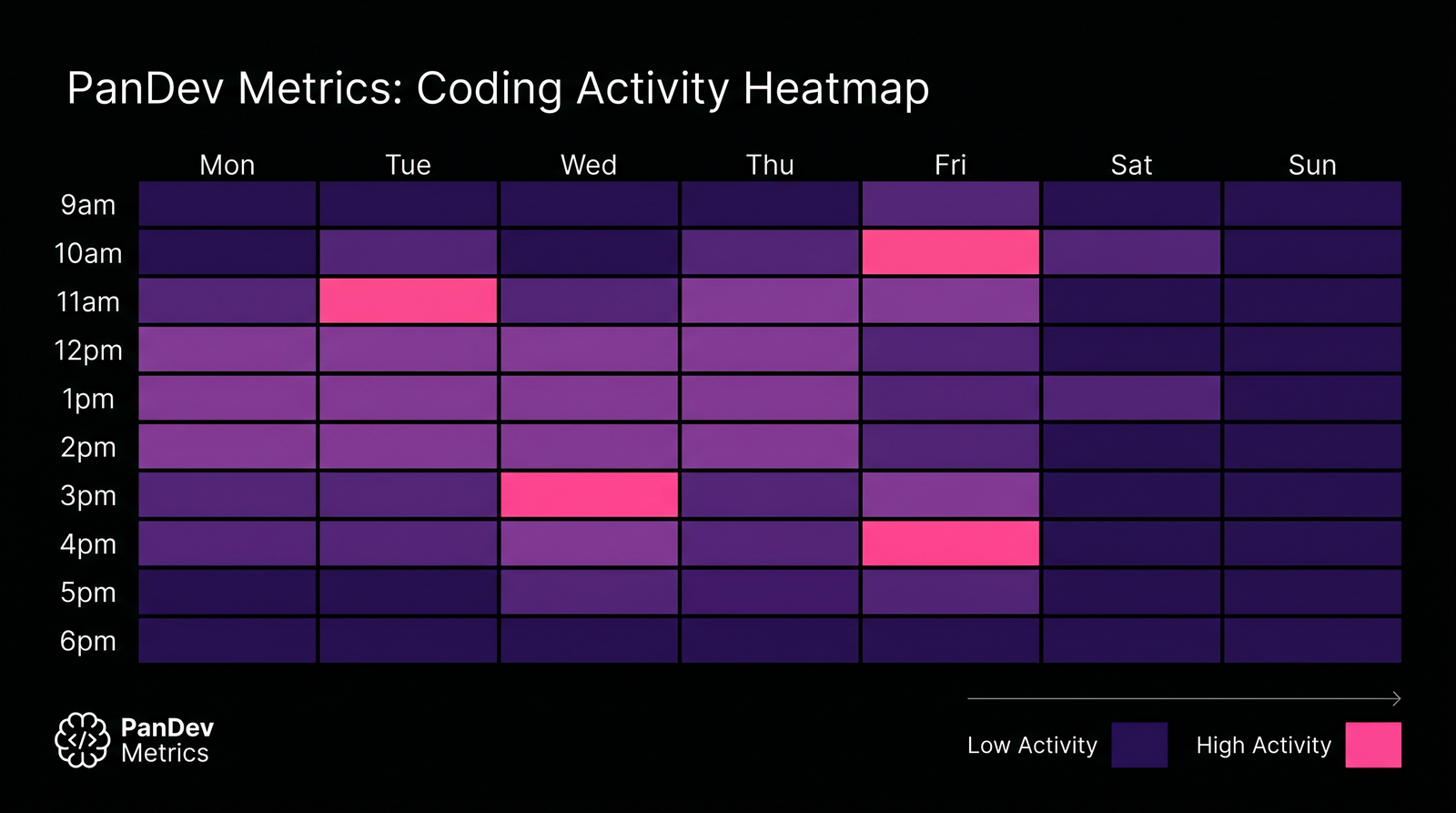 The shape that works: mornings are yours, afternoons are the team's, Friday is for shipping.
Monday: planning + protected morning
| Time | Block | Purpose |
|---|---|---|
| 09:00-11:30 | Focus block | Code or write — no meetings, no Slack notifications |
| 11:30-12:00 | Weekly planning | 30 minutes alone: what ships this week, what's at risk |
| 13:00-14:30 | Team standup + triage | Team sync + any triage that happens once a week |
| 15:00-17:30 | Open / review / meetings | Flexible reactive block |
Tuesday: meeting day
| Time | Block | Purpose |
|---|---|---|
| 09:00-11:00 | Focus block | Light morning coding |
| 11:00-12:30 | 1:1s, cross-team syncs | Stacked, back-to-back |
| 13:30-17:00 | Design reviews, roadmap, stakeholders | The afternoon meetings live here |
Wednesday: deep-work day
| Time | Block | Purpose |
|---|---|---|
| 09:00-12:30 | Deep focus block | The 3-hour uninterrupted code block — the week's most valuable unit |
| 14:00-17:00 | Focus or pairing | Afternoon code / collaboration |
No recurring meetings are placed on Wednesday. If an absolutely-required meeting appears, it displaces something else, not Wednesday. This is the single most effective rule in the template.
Thursday: meetings + review
| Time | Block | Purpose |
|---|---|---|
| 09:00-11:00 | Focus block | Morning focus |
| 11:00-12:30 | 1:1s, cross-team | Second cluster of the week |
| 13:30-16:00 | Reviews, QA, design | Stacked afternoon |
| 16:00-17:30 | Personal buffer | Email, admin, Slack catch-up |
Friday: shipping + buffer
| Time | Block | Purpose |
|---|---|---|
| 09:00-12:00 | Shipping block | Merge, deploy, verify in production if safe |
| 13:00-15:00 | Review other teams' PRs | Your contribution to other teams' velocity |
| 15:00-16:00 | Weekly close | Learnings, carryover, set Monday's first block |
| 16:00-17:00 | Buffer | Reality rarely matches the plan; this is the give |
The template produces 14-17 hours of focus time per week, clustered in 90-180 minute blocks. That's in the top quartile of what our IDE heartbeat data shows for active coding time, and the clustering matters more than the total.
The 9 rules that make this template survive
Templates without rules rot within a month. These are the ones that hold.
| Rule | Why |
|---|---|
| No recurring meetings on Wednesday mornings | Without a single protected day, meetings win |
| Cluster all 1:1s into 2 windows (Tue/Thu morning) | Context-switching cost on mentorship time is huge |
| Default decline recurring meetings you weren't needed in twice | The main driver of meeting creep |
| 25-minute meetings, not 30 | Buffer for notes, stretch, refocus |
| "Focus" blocks on calendar with DND on Slack | The calendar tells the team; DND tells the laptop |
| Async-first for status updates | No standup longer than 15 minutes |
| Quarterly calendar audit | Remove recurring meetings that fired 4+ times where nothing was decided |
| Protect morning deep block from post-meeting drag | If you end a meeting 10 min late, don't poach from the focus block that follows |
| Track your own actual vs planned calendar | The honest audit is what keeps the template honest |
The "default decline" rule is the one teams resist the most and the one that changes the calendar the most. In a team we instrumented in 2025, the VP Engineering adopted this rule for one quarter and eliminated 4.5 hours of recurring meetings per week across the team by mid-quarter. The meetings she declined had no visible negative consequences — the meetings existed because they existed.
What engineering managers should do differently
Engineering managers have the inverse calendar problem: meetings are most of the job. But if your calendar is 80% meetings, the shape still matters.
- Cluster 1:1s into 1-2 days, not spread across 5.
- Keep at least one half-day per week free for one focused thing — a spec to write, a hire to think about, a customer conversation to prepare.
- Don't book yourself wall-to-wall; a 45-minute buffer between meeting blocks produces better decisions in the next one.
Data-driven 1:1s are especially important to protect from fragmentation. Our guide to running them covers the prep time, which only exists if the 1:1s are clustered.
Common mistakes to avoid
- The "no-meetings Wednesday" that slips to Thursday. Teams that succeed defend Wednesday absolutely. Teams that fail move it.
- Stacking 6 meetings in a row with no buffer. By meeting 4, your decision quality collapses. 25-minute meetings instead of 30 preserves 30 minutes of the day for thinking.
- Not blocking focus time on the calendar. An unblocked hour gets booked within 48 hours. Calendar is the social contract.
- Being the first to break the template. If you run the team and your Wednesday's broken, the team's Wednesday breaks next week.
- Treating the template as permanent. Revise every quarter. Calendar shapes change as the team grows and roles shift.
How to measure if this is working
Three signals, quarterly check:
- Total focus time per week, measured from actual uninterrupted blocks. Target: 12-18 hours for an IC engineer; 6-10 for an EM.
- Focus-block distribution. Are the blocks 90+ minutes, or shredded? Mark's research puts useful coding sessions at 45+ minutes; under 45, cognitive warm-up dominates.
- Meeting count trend. Up 15% this quarter over last? Time to audit.
Teams with PanDev Metrics installed see all three automatically — IDE heartbeat data gives you focus time, block distribution, and the shape of the working day. Our research piece on focus time covers the deep-work threshold: Focus Time: Why 2 Hours of Uninterrupted Code Equals 6 Hours.
The checklist (copy and use)
- Wednesday morning is calendar-blocked, protected absolutely
- 1:1s clustered into 2 days maximum
- All recurring meetings audited in the last 90 days
- Default meeting length is 25 minutes, not 30
- Focus blocks visible on calendar with DND on chat
- Friday has a shipping window and a buffer
- The template is visible to your team, not secret
- You track actual vs planned time once per quarter
- Morning deep block is at least 90 minutes for IC engineers
When this template doesn't fit
Three cases:
- On-call week. Throw the template out. On-call is a reactive role. The template returns the week after.
- Release weeks. The Friday shipping block expands; Wednesday's focus might shift to Thursday. Know which weeks are release weeks and plan the template around them.
- First 90 days in a role. New engineers, new managers — you need more meeting time to build context. Adopt the template gradually over the first quarter.
The template is the median week, not every week. Treat it as a default, not a law.
Related reading
- Focus Time: Why 2 Hours of Uninterrupted Code Equals 6 Hours
- The 40% Productivity Tax of Context Switching
- Deep Work Schedules for Developers
- External: Gloria Mark — Attention Span on the 23-minute refocus finding
Honest limit: our data is from B2B companies with salaried developers on fixed schedules. Contractors, freelancers, and open-source contributors operate on different rhythms and we don't have strong signal there. If your work shape is radically different, start from the rules, not the times.
The sharp version of the rule: you don't have a focus problem, you have a calendar problem. The calendar is the only thing in your day that's public, negotiated, and debuggable. Fix that first and the focus follows.