5 Daily Standup Alternatives That Actually Save Time

A 6-person engineering team running a 15-minute daily standup costs you 7.5 person-hours a week in scheduled time alone. Add context switching cost — UC Irvine's Gloria Mark measured ~23 minutes to refocus after an interruption — and the real cost is closer to 15 hours a week. For a team running 10 weeks on one feature, that's 150 engineering-hours. That's not a meeting. That's a part-time engineer you hired and immediately deployed to talking.
Standups aren't inherently bad. They solve a real problem: surfacing blockers before they rot. The question is whether the daily synchronous format is the only way — or even the best way — to solve it. The State of Agile 2024 report shows 32% of teams actively experimenting with async-first alternatives, and the cleanest data we have from IDE telemetry suggests these alternatives recover 1-2 hours of focus time per developer per week without harming delivery.
This is a comparison of 5 standup alternatives, when each fits, and how to decide which one your team needs.
Why this matters: the hidden cost of standups
The argument for daily standups rests on two assumptions:
- Developers don't know what their teammates are working on otherwise.
- Blockers surface only in conversation.
Both were probably true in 2001 when the Agile Manifesto was drafted and the canonical team sat in the same room. Both are substantially false in 2026, when Git, Jira, Slack, and IDE telemetry make the "what's happening" question answerable without a meeting.
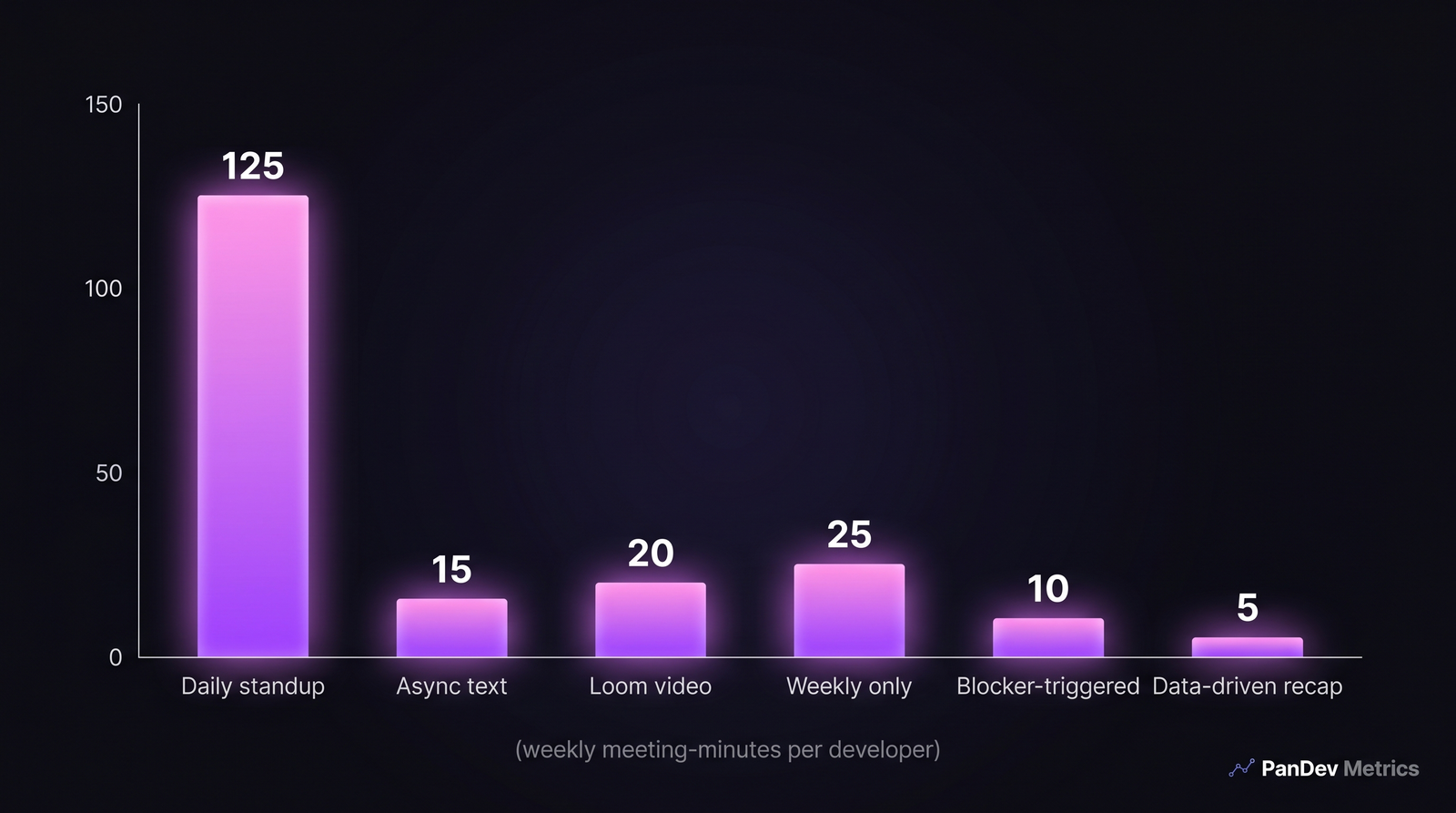 Weekly meeting minutes per developer across 6 standup formats. The daily synchronous format costs 5-25× more time than any alternative.
Microsoft Research (Perlow, Hadley, Eun, 2017, Stop the Meeting Madness, Harvard Business Review) found that 71% of managers called meetings unproductive or inefficient in a study of 182 senior leaders. Engineering teams aren't exempt. The best evidence we have is that daily standups become performative as teams stabilize — the same five people saying "yesterday I worked on TASK-324, today I'll continue TASK-324, no blockers" for four sprints running.
When that pattern emerges, the standup stopped doing the work. Something else should replace it.
The 5 alternatives, ranked by adoption ease
1. Async text standup (Slack bot, 15-min written updates)
How it works: A bot (Geekbot, Standuply, or a custom thread) prompts each team member in the morning with three questions. Responses post to a shared channel. Anyone can skim in 2 minutes instead of attending a 15-minute meeting.
When it fits: Distributed teams across 3+ time zones. Teams where 60%+ of work is independent (parallel streams, not tightly coupled).
When it fails: High-alignment work requiring tight coupling (rewriting a core service, coordinating a migration). Async text loses the fast-loop Q&A that synchronous formats enable.
Time cost: ~5 min/day/dev to write + ~2 min to skim others = 7 min/day per developer, vs 15 min standup + context-switching. Net recovery: ~50-60 minutes/week of focus time per developer.
2. Loom / video-message standup (record once, watch async)
How it works: Each developer records a 60-90 second video once a day. Others watch at their desk during natural breaks. Slightly richer signal than text (you hear tone, you see body language), slightly slower to skim (can't scan-read).
When it fits: Hybrid teams where leads are remote and most devs are in-office. The video format preserves some of the "I can see my team" benefit without the synchronous tax.
When it fails: Team members who hate recording themselves. Teams with shallow update patterns — video is overkill for "continuing yesterday's ticket."
Time cost: ~3 min recording + ~5 min watching others = 8 min/dev. Modest savings vs standup, bigger quality-of-life win.
3. Blocker-triggered sync (no standing meeting, call one when blocked)
How it works: No scheduled standup at all. If anyone hits a blocker, they post in the team channel tagged @team blocker, and a 10-minute huddle spins up within 30 minutes to resolve it. Otherwise, no meeting.
When it fits: Senior teams (2+ years together) where everyone knows when to ask for help. Teams with good written status discipline already — this is the graduation format from async text standup.
When it fails: Junior-heavy teams (they under-ask for help, blockers rot silently). Teams with weak Slack culture.
Time cost: ~10-15 min/week across the team. Near-zero overhead, but requires a mature team to run.
4. Weekly-only sync (one 45-min session, Mondays)
How it works: Replace the five daily 15-minute meetings with one weekly 45-minute meeting. Agenda: recap the previous sprint, preview the upcoming week, surface blockers.
When it fits: Stable, long-running feature teams (not ones juggling 10 small tasks). Teams where the work is scoped in 3-5 day increments, not hourly.
When it fails: Incident-response teams, on-call-heavy teams, teams with high external-request volume. The week is too long between checkpoints.
Time cost: 45 min/week/dev + overhead = ~50 min vs standup's 125 min. More than halves meeting time without going fully async.
5. Data-driven recap (dashboard first, sync only if yellow/red)
How it works: The team reads a shared dashboard every morning (auto-generated, updated from Git, Jira, and IDE telemetry). It shows: who's working on what (from IDE heartbeats), what tickets moved, what PRs are stale >24h, what builds are broken. If the dashboard is all-green, no meeting. If anything's yellow or red, a 5-minute huddle addresses it.
When it fits: Teams with solid tooling and an engineering leader who can read a dashboard. This is the format that replaces a ritual with a measurement system.
When it fails: Teams without unified tooling (Git events in one place, tasks in another, time-tracking absent). The dashboard is only as good as the signals feeding it.
Time cost: 2-5 min/dev/day reading the dashboard. Minimal overhead — but the dashboard takes real setup effort.
PanDev Metrics is built around this model. IDE heartbeat data plus Git events plus task-tracker state produces a single view of what's actually happening on a team. The "who's active on what right now" question becomes answerable without a meeting. Teams using this format typically also run a weekly sync for longer-horizon coordination; the daily ritual goes away.
The decision framework
| Team profile | Best fit |
|---|---|
| Distributed across 3+ time zones, parallel work streams | Async text standup |
| Hybrid (some in-office, some remote), moderate coupling | Loom / video messages |
| Senior team (2+ yrs together), strong async culture | Blocker-triggered sync |
| Stable long-running feature team, 3-5 day ticket scope | Weekly-only sync |
| Tooling-mature team with shared dashboards | Data-driven recap |
| Junior-heavy team, learning the domain | Keep the daily standup (the exception — they need it) |
The last row is important and honest. If your team is mostly junior and still building their mental model of the codebase, the daily sync is genuinely teaching time. Don't optimize it away. Revisit in 6-9 months as the team matures.
Common mistakes to avoid
| Mistake | Why it hurts | Fix |
|---|---|---|
| Switching from daily to weekly without async fallback | Blockers rot between syncs | Always pair weekly sync with an async channel for blockers |
| Making async text optional | Half the team stops participating, alignment degrades | Required, with a named "standup owner" who follows up on skips |
| Dashboards nobody reads | Data-driven recap becomes fiction | Make dashboard-review the first 5 minutes of the workday — named responsibility |
| Killing the standup without team agreement | Feels imposed, resentment compounds | Propose a 4-sprint trial, then vote to keep or revert |
| Keeping the standup but making it 5 minutes | 5-minute meetings still break focus | 15 minutes with substance > 5 minutes without |
The checklist: which alternative should you pilot?
- Count your team's weekly meeting minutes from standups
- Survey developers: is the standup surfacing information they couldn't get elsewhere? (Honest answer often: no)
- Identify which row of the decision table matches your team
- Propose a 4-sprint trial (8 weeks) with an explicit success metric
- Define the success metric in advance: typical options are "time to resolve blockers stays <24h" and "focus-time minutes/day increases"
- Run the trial. Don't modify mid-stream.
- At 8 weeks, vote: keep, revert, or iterate
How to measure if this is working
The wrong measure: "are we happier." People report being happier immediately after any change. The signal doesn't survive 4 sprints.
The right measures:
- Time-to-resolve-blocker — from the moment a developer is blocked to the moment they're unblocked. Should stay under 24 hours (4 business hours is better).
- Focus time per developer — the number of uninterrupted blocks ≥ 45 minutes per day. Should increase. The focus-time metric is where the real productivity recovery shows up.
- Delivery predictability — the standard deviation of completion dates for similarly-sized tickets. Should not worsen; if it worsens, the async alternative is missing blocker surfacing.
If any of these three regress, revert. The comparison isn't "alternative beats daily standup" — it's "alternative beats daily standup while holding these metrics steady or better."
When the daily standup is genuinely the right answer
Three scenarios where you should keep the standup:
- Incident-response teams. SREs, on-call rotations. The information lifespan is short; synchronous is cheaper than async.
- New teams (< 6 months together). The ritual builds rhythm. Kill it too early and coordination fragments.
- Junior-heavy teams on complex domains. The standup is teaching infrastructure. Name it that and protect it.
In everything else, the math favors an alternative. Most teams don't switch not because they calculated and lost, but because they never calculated.
The contrarian claim
The dominant advice for remote-friendly teams is "keep the daily standup, just move it to video." That's the worst of both worlds: you pay the full synchronous tax and lose the in-person benefits. If you're remote, either go async-first (text or video-message), or go fully synchronous and use the video for collaboration, not for status updates.
A standup that exists to read each other's status out loud is solving a problem Git and Jira already solved. The real value of a synchronous meeting is the unscripted conversation at the edges — and that conversation doesn't need a daily cadence.
The honest limit
Our data shows IDE-activity and focus-time shifts at the team level. We don't cleanly measure "meeting time" — that signal lives in calendar systems we don't integrate with. The meeting-minute numbers above come from customer conversations, the Microsoft HBR study, and two years of our own internal experimentation. Your team's starting baseline may be substantially different; measure it before making the comparison.
Related reading
- The 40% Productivity Tax of Context Switching — why meeting-driven context switches compound worse than teams expect
- Focus Time: Why 2 Hours of Uninterrupted Code Equals 6 Hours Fragmented — the metric your alternative should be improving
- How to Run Data-Driven 1:1s With Your Developers — the sync that should definitely stay, but run differently
- External: Perlow, Hadley, Eun, Stop the Meeting Madness (Harvard Business Review, 2017) — the foundational study on meeting-cost awareness