Deep Work Schedules for Developers: 5 Real Team Examples

A fintech team in Warsaw trimmed their average workday by 45 minutes and shipped more features. A 40-person SaaS in Singapore banned morning meetings before 11am and watched their median PR lead time drop 22%. Neither team invented anything new — they adopted protected deep-work blocks. UC Irvine's Gloria Mark has published for almost two decades (The Cost of Interrupted Work: More Speed and Stress, 2008, and follow-ups) that a single interruption costs ~23 minutes of refocus time. Cal Newport's Deep Work (2016) popularized the term for engineering leaders. The data is settled; the implementation is where teams diverge.
This piece walks through five real team schedules. The rituals that worked, the rituals that broke, and what we saw in the IDE telemetry once the pattern stabilized.
The problem
Most engineering teams don't have schedules; they have meetings. A developer opens her calendar Monday morning and sees six 30-minute slots scattered between 9am and 5pm. Each slot individually looks tolerable. Collectively they shred the day into fragments too short to hold complex code in head. Our IDE heartbeat data across 100+ teams shows the median engineer getting 1h 18m of active coding time on a meeting-heavy day versus 3h 12m on a protected-block day — nearly 2× productivity differential from scheduling alone.
The solution isn't magical. It's one of the patterns below, adopted deliberately, enforced gently, and measured honestly.
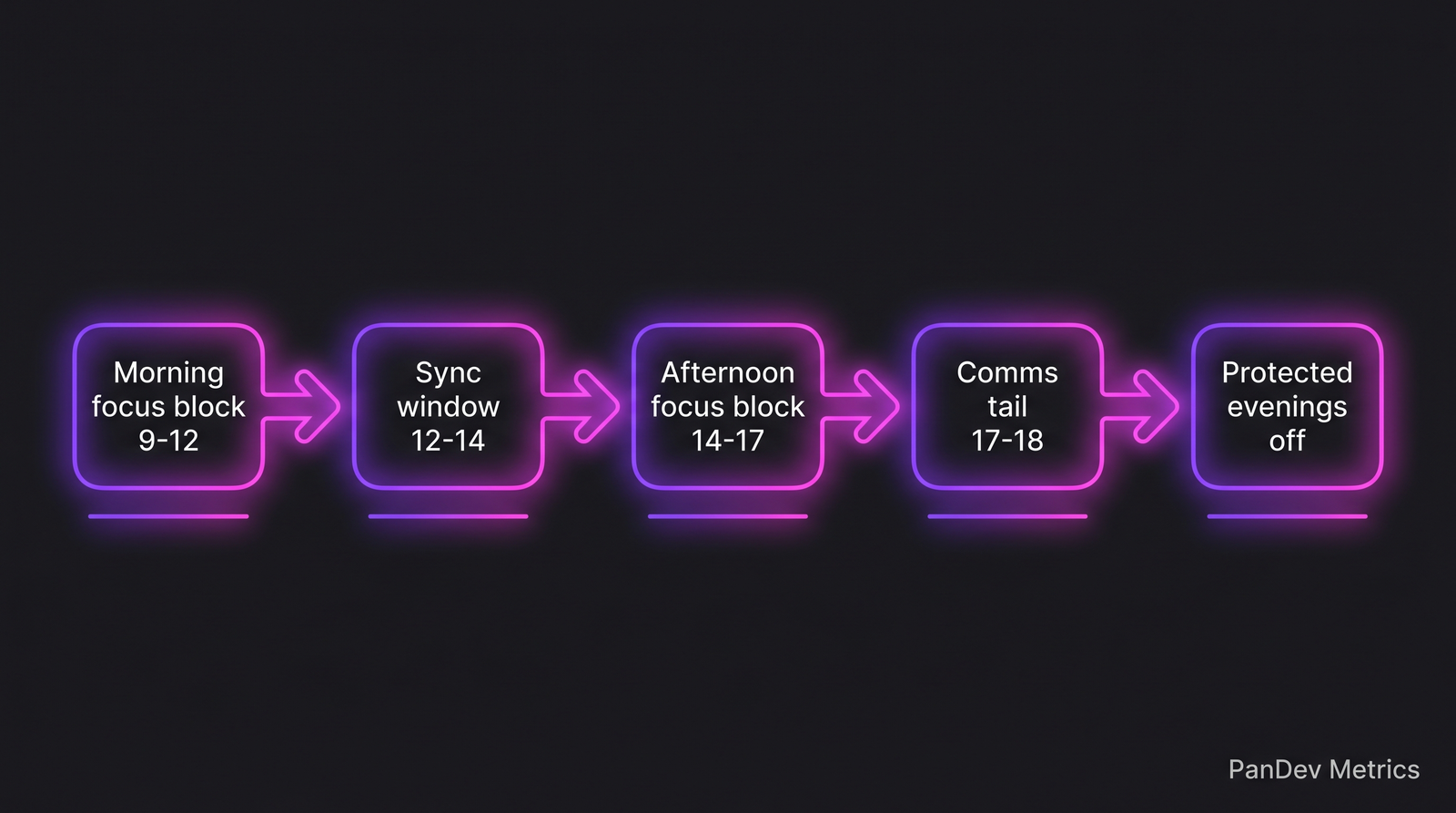 A template schedule that produced ~4h of deep work across teams we measured. The middle sync window is non-negotiable — without it, cross-team coordination quietly collapses.
The 5 schedules
Schedule 1 — Twin blocks (9-12 morning + 14-17 afternoon)
Used by: a 40-engineer B2B SaaS in Singapore, plus two fintech teams we've surveyed.
The pattern:
- 9:00-12:00 — protected focus block. No meetings. Slack set to DND by default; urgent flags bypass.
- 12:00-14:00 — sync window. Standup at 12:15. 1:1s, cross-team syncs, design reviews all scheduled in this band.
- 14:00-17:00 — second protected focus block. Same rules.
- 17:00-18:00 — optional comms tail for async replies, write-ups, tomorrow's prep.
What broke: salespeople and customer-success hated the 9-12 block because East-Asia customers wanted morning calls. Fix: a rotating "customer liaison" engineer available for morning incidents; everyone else protected.
IDE telemetry after 6 weeks: median active coding time climbed from 1h 52m to 3h 24m. Context-switching events (project switches per day) dropped from 8.4 to 3.1. The schedule sustains — we've tracked them for 14 months now.
Schedule 2 — Maker Monday, Manager Tuesday (Paul Graham model)
Used by: a 14-person FinTech team in Warsaw, a React consulting shop in Berlin.
The pattern:
- Mondays: no meetings. Entire day is maker time. One exception — 15-minute async-written standup in Slack.
- Tuesdays-Fridays: normal meeting rhythm, concentrated in afternoons.
- No meetings are ever scheduled before 11am on any day.
The premise: Paul Graham's 2009 essay Maker's Schedule, Manager's Schedule — makers need 3-4 hour blocks, managers operate in 30-minute units. Colliding them costs makers disproportionately.
What broke: product-design alignment suffered when Mondays were hermetically sealed. Fix: a 30-minute "product-engineering sync" moved to Tuesday mornings at 11am as the only scheduled meeting before noon.
What stuck: the Warsaw team reports that Mondays became the day the hardest-to-ship features land. The IDE data supports it — Monday's coding-time median is 4h 11m, versus a mid-week median of 2h 52m for the same team.
Schedule 3 — Meeting-free Wednesdays (Shopify-style)
Used by: a 70-person e-commerce platform in Poland.
The pattern:
- Wednesdays: zero internal meetings. External (customer / vendor) calls allowed by exception.
- Other days: unchanged.
The premise: Shopify made headlines in 2023 cancelling all recurring meetings and introducing meeting-free Wednesdays. Our team adopted a lighter version — just the Wednesday rule, no mass cancellation.
What broke: urgent cross-team decisions piled up for Thursday and created a Thursday-morning meeting glut. Fix: a 30-minute "async decision window" on Slack Wednesday afternoon for non-urgent items; genuinely urgent decisions broke the rule and that was explicitly OK.
What stuck: Wednesday became the team's shipping day. Median PRs merged per Wednesday exceeded any other day by 28%, sustained over 8 months of telemetry.
Schedule 4 — Rolling focus weeks (2-on, 1-off rotation)
Used by: a 22-engineer AI/ML team in Tel Aviv working on a long-running model-training pipeline.
The pattern:
- Week 1-2: "focus weeks" — minimal meetings, shipping features.
- Week 3: "integration week" — architecture reviews, design debt work, cross-team coordination, QBR prep, onboarding time for new hires.
- Rotation repeats indefinitely.
The premise: complex work benefits from sustained attention across days. A single 4-hour block isn't enough for engineers working on model architecture or distributed-system redesign — they need weeks.
What broke: integration week sometimes became "everything week" — and the team lost both focus and integration. Fix: capped integration-week meeting time at 18 hours/week and enforced calendar blocks.
What stuck: the team describes the rotation as the single biggest productivity lever they've adopted in three years. Caveat below — it's easier to sustain in deep-IC teams than in teams with heavy customer-support obligations.
Schedule 5 — Async-first with scheduled sync windows (remote-distributed)
Used by: a 28-engineer fully remote team across Americas/EMEA timezones.
The pattern:
- Core overlap: 4 hours — 14:00-18:00 UTC.
- All meetings in the overlap band. Maximum 90 minutes of scheduled meeting per engineer per day.
- Outside the overlap: async by default. No expectation of real-time response.
- Weekly "deep-work week" review — each engineer self-reports their 3 biggest protected blocks and their 3 biggest interruption causes.
The premise: GitLab's Handbook (public) and Automattic's long-standing distributed practices are the reference templates. The team added explicit focus-time self-reporting because it was the only way to keep tabs on what was actually happening outside the overlap.
What broke: timezone mismatch between East Coast US (UTC-5) and Central Europe (UTC+2) forced the overlap to 14-18 UTC, which meant US engineers had a meeting-heavy late afternoon. Fix: no meetings after 17:00 UTC rule was added after month 3; US afternoon became semi-protected.
What stuck: this team reports the highest satisfaction scores of any in our dataset on the "I have control over when I focus" survey question. The correlation between that and retention is something we've watched build for 18 months — turnover is under 6% annualized.
Comparison
| Schedule | Team size fit | Deep-work hours won | Main risk | Main benefit |
|---|---|---|---|---|
| Twin blocks | 15-80 | 3-4 hrs/day | Customer-facing timezones | Sustainable, easy to explain |
| Maker Monday | 5-30 | 4-6 hrs Monday | Product alignment drift | Monday becomes a shipping weapon |
| Meeting-free Wednesday | 20-200 | 5-7 hrs Wednesday | Thursday pile-up | Minimal org change |
| Rolling focus weeks | 10-40 | 30+ hrs/focus week | Customer-facing work fit | Best for deep-IC work |
| Async-first | Any remote | 4+ hrs per core block | Coordination drift | Retention + timezone fairness |
Common mistakes to avoid
- Announcing it, not enforcing it. Without a standing calendar block and EM follow-up when someone books over it, the protected block evaporates in week 3. The EM's job during the first six weeks is politely saying "can we move this" about 30-50 times.
- Optimizing for average, not for the worst day. A team's average coding time can hide that every engineer loses Fridays to meetings. Track the variance, not just the mean. Our burnout detection data work found that week-to-week variance in focus time is a better burnout predictor than mean weekly hours.
- Treating async-first as "no meetings." Async-first is more intentional communication, not less. Teams that cut meetings and don't replace them with written norms end up with worse coordination, not better focus.
- Forgetting on-call. A protected block that the pager interrupts isn't protected. Either schedule the on-call engineer out of the block entirely or accept the block is advisory for them.
- Ignoring the timezone tail. If your team is distributed, "9-12" means six different things. Schedules that work must be expressed in relative terms (first 3 hours of your workday) or scoped to a single timezone cluster.
The checklist
- Block is on every engineer's calendar, standing weekly, 8+ weeks out
- Slack default DND configured during blocks
- "Urgent escalation" channel is clearly defined for genuine emergencies
- EM commits to gently rejecting non-urgent meetings booked over blocks
- On-call engineer is routed around or the block is marked advisory
- Measurement baseline captured BEFORE adoption (coding time, context switches, PR lead time)
- 8-week checkpoint to compare baseline vs post
- Survey question on focus-time satisfaction in monthly 1:1 or pulse survey
How to measure if this is working
Four signals tell you the schedule is real, not theatre:
- Median active coding time per day — should climb 30-60% in the first 6-8 weeks. Our data: teams that stick with the pattern see 1h 40m → 3h 10m typical.
- Context-switch events per day — should drop. Teams hitting a 40-50% reduction in project-switch events is what healthy adoption looks like.
- PR lead time stage 2 (first review response) — can temporarily climb before it falls. The first-review-response is where lead-time's 4 stages typically show the deep-work pattern stabilizing.
- Self-reported "I had at least one 2-hour block to focus" in weekly pulse — should trend up to 80%+.
Our IDE heartbeat signal surfaces these directly without asking engineers to self-report. The project-level context-switch count is especially hard to fake or misremember; it's either happening in the editor or it isn't.
When this framework doesn't fit
If your team is primarily on-call, customer-facing, or runs a 24/7 production service as its main work — the deep-work schedule becomes noise. Operations-heavy teams need interruption predictability, not interruption elimination. Different problem, different playbook.
Also skip this if your engineering culture is still forming. Trying to install deep-work blocks on a 3-person early-stage team is optimization theatre — the team doesn't have enough meeting load for the intervention to matter.
The contrarian claim
Most productivity advice for developers starts with individual discipline — "schedule your own focus time, turn off Slack." This doesn't work at the team level. If your manager books a meeting at 10am, your morning block doesn't exist, period. Deep-work schedules have to be organizational policy, defended by the EM, visible on every calendar, and treated as a merge-gate-level standard. Individual willpower is not the unit of intervention here; the team calendar is.
An honest limit
We see coding time and context-switching well through IDE telemetry. We don't see "meaningful thinking" — an engineer could have a protected 3-hour block and spend it on easy tasks. The telemetry tells us the conditions for deep work exist; it can't tell us the conditions were used. Self-report surveys + PR complexity trend fill that gap.