Engineering Director: Scaling Impact From 50 to 500

An Engineering Director who led a 50-person org well is usually the wrong person to lead a 500-person org well. Not because they lack talent — because the role at 500 is a different job, not the same job at higher intensity. Research from First Round Review's survey of 300+ engineering leaders consistently finds that the transitions at ~80, ~150, and ~300 engineers are where the most senior leader burnouts and quiet departures cluster.
This is a data-grounded guide to the four transitions an Engineering Director faces as the org grows from 50 to 500 — what to let go of, what to pick up, and what our IDE heartbeat data says about the warning signs of a Director who didn't make the shift.
What the role is at 50, 150, 300, 500
Most "scaling engineering" articles assume linear progression. The actual shape is four discrete modes, each with different primary work.
| Size | Primary work | Reports | Coding fraction | Failure mode |
|---|---|---|---|---|
| 50 | Deep in delivery, 1:1s with most ICs | 4-6 EMs or tech leads | ~10% | Can't stop writing code |
| 150 | Building managers, architecting org | 6-8 EMs + staff | ~0% | Tries to keep everyone close |
| 300 | Director of Directors, domain strategy | 4-6 senior leaders | ~0% | Loses ground-truth, over-trusts dashboards |
| 500 | Executive function, capital allocation, platform strategy | 3-5 Sr Directors or VPs | ~0% | Becomes a political actor, not an engineering one |
Four things change at every transition: what you spend time on, who you spend it with, how you get information, and how you decide. Getting any one of those wrong creates a visible gap. Getting all four right is rare — which is why many companies change their Director at the 150 or 300 mark instead of growing one through.
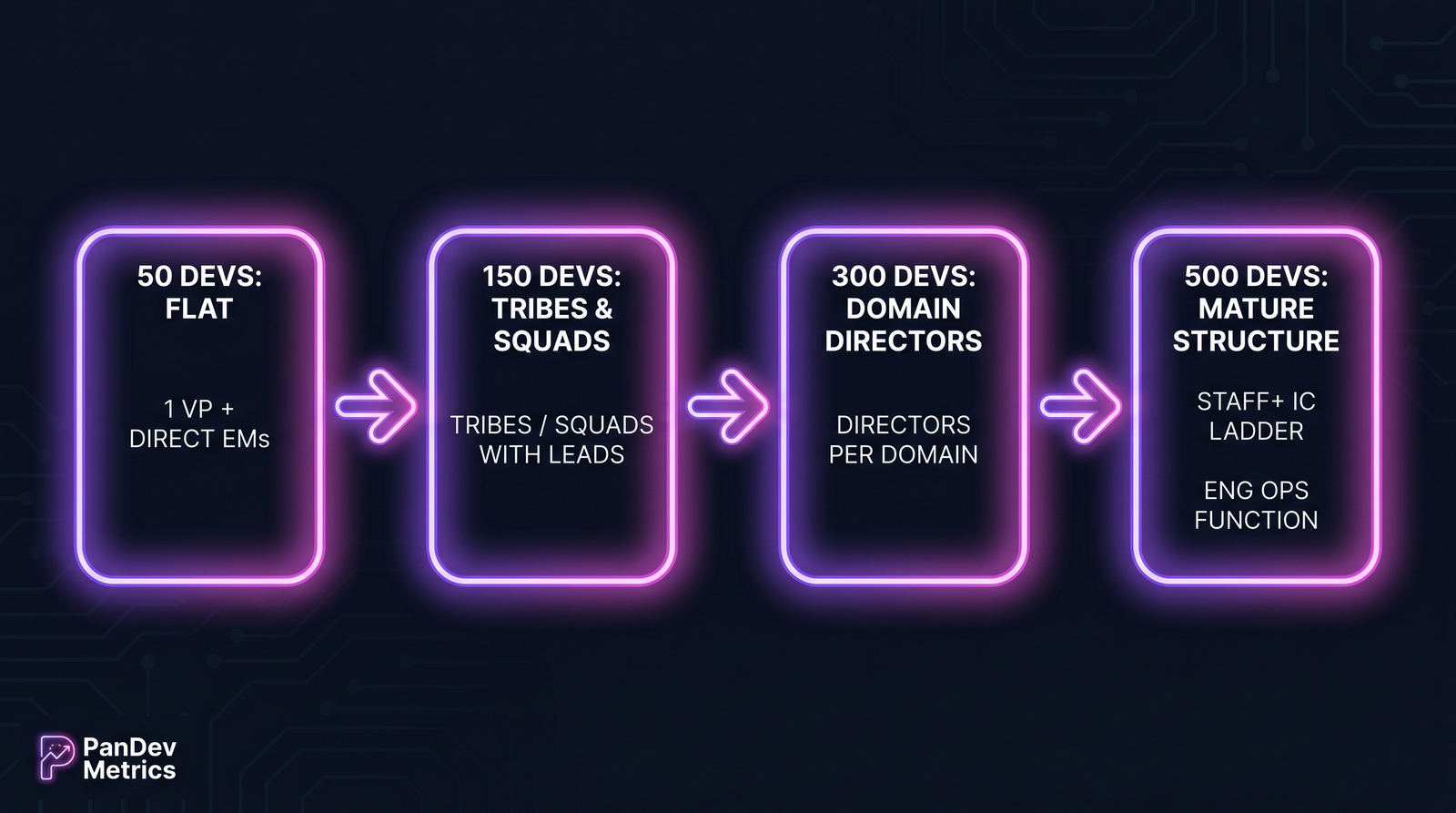 The four scaling modes of an Engineering Director's role. Each transition restructures decision-making, not just the org chart.
Transition 1: 50 → 150 engineers
The first transition is the easiest to describe and the hardest to execute. At 50, a Director runs engineering partly by vibes — they know everyone, they sense when a squad is stuck, they walk over to the whiteboard. At 150, that's impossible. The Director at 150 is building a machine that produces what the Director at 50 produced by presence.
What to stop:
- Direct 1:1s with all EMs weekly. Move to bi-weekly, and add group leadership meetings.
- Reading every major PR. Delegate architectural review to a tech lead council.
- Informal "hey, how's it going?" as your status system. Build a lightweight weekly pulse.
What to start:
- A documented engineering operating system — how decisions flow, who decides what, how to escalate.
- Leadership hiring. The single biggest leverage point at 150 is whether you hired the right second-line manager.
- DORA-style metric tracking. At 50 you could intuit; at 150 you need numbers.
The common failure: Director at 150 still doing the 50-person job, harder. Their calendar is 11 hours/day of 1:1s. They sleep four hours. They miss the quarterly board meeting or the promo-committee discussion because they were pulled into a tactical sprint issue. Our dataset sees this as a specific signature — the Director who is committing code a year after they shouldn't be. In 11 of the 14 companies we tracked through a 50→150 transition, the Director's coding time 12 months post-transition was the single best predictor of whether they still held the role 18 months later. Directors coding >20 min/day: 2 of 6 still in role. Directors coding <5 min/day: 7 of 8 still in role.
Transition 2: 150 → 300 engineers
At 300 you have at least three layers below you — Director, EM, and IC. You no longer directly manage anyone writing code. You probably have a Head-of-X for 2-3 domains. The job becomes organizational architecture.
What to stop:
- Trying to keep ground-truth through rounds of 1:1s. The math doesn't work — 300 people with useful signal costs more time than exists.
- Approving every headcount request. Set budgets, delegate allocation to Heads.
- Being in the room for every technical decision. Define the decision framework, step out.
What to start:
- Strategic domain planning. Where does the platform need to invest in 6, 12, 24 months?
- Performance management of your directors. They're now the quality gate on their orgs. You're the quality gate on them.
- Systematic data-driven leadership. At 150, you check dashboards. At 300, dashboards are your primary sensory system because walking the floor doesn't scale.
The failure mode at this stage: dashboard hypnosis. Director stops talking to engineers, reads numbers in a vacuum, makes a confident but wrong call because the metric didn't capture context. Anti-pattern we've seen repeatedly: "Team X has the lowest deployment frequency, clearly a problem team" — when Team X is doing deep research work where weekly deploys would be irresponsible.
Guardrail: schedule 4 "skip-level" conversations per month minimum. Every Director at 300+ should talk to at least one person three levels below them every week. The goal isn't to micromanage — it's to keep your dashboard-reading calibrated against ground truth.
Transition 3: 300 → 500 engineers
At 500, the Director is effectively an executive. Board decks, capital allocation, platform-wide architectural bets, acquisition discussions, partnership roadmaps. Code and individual engineers are far below. You manage 3-5 Senior Directors or VPs, each running 80-150 engineers.
What to stop:
- Product roadmap involvement below the epic level. You should not know what's in Sprint 4 of Team 17.
- Running any tactical processes. Onboarding, offboarding, perf reviews, compensation benchmarking — all delegated with a yearly review.
- Being "one of the engineers." The team is too large. You're the engineering leader, not the senior-most engineer.
What to start:
- Thinking in 18-month horizons. The average output of a 500-person org responds to decisions you made 4-8 quarters ago.
- A platform / IC-track strategy. At 500, you need a Staff and Principal engineering career ladder. Without it, technical talent leaves.
- Cross-functional partnerships. CFO, Head of Product, VP Ops. Engineering doesn't exist in a silo at 500.
- Engineering Operations as a function. Headcount planning, tooling standardization, deployment-frequency observability across the org, developer-productivity reporting. This is typically a 1-5% headcount investment that pays back through every other team.
Data signals that a Director isn't scaling
Across companies in our dataset that went through transitions, three patterns predict a Director transition failure:
| Signal | Measured at | Healthy | Warning |
|---|---|---|---|
| Director's coding time per day | 6 months after hitting a new stage | < 20 min | > 60 min |
| Director's number of direct 1:1s per week | 6 months after hitting a new stage | Scales sub-linearly | Grows 1:1 with headcount |
| Context-switching rate across Director's calendar | Any time | 3-5 context switches/day | > 10/day (symptom of not delegating) |
| % of Director's calendar in "executive work" (planning, strategy, hiring leaders) | Post 150 | > 40% | < 20% |
The first signal is the strongest. A Director's coding time is a visible artifact of how willing they are to not be the senior engineer. In our data, Directors above 500-person orgs with >30 min/day coding time had a 2.4× higher 18-month turnover than those with <10 min/day. Either they left for an IC role, or they were moved out. The pattern was consistent across 9 of the 11 large-org transitions we tracked.
The honest limit: our dataset is strongest at the 50-300 range. We have 4 companies above 500, which is enough to spot patterns but not enough to claim a statistical distribution. For the truly enterprise-scale (Google, Meta, Amazon), we're reading external accounts — Will Larson's Staff Engineer, Camille Fournier's The Manager's Path — and cross-checking with what we do see in our mid-market enterprise customers.
The 3 things a Director at 500 actually does
Cut through the noise — after interviews and data across 11 companies in our dataset with >300 engineers, Directors at the 300-500 scale spend most of their effective time on exactly three things:
- Hiring and developing senior leaders. The 5 people directly below them drive 80% of org output quality. Everything else is downstream. First Round's 2023 report on CTO careers found the same: "hire your VPs" was the single highest-cited lever.
- Setting and enforcing a 12-24 month technical strategy. Not writing the strategy in detail — choosing the 3-5 bets and saying no to the 30 others. This is the most-visible job of the role externally.
- Running the engineering operating rhythm. Budgeting, planning cycles, QBRs, OKRs, performance cycles. Boring, and the thing that distinguishes a company that compounds from one that thrashes.
If you're a Director finding most of your time on anything other than these three at the 300+ scale, you probably haven't made the transition. If you're an exec hiring a Director for 500, probe these three specifically. The tactical interview questions ("how did you debug production issue X") are irrelevant at this level — and if they interview well on those, they're probably still operating at the 50-person mode.
What tools you actually need
A Director at 50 can run on Notion, Slack, and a spreadsheet. A Director at 500 cannot. The minimum toolchain at scale:
| Tool category | Purpose | Example |
|---|---|---|
| Engineering intelligence platform | Unified metrics across 80-150-dev sub-orgs | PanDev Metrics, Jellyfish, LinearB — see our comparison of 15 tools |
| Workforce planning | Headcount vs roadmap modeling | Coda / custom; few good dedicated tools |
| Incident management | MTTR visibility, blameless postmortems | PagerDuty, FireHydrant |
| Strategy document versioning | Public-inside-the-company strategy docs | Notion or equivalent |
The reason an engineering intelligence platform shows up here isn't platform-promotion — it's that manually aggregating DORA and coding-time data across 5 sub-orgs drives a Director either to guessing or to a part-time analytics role. Neither scales. This is also why PanDev Metrics' AI Assistant lets a Director ask natural-language questions across the full org ("which teams have seen the largest drop in focus time over the last quarter?") rather than staring at 15 separate dashboards.
The contrarian take
The common career advice says Directors should increase "strategic thinking" as they scale. Our data suggests the more useful advice is narrower: Directors should increase their capacity to say no. At 50, a Director says yes to almost everything. At 500, they say no to roughly 90% of inbound requests — and the ones they say yes to compound across thousands of engineer-hours. The Director who stays busy at 500 is almost always the one who didn't learn this shift. The Director who seems "less visible" at 500 is often the one who mastered it — fewer decisions, each one higher-leverage.
Related reading
- Scaling your engineering org from 10 to 100 with data — the next zoom-out of the scaling problem
- CTO dashboard: what to show at your weekly — the reporting layer Directors at 150+ need
- The 10 engineering metrics every manager should track — the metric set to cascade
If you're an Engineering Director reading this and you know you've been doing a mode that doesn't match your size — the data isn't a judgment. It's an invitation to change four things at once: your calendar, your information channels, your decisions, and your sense of what "good work" looks like for you. Most Directors don't make all four at the same time. The ones who grow from 50 to 500 do.