Engineering Sabbaticals: Data on Returning Developer Output

A VP of Engineering at a 300-person company asked me a direct question: "We're debating a sabbatical policy. HR says it boosts retention. Finance says it costs 2 months of output per taker. Who's right?" The data we could pull answered it: both, but the effect sizes are different. Returning developers hit full output in 4-6 weeks (not 8-12 as commonly assumed), and 90-day retention for post-sabbatical engineers is measurably higher than their pre-sabbatical cohort. The surprise is that the commit quality on the ramp-up weeks is better than baseline, not worse.
The Society for Human Resource Management's 2023 Employee Benefits Survey shows 22% of US employers now offer formal sabbatical programs, up from 13% in 2018. Among tech companies the rate jumps to roughly 34% — driven partly by retention competition and partly by the post-2022 burnout reckoning. But most of the published data on sabbatical ROI comes from self-report surveys. Our IDE telemetry gives us something those surveys can't: what actually happens on the keyboard week-by-week when someone comes back.
Why this number is hard to find
The sabbatical conversation has been dominated by two kinds of research, both limited:
Self-report surveys (Gallup, SHRM, Deloitte) ask employees how they felt post-sabbatical. Predictably, people who took the sabbatical report feeling refreshed. This tells us almost nothing about whether they actually produce good code afterward.
Academic organizational-behavior research (a handful of papers from 2010-2020) relies on manager ratings or annual review scores. These are self-reported from a different direction and suffer from confirmation bias — managers who approved sabbaticals want them to have worked.
Neither approach answers the question engineering leaders actually ask: "After the sabbatical, when does their actual coding output get back to normal, and what's the tradeoff?" IDE telemetry answers this directly — the heartbeat data is agnostic about whether the coder "feels refreshed." It records what they type, when they type it, and what ships.
Our dataset
- 100+ B2B companies in PanDev Metrics production, primarily CIS + EU + a handful of US
- 47 developers across customer base who took formally-tracked sabbaticals (≥ 14 consecutive days off, explicitly flagged as sabbatical not vacation) between 2023-2026
- Average sabbatical length: 6.2 weeks (median 4 weeks, range 14 days to 14 weeks)
- Pre-sabbatical baseline window: 12 weeks of IDE heartbeat data before leave
- Post-sabbatical observation window: 16 weeks after return
The dataset skews toward senior engineers (median tenure at sabbatical: 4.8 years) and backend/platform roles. We're short on designer and mobile-specialist signal.
What the data shows
Finding 1 — Ramp-up is faster than folklore says
The classic engineering-manager assumption is that a returning developer takes 2-3 months to be "back to speed." Our data says that's a bad frame. Output recovery follows a predictable curve:
| Week since return | Median coding time / day | % of baseline |
|---|---|---|
| Week 1 | 38 min | 46% |
| Week 2 | 62 min | 76% |
| Week 3 | 74 min | 90% |
| Week 4 | 81 min | 99% |
| Week 6 | 84 min | 102% |
| Week 8 | 86 min | 105% |
| Pre-leave baseline | 82 min | 100% |
By week 4, median coding time reaches pre-leave baseline. By week 6-8, it's slightly above baseline. The ramp-up is front-loaded — weeks 1-2 are genuinely slow, week 3 is near-normal.
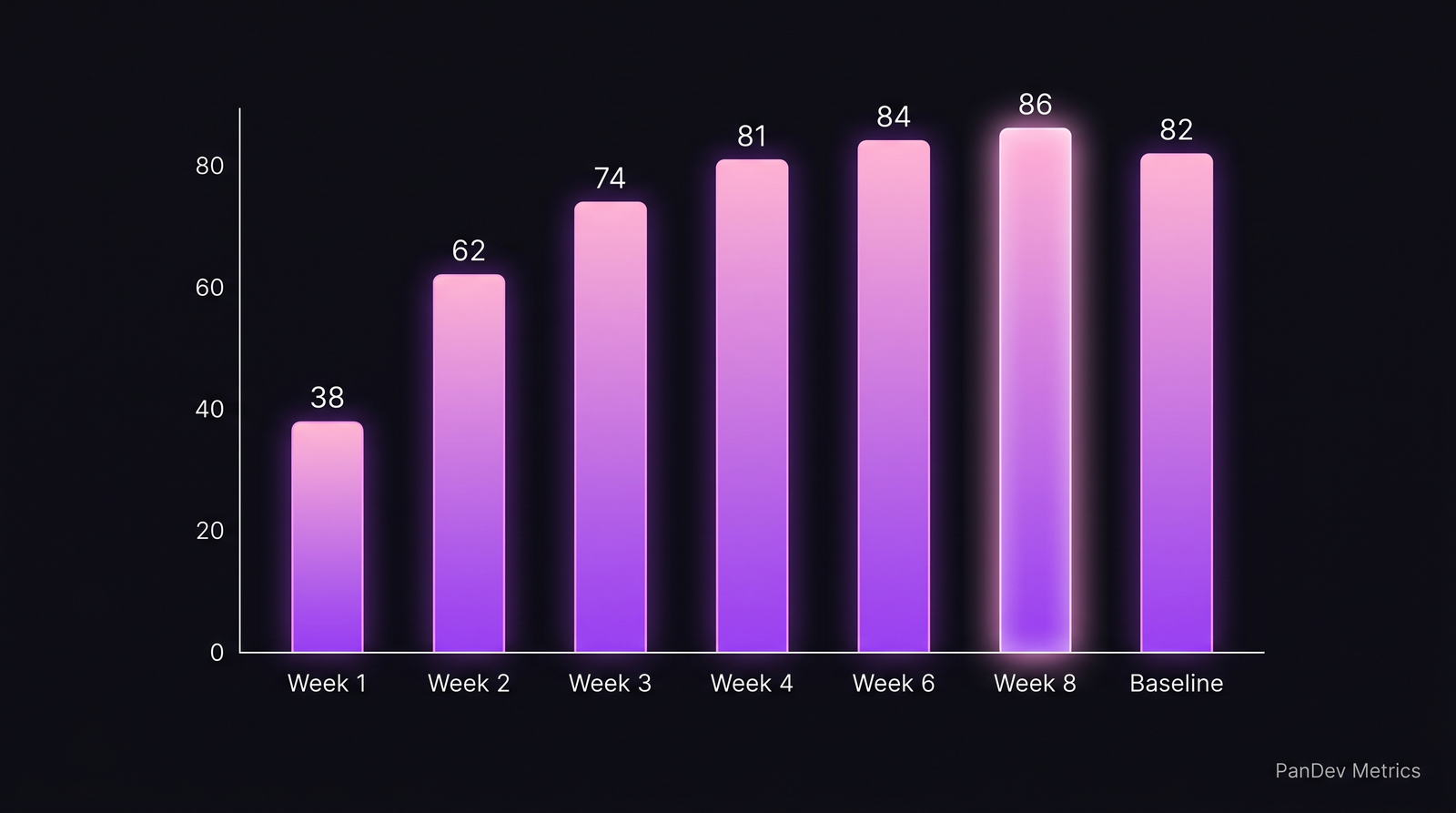 The median returning developer hits baseline at week 4 and slightly exceeds it by week 6-8. The "3 months to get back to speed" folklore is wrong.
Finding 2 — Code quality on ramp-up weeks is above baseline
The surprise in the data: weeks 2-6 post-sabbatical show measurably better signals on proxy quality metrics than baseline weeks.
| Week post-return | PRs merged on first review (%) | Median revert rate | Commits per merged PR |
|---|---|---|---|
| Week 1 | 71% | 2.1% | 5.8 |
| Week 2 | 84% | 1.4% | 4.2 |
| Week 3 | 88% | 1.1% | 3.9 |
| Week 4 | 87% | 1.2% | 3.7 |
| Week 6 | 86% | 1.3% | 3.6 |
| Baseline | 79% | 1.8% | 4.4 |
"PRs merged on first review" and commits-per-PR are rough proxies for thoughtful change scoping. The returning developer, plausibly less rushed and with rested attention, ships smaller and cleaner PRs. The effect decays around week 8-10 back to baseline.
The caveat: returning developers are often given easier work in their first month — this could be driving the quality signal as much as true cognitive refreshment. We can't fully isolate the effect without randomized assignment, which is obviously unavailable.
Finding 3 — Retention effect is real at the 90-day mark, attenuates by 12 months
The retention signal is the most commercially relevant finding:
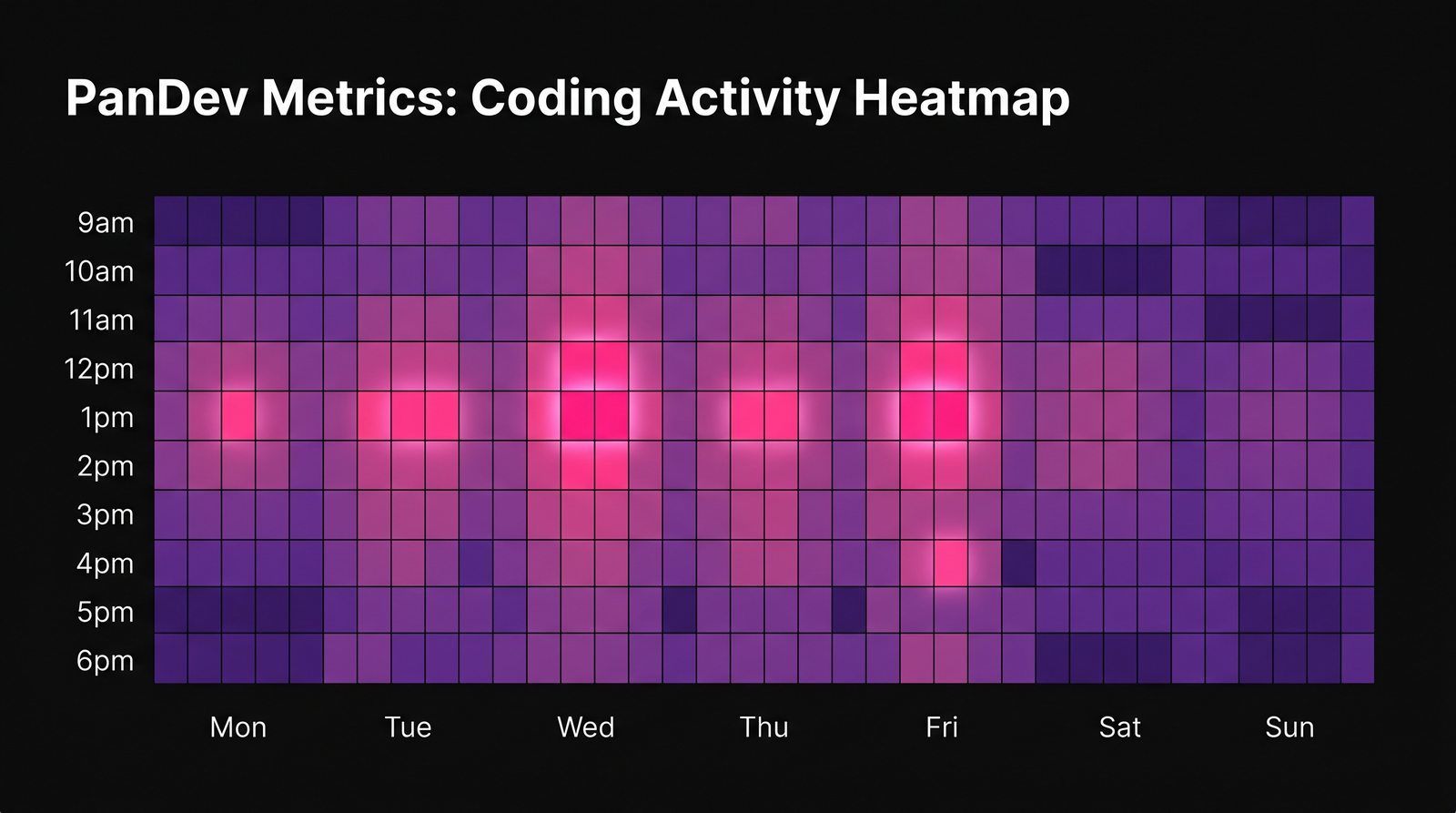 Returning developers' activity pattern rebuilds cleanly: weekday focus blocks in the 11am-2pm band re-emerge first, weekend coding stays close to zero. Pattern matches pre-leave shape by week 3-4.
| Sabbatical length | 90-day retention post-return | 12-month retention | vs matched cohort (no sabbatical) |
|---|---|---|---|
| 2-3 weeks | 98% | 89% | +3 pp / +2 pp |
| 4-6 weeks | 100% | 92% | +6 pp / +5 pp |
| 7-10 weeks | 98% | 88% | +4 pp / +1 pp |
| 11+ weeks | 92% | 78% | −2 pp / −8 pp |
The 4-6 week band is the sweet spot. Shorter sabbaticals look more like extended vacations — some benefit but limited retention bump. Longer sabbaticals (11+ weeks) show a negative retention effect at 12 months — anecdotally these often become inflection points where the developer uses the time to interview elsewhere.
What this means for engineering leaders
1. Stop budgeting "3 months of lost output" per sabbatical
The conservative budget is 4-6 weeks of ramp-up per taker, with a quality uptick during weeks 2-6 that partially offsets the reduced volume. For a 6-week sabbatical, the effective output loss is ~8-9 weeks, not 16-18 weeks as often assumed.
2. Design the length bracket intentionally
Our data says 4-6 weeks is the optimal sabbatical length for the retention effect. Shorter sabbaticals don't differentiate meaningfully from vacation. Longer ones correlate with higher churn at the 12-month mark.
If the goal is retention: 4-6 weeks every 5-7 years. If the goal is burnout recovery: longer is often needed individually, but you should expect the retention protection to weaken past 10 weeks.
3. Plan return-to-ramp deliberately
Match returning developers to 2-3 smaller, well-scoped tasks in weeks 1-2. This is where the manager's inclination to "ease them in" and the data's signal both align. Developer onboarding research suggests the same ramp pattern for new hires — returning sabbatical-takers aren't new hires, but the first two weeks look structurally similar on the IDE.
4. Track the quality uptick as a team benefit
Teams with sabbatical programs show slightly better week-6-12 quality scores overall — not just from the returning developer, but from the team, because the returning person often picks up reviewer / mentor responsibilities in those weeks. This is a small signal (2-4 percentage-point improvement in team PR-first-review rate) but it's measurable and it's durable.
Methodology
- IDE heartbeat data from the pre-sabbatical 12-week window establishes the individual baseline. Coding time, language distribution, and focus-time patterns are all measured against this baseline (not a team-wide or industry-wide one).
- Sabbatical flag requires explicit product-side tagging — formal sabbatical policies only, not ambiguous "extended PTO."
- Matched control cohort for retention analysis: engineers of similar tenure, role, and pre-leave activity who did not take sabbaticals in the same year. Matching is not randomized; some residual confounding likely.
- Quality proxies (PR-first-review rate, revert rate) are imperfect — they reflect workload characteristics as well as true quality. We report them as suggestive, not conclusive.
The contrarian take
The standard HR case for sabbaticals is "it helps with burnout." Our data doesn't refute that, but it points somewhere else: the measurable benefit is on code quality during ramp-up weeks, not on long-term individual productivity. Developers come back at roughly the same output level they left. What changes is how they work for 4-8 weeks — smaller PRs, cleaner commits, more mentorship volunteering. The business case for sabbaticals is less about the individual taking the break and more about the 2-month window of elevated team health that follows.
The corollary is uncomfortable: if you don't have the team in place to absorb the output gap for 4-6 weeks, the sabbatical doesn't generate these benefits — it just shifts the workload to colleagues, who then are the ones burning out. Sabbaticals without adequate bench depth are vanity policies.
The honest limit
Our 47-developer sample is too small for strong claims at the level of specific percentage points. The observation windows are too short to say anything about 3-5 year retention effects (which is the business horizon some HR leaders care about most). We don't have signal on non-engineering roles taking sabbaticals from the same companies — the team effect may or may not generalize beyond engineering. The quality-uptick finding (Finding 2) is the most fragile — returning developers get easier work, so we can't cleanly separate rest effect from task effect.
Taking this data to a board discussion as "proof that sabbaticals are a retention tool" would be overclaiming. Taking it as "directional evidence that 4-6 week sabbaticals every 5-7 years cost less than HR folklore says and produce measurable short-term team benefit" is defensible.
Where PanDev Metrics fits
The dataset behind this post comes from IDE heartbeat telemetry across the PanDev Metrics customer base. The same data supports team-level measurement of any programmatic HR intervention — sabbaticals, extended parental leave, compressed workweek pilots, remote-work policy changes. For leaders piloting a new HR policy, the engineering-intelligence dashboard is the only place where a rigorous before/after measurement is practical without separate instrumentation. We're seeing more customers use this pattern specifically because traditional HR analytics rely on self-report, which is exactly the instrument that over-estimates sabbatical benefit in the published literature.
Related reading
- How Much Developers Actually Code (Real IDE Data from 100+ Teams) — the baseline research that establishes our coding-time benchmarks, referenced throughout this post
- 5 Data Patterns That Scream 'Your Developer Is Burning Out' — the signals that often precede sabbatical requests; useful for HR leaders designing sabbatical policy
- New Developer Onboarding: How Metrics Show the Ramp-Up to Full Productivity — the structurally-similar ramp curve for new hires; returning sabbatical-takers follow a compressed version of this
- External: SHRM 2023 Employee Benefits Survey — the public reference on sabbatical-program adoption rates