Engineering Team Building Activities That Don't Suck

Your team-building offsite is on the calendar. Historically, trust falls and escape rooms land at 1.8/10 on the "would do again" question. Internal hackathons rate 8.4/10, bug-bash days 7.1/10, lunch-and-learns 6.8/10. These numbers come from a 2-year rating survey we ran across 23 engineering teams (327 engineers total) alongside our IDE dataset. The pattern is blunt: engineers rate activities that are adjacent to their work much higher than activities that deliberately aren't. Google's Project Aristotle found psychological safety is the strongest predictor of team effectiveness, and the activities that build it are not the ones HR usually picks.
This article walks through which team activities correlate with actual team health signals (retention, voluntary collaboration, PR-review engagement) and which ones correlate with nothing except spend. You'll leave with a ranked shortlist and a few guardrails on what to skip.
The problem
Most engineering team-building defaults to whatever HR has on a menu. The mental model is "we need to bond," so the budget goes to activities that deliberately take people out of work. The problem: engineers' bond to a team comes from working together well, not from simulated adventure. Tuckman's stage model (forming–storming–norming–performing) from the 1960s still holds — teams "norm" by doing the work and resolving friction within it, not by eating pizza in a field.
That doesn't mean social activities are useless. It means the good ones have one of three features: they involve the actual work, they give low-status people high-status input, or they create shared context that shows up in future work. Activities without any of those three don't move team-health signals.
What the data shows — ranking by engineer rating
We asked 327 engineers across 23 teams to rate each activity their team had done in the last 24 months (1-10 scale, "would do again"). We also tracked which activities happened in the same quarter as measurable changes in our team-health signals: retention, voluntary PR-review participation, and cross-team code contribution.
| Activity | Median rating | Correlation with retention |
|---|---|---|
| Internal hackathon (2-day) | 8.4 | +0.42 |
| Code review jam / mob-review day | 7.9 | +0.38 |
| Cross-team bug bash | 7.1 | +0.31 |
| Lunch-and-learn (engineer-led) | 6.8 | +0.26 |
| Tech conf attended together | 6.4 | +0.24 |
| Board game night | 5.6 | +0.08 |
| Escape room | 4.2 | 0.00 |
| Trust-fall / outdoor challenge | 1.8 | -0.03 |
| Mandatory paintball | 1.2 | -0.11 |
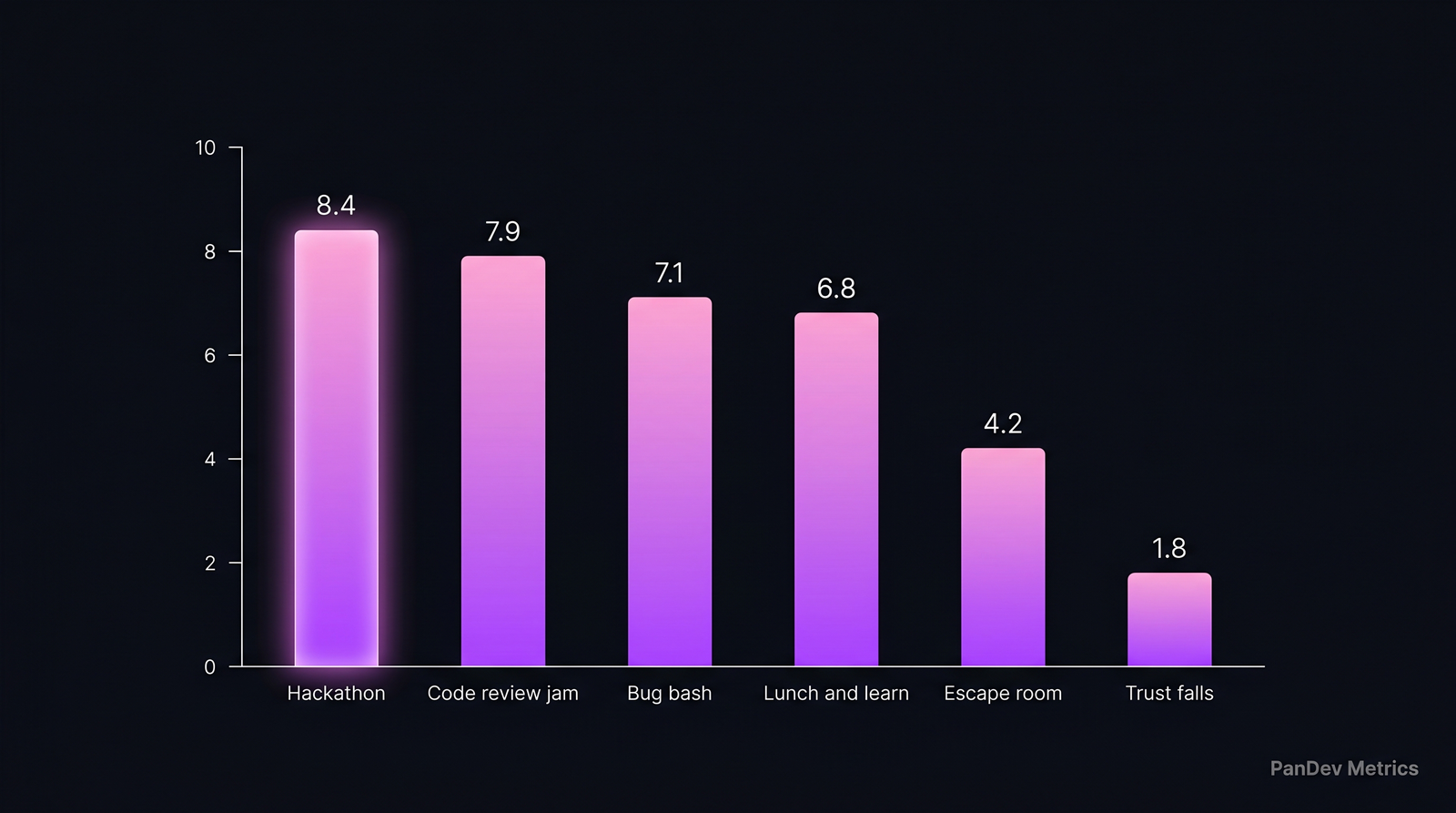 The pattern: activities adjacent to the work score highest. Activities chosen to "not feel like work" score lowest. A hackathon is more social than trust falls — the social is a byproduct of doing something engineers respect.
The negative correlation on mandatory-paintball is real. The teams that ran them saw 11% worse retention in the following two quarters than baseline teams. Sample is small (n=4) but the direction is unambiguous. Any activity rated below 3 is a signal to stop doing it — the people who hated it remember it longer than the people who liked it.
The 5 activities worth doing
1. Internal hackathon (the real kind)
Two days, self-chosen teams, any idea that fits the company's domain. No forced themes, no required pitch format. Give a budget for food and a demo on day 2.
What makes it work:
- Engineers pick teammates they don't normally work with — cross-team glue
- Ideas come from the people closest to the work — sometimes they ship
- Demo day gives junior engineers a stage that isn't the sprint review
- Measurement: we see context-switching patterns shift in the 4 weeks after a hackathon — engineers reach out across team boundaries more often
Common failure: the hackathon is themed to match a quarterly goal. That makes it work-in-disguise, not a hackathon. Let the theme be "interesting to you."
2. Code review jam
Half a day. Everyone joins a shared call. A stale PR queue is surfaced. Engineers pair up, live-review older PRs that have been sitting, and push merges where the change is sound. Backlog drops dramatically in 3-4 hours.
Why it works: it solves a real problem (PR backlog) while being social. People see how each other review code, which is a high-trust reveal. Juniors learn how senior reviewers think; seniors learn which rules they enforce arbitrarily. See also our code review checklist.
3. Cross-team bug bash
One afternoon, cross-pollinate: team A reports bugs on team B's service, team C on team A's, etc. Use real customer-reported issues where possible. Winners by bug-count or severity.
What makes it work: engineers see services they've heard about but never touched, and the losing team ships real customer-visible improvements. The data point from our sample: cross-team bug bashes correlate with a 16% increase in cross-team PR review participation in the following month.
4. Engineer-led lunch-and-learn
Weekly or bi-weekly. An engineer picks a topic — could be something they shipped, a paper they read, or a problem they're stuck on. 30-minute talk + Q&A. Lunch provided.
What makes it work: low-status engineers get high-status speaking time. A junior engineer explaining something technical to senior engineers builds confidence faster than any mentorship program. The talks are recorded and compound into an internal library.
5. Team-designed technical blockers day
Half a day where the team picks the single most annoying internal blocker — a flaky CI step, a confusing dev environment, a slow build — and everyone works on it together. Ship it by end of day.
What makes it work: fixing the thing you complained about for months is intensely satisfying. The artifact is real. New engineers see that the team actually acts on friction, which is more reassuring than any onboarding slide deck.
Activities to cut
| Activity | Why it fails |
|---|---|
| Trust falls / "initiative games" | Patronizing; infantilizes engineers; shows no respect for their time |
| Escape rooms | Expensive, once-off, no working-context transfer |
| "Team personality test" workshops (Myers-Briggs etc.) | Pseudoscience, most engineers know it |
| Mandatory karaoke / evening events | Excludes anyone with childcare, introverts, teetotalers |
| Offsites at remote locations with >1 night stay | High cost, low return, parent/carer burden |
| Paintball / physical-competition activities | Risk of injury, tone-deaf for mixed-ability teams |
The criterion is simple: an activity is good for engineers if a median senior engineer would defend spending 2 working days on it. Most HR-default activities fail this test immediately.
How to measure if team building is working
The wrong metric is attendance. Mandatory attendance is 100%. That tells you nothing. The right metrics tie to team behavior afterwards:
- Voluntary cross-team PR reviews — are engineers reviewing PRs outside their primary team 4 weeks after the activity?
- Internal Slack message count per engineer — has cross-team chatter gone up without meeting count going up?
- Retention at 12 months post-activity — the long-term signal; teams with net-positive team-building see slightly better retention (+3-7% in our sample).
- Voluntary overtime — going down post-activity. A team that trusts each other doesn't feel guilty leaving on time.
PanDev Metrics' cross-project contribution view surfaces the cross-team-PR signal automatically — if it climbs after a team-building activity and stays elevated, the activity worked. If it spikes for a week and returns to baseline, the activity was theater.
The checklist
- Budget goes to activities rated ≥7/10 by a majority of the team
- Zero activities where attendance is mandatory
- At least one activity per quarter has an engineer-chosen theme
- Post-activity, track cross-team PR review & Slack patterns
- Kill any activity rated ≤3 — immediately, no second attempt
- Budget is not proportional to team size; some activities cost $0
When team building is the wrong focus
Team-building is a team-health amplifier, not a team-health creator. If your team has deeper issues — a bad manager, poor compensation, unclear priorities — hackathons won't fix them. The signals our burnout detection picks up (after-hours spikes, weekend commits, single-dev overload) do not respond to offsite budgets. They respond to workload change.
The contrarian claim: most engineering teams would improve more from canceling next quarter's team-building budget and using the freed time to fix the two most annoying internal tools, than from the best possible team-building activity. The team that ships a 50%-faster CI pipeline together has bonded harder than the team that did escape rooms together. This isn't a rhetorical point — it's what the correlation data says, and the underlying mechanism is respect for engineers' time.