Focus Time: Why 2 Hours of Uninterrupted Code Equals 6 Hours of Fragmented Work

Gloria Mark's research at UC Irvine found that it takes an average of 23 minutes and 15 seconds to refocus after a single interruption. Now consider a typical developer morning: 9:07 Slack pings, 9:15 standup reminder, 9:45 a "quick question" from a PM. By 10:30, they've been "working" for 90 minutes but written exactly 11 lines of code. Three interruptions consumed roughly 70 minutes of cognitive recovery time.
This isn't a productivity problem. It's a focus time problem. And the data shows it's costing your team far more than you think.
What Is Focus Time and Why It Matters
Focus Time is uninterrupted, sustained coding activity — the periods when a developer is genuinely engaged in writing, refactoring, or debugging code without switching to Slack, email, or meetings.
Cal Newport's Deep Work (2016) argues that most knowledge workers can sustain at most 4 hours of deeply focused creative work per day — and that this capacity is the scarce resource that determines output quality. For software developers, this translates directly to continuous IDE activity — the stretches where fingers are on the keyboard, the mental model of the codebase is loaded into working memory, and progress actually happens.
At PanDev Metrics, we track Focus Time as a core metric alongside Activity Time. The difference is significant: Activity Time counts any time the IDE is active. Focus Time counts only sustained sessions where a developer maintains continuous engagement without significant gaps.
The Research Behind the 3x Multiplier
The claim that 2 hours of focused work equals 6 hours of fragmented work isn't hyperbole — it's grounded in research and production data.
The cognitive cost of interruptions
A widely cited study by Gloria Mark at UC Irvine found that it takes an average of 23 minutes and 15 seconds to return to a task after an interruption. But for developers, the cost is even higher. Programming requires holding complex mental models — data flows, state transitions, architectural patterns — in working memory. Each interruption forces a reload of that mental context.
Chris Parnin's research on programmer interruptions (published in IEEE) found that after being interrupted, developers needed an average of 10-15 minutes to resume editing code, and only 10% of interrupted sessions resulted in resuming work within a minute.
What our data shows
Across B2B engineering teams tracked by PanDev Metrics, the median developer codes 78 minutes per day, with a mean of 111 minutes. These figures are consistent with McKinsey's 2023 finding that developers spend only 25-30% of their time writing code. But the averages hide a critical distribution pattern:
| Session type | Avg. duration | Code output quality | Frequency |
|---|---|---|---|
| Micro-sessions (< 15 min) | 8 min | Low — mostly navigation and small fixes | Very common |
| Short sessions (15–45 min) | 28 min | Medium — feature work begins but rarely completes | Common |
| Deep sessions (45–120 min) | 72 min | High — complex features, meaningful refactors | Uncommon |
| Extended sessions (120+ min) | 148 min | Very high — architecture-level work | Rare |
Developers in our dataset who maintain at least one 90+ minute uninterrupted session daily have significantly higher Delivery Index scores than those whose work is fragmented into sub-30-minute bursts.
The Tuesday Effect: When Focus Time Peaks
Our data across thousands of tracked hours shows that Tuesday is the peak coding day. This isn't random. Here's the pattern:
| Day | Focus Time potential | Why |
|---|---|---|
| Monday | Medium | Standups, sprint planning, catching up on weekend messages |
| Tuesday | High | Plans are set, minimal meetings, maximum runway |
| Wednesday | Medium-High | Mid-week reviews start creeping in |
| Thursday | Medium | Demo prep, code reviews, planning next sprint |
| Friday | Low-Medium | Wrap-up mentality, deployment freezes, early checkouts |
Tuesday works because Monday absorbs the coordination overhead. By Tuesday, developers know what they're building and have the clearest calendar to build it. Engineering managers who protect Tuesday and Wednesday mornings from meetings see measurable improvements in their team's Focus Time.
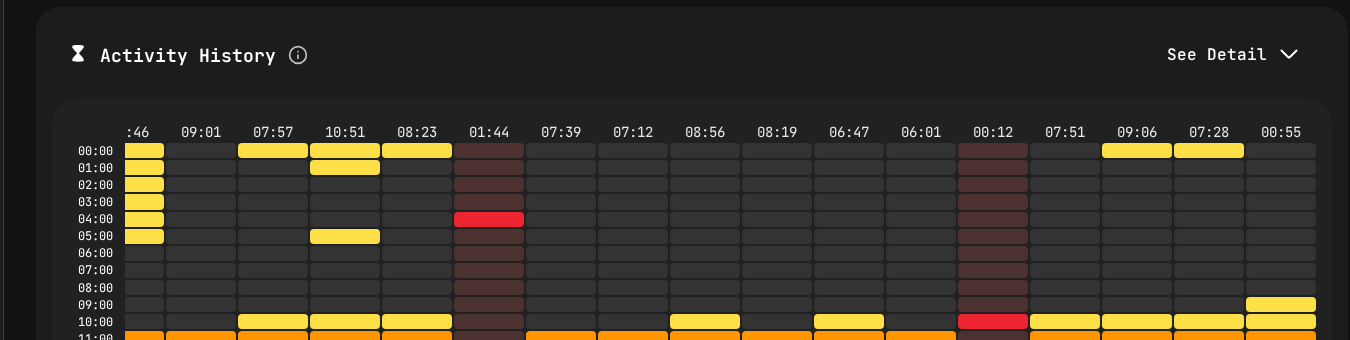 Activity heatmap from PanDev Metrics — yellow blocks show active coding sessions, gaps reveal meetings and interruptions throughout the week.
Five Practical Strategies to Protect Focus Time
1. Implement meeting-free mornings
Block 9 AM to 12 PM (or your team's equivalent) on at least three days per week. Our data shows that morning coding sessions tend to be longer and more productive than afternoon ones. When meetings cluster in the morning, the entire day's deep work potential collapses.
How to measure it: Track Focus Time before and after implementing the policy. In PanDev Metrics, compare Focus Time distribution across weeks to see if session lengths increase.
2. Batch communication windows
Instead of real-time Slack responsiveness, establish 2-3 communication windows per day. For example: 8:30–9:00 AM, 12:00–12:30 PM, and 4:30–5:00 PM. Outside these windows, developers should feel empowered to mute notifications.
| Communication model | Avg. Focus session length | Interruptions per hour |
|---|---|---|
| Always-on Slack | 12–18 min | 3–5 |
| Batched (3x/day) | 45–70 min | 0.5–1 |
| Async-first (Slack + tickets) | 60–90 min | 0.3–0.5 |
3. Use "office hours" for cross-team questions
PMs, designers, and stakeholders often need developer input. Instead of ad-hoc interruptions, establish daily office hours — a 30-minute window where developers are available for questions. This respects both sides: stakeholders get access, developers get predictability.
4. Make Focus Time visible
What gets measured gets managed. When Focus Time is a visible metric on a team dashboard, it changes behavior. Managers start noticing when a developer's Focus Time drops from 2 hours to 30 minutes — and they investigate why.
PanDev Metrics tracks Focus Time automatically through IDE plugins. No self-reporting, no timers, no distractions. The data flows from the editor directly into dashboards that engineering managers can review during 1:1s.
5. Protect your top contributors differently
Our data shows significant variance in coding patterns. The top 6% of developers in our dataset code more than 4 hours per day. These developers aren't 3x more talented — they typically have fewer meetings, fewer Slack channels, and more autonomy. If your senior engineers are drowning in meetings, you're paying senior rates for junior-level output.
| Developer tier | Median daily coding time | Typical meeting load |
|---|---|---|
| IC (Junior) | 65 min | 1–2 meetings/day |
| IC (Mid) | 82 min | 2–3 meetings/day |
| IC (Senior) | 95 min | 3–5 meetings/day |
| Staff+ | 45 min | 4–7 meetings/day |
Notice the paradox: Staff+ engineers — your most experienced and expensive contributors — often have the least Focus Time because they're pulled into every architectural discussion, planning meeting, and incident review.
How to Measure Focus Time Properly
Not all "time tracking" captures Focus Time. Here's what works and what doesn't:
| Method | Accuracy | Developer friction | Captures Focus Time? |
|---|---|---|---|
| Self-reported timesheets | Low | High | No |
| Calendar analysis | Medium | None | Partially (shows meeting load) |
| Browser/app tracking | Medium | Medium | No (activity ≠ focus) |
| IDE heartbeat tracking | High | None | Yes |
IDE heartbeat tracking — the method used by PanDev Metrics — sends anonymous activity signals from the editor. When a developer is actively coding (keystrokes, navigation, debugging), the signal is "active." When they switch to Slack or a browser, the coding session ends. This creates an accurate timeline of Focus Time without requiring any manual input.
The ROI of Protecting Focus Time
Let's do the math for a 10-person engineering team:
Current state: Average 78 minutes of coding per day, fragmented into 5-6 sessions.
After Focus Time protection: Average 110 minutes of coding per day, consolidated into 2-3 sessions.
That's a 41% increase in coding time — without hiring anyone, without working longer hours, just by restructuring when and how interruptions happen.
| Scenario | Daily coding/developer | Weekly team total | Monthly team total |
|---|---|---|---|
| Fragmented (baseline) | 78 min | 65 hours | 260 hours |
| Focus-protected | 110 min | 91.7 hours | 367 hours |
| Difference | +32 min | +26.7 hours | +107 hours |
That's the equivalent of adding 2.7 full-time developers to your team — just by protecting focus.
What Engineering Managers Should Do Monday Morning
-
Audit your team's meeting load. Count meetings per developer per day. If anyone has more than 2 hours of meetings daily, they're unlikely to achieve meaningful Focus Time.
-
Establish meeting-free blocks. Start with Tuesday and Wednesday mornings. Communicate the policy clearly and enforce it.
-
Start measuring Focus Time. You can't improve what you don't measure. Set up IDE-level tracking to see actual Focus Time, not estimated time.
-
Review Focus Time in 1:1s. When a developer's Focus Time drops, ask why. Often the answer is a new recurring meeting, an on-call rotation, or a cross-team dependency that can be restructured.
-
Set a team Focus Time target. Based on our data, a healthy target is 90-120 minutes of Focus Time per developer per day. Not as a quota — as a signal that your team has the space to do their best work.
Focus Time Is a Leadership Responsibility
Developers can't protect their own Focus Time. They can't decline meetings invited by their skip-level. They can't ignore a VP's Slack message. They can't refuse to help a teammate who's stuck.
Protecting Focus Time is a management responsibility. It requires setting policies, enforcing boundaries, and sometimes saying "no" to stakeholders who want a developer's attention right now.
The data is clear: the difference between a high-performing engineering team and a struggling one often isn't talent, tools, or technology. It's whether developers have the uninterrupted time to actually think.
Based on aggregated data from PanDev Metrics Cloud (April 2026), thousands of hours of IDE activity across B2B engineering teams. Research references: Gloria Mark, "The Cost of Interrupted Work" (UC Irvine, 2008); Chris Parnin, "Resumption Strategies for Interrupted Programming Tasks" (IEEE, 2011); Cal Newport, "Deep Work" (2016); McKinsey developer productivity report (2023).
Ready to measure your team's Focus Time? PanDev Metrics tracks Focus Time automatically through IDE plugins — no timers, no self-reporting, just real data from your editors.