Developer Gamification: Levels, Badges, and XP — Does It Work or Annoy?

Add XP, levels, and badges to a developer platform and you'll get two reactions. Some developers light up — they check their progress daily, compete on leaderboards, and proudly display badges on their GitHub profiles. Others recoil — they see it as surveillance dressed up in game mechanics, an infantilizing system that reduces their craft to a score.
Both reactions are valid. The question isn't whether gamification works in absolute terms. It's when, how, and for whom.
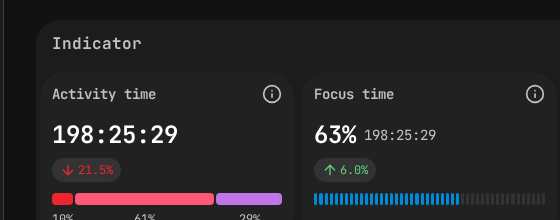
Activity Time and Focus Time indicators — the metrics behind gamification levels.
What Developer Gamification Actually Looks Like
Let's define terms. When we talk about gamification in engineering, we mean applying game-like mechanics to developer workflows:
- XP (Experience Points): Points accumulated through coding activity, code reviews, commits, or other contributions
- Levels: Progression tiers unlocked by accumulating XP (e.g., Level 1 Novice → Level 10 Master)
- Badges/Achievements: One-time awards for specific accomplishments (e.g., "First Pull Request," "100-Day Streak," "Polyglot — coded in 5 languages")
- Leaderboards: Rankings comparing developers within a team or organization
- Profile decorations: Visual indicators (like SVG badges for README profiles) that showcase achievements
PanDev Metrics implements several of these mechanics. With nearly 1,000 individual users across 100+ B2B companies, we've observed how real engineering teams interact with gamification features. Here's what we've learned — the good, the bad, and the nuanced.
The Case FOR Gamification
1. It Makes Invisible Work Visible
Most developer work is invisible. You write code, push it, and it disappears into the product. Gamification creates tangible markers of progress. When a developer reaches Level 5 or earns a "Code Review Champion" badge, there's a concrete acknowledgment of work that would otherwise go unnoticed.
This matters more than you might think. Research from the Developer Experience Collective and findings in the Stack Overflow Developer Survey confirm that "feeling recognized for contributions" is one of the top 5 factors in developer job satisfaction. Gamification, when done well, provides this recognition automatically and consistently — without relying on managers to remember to say "good job."
2. It Encourages Desired Behaviors
Smart gamification design rewards behaviors the organization wants to encourage:
- Badge for thorough code reviews → developers write better reviews
- XP for documentation contributions → documentation improves
- Achievement for mentoring new hires → onboarding gets better
- Streak badges for consistent activity → reduces extreme feast-or-famine work patterns
The key is aligning incentives with outcomes that benefit both the individual and the team. If the gamification system rewards the right things, it subtly steers behavior in a positive direction.
3. It Creates a Shared Language
Levels and badges create a common vocabulary for progress. Instead of vague discussions about seniority, teams can reference concrete milestones. "She reached Level 8 — she's been incredibly consistent" is more specific than "she's doing well."
This shared language is especially valuable for distributed teams where visibility into individual contributions is limited.
4. It Adds Fun (For Some People)
Let's not over-intellectualize it. Some developers enjoy gamification. They like seeing numbers go up, unlocking achievements, and having a visual representation of their work. Not every system needs a deep psychological justification. If it makes work slightly more enjoyable for a portion of your team, that has value.
The Case AGAINST Gamification
1. Goodhart's Law: When the Metric Becomes the Target
"When a measure becomes a target, it ceases to be a good measure." This is the #1 risk of gamification.
If XP is based on lines of code, developers write verbose code. If it's based on commits, they make tiny commits. If it's based on hours logged, they leave their IDE open while browsing Reddit.
The mitigation: Design the XP system to reward outcomes that are genuinely valuable and hard to game. PanDev Metrics tracks actual coding activity via IDE heartbeats — you can't inflate your hours by leaving Slack open. But no system is completely game-proof, and acknowledging this limitation is important.
2. Extrinsic vs. Intrinsic Motivation
Self-Determination Theory (Deci & Ryan) suggests that extrinsic rewards can undermine intrinsic motivation. If a developer who previously coded for the joy of problem-solving starts coding for XP, their underlying motivation shifts. Remove the XP, and they may feel less motivated than before.
This is a real concern. The research on this is mixed — some studies show gamification increases engagement, others show it crowds out intrinsic motivation. The effect likely depends on the individual and the implementation.
The nuance: Gamification works best as recognition rather than reward. "Here's a badge acknowledging what you already do well" is different from "do more of this to earn points." The first reinforces intrinsic motivation. The second replaces it.
3. It Can Feel Surveillance-Like
Developers are highly sensitive to monitoring. Any system that tracks their activity and converts it to scores can feel like surveillance. Even if the intent is motivation, the perception may be control.
The mitigation: Transparency and opt-in design. Developers should understand exactly what's tracked, how scores are calculated, and have agency over what's public. PanDev Metrics shows developers their own data first — it's a tool for self-reflection, not a panopticon.
4. Unhealthy Competition
Leaderboards can turn collaboration into competition. If Developer A is one rank ahead of Developer B, Developer B might skip helping a colleague to protect their coding time. Worse, developers might overwork — sacrificing health, weekends, and relationships to climb the rankings.
The mitigation: See our separate article on setting up leaderboards the right way. Short version: emphasize team achievements, use timeboxed challenges rather than permanent rankings, and never tie gamification to compensation or performance reviews.
5. One Size Doesn't Fit All
Some developers are competitive and love leaderboards. Others are intrinsically motivated and find gamification distracting. Some are early-career and benefit from progress markers. Others are senior and find levels patronizing.
A gamification system that assumes all developers respond the same way will alienate a significant portion of the team.
The mitigation: Make gamification features optional. Let individuals choose whether to display badges, participate in leaderboards, or track XP. The developers who enjoy it will opt in. The others won't be bothered.
What We've Learned from Nearly 1,000 Users
At PanDev Metrics, we've rolled out gamification features (levels, XP, achievements, SVG badges for README profiles) across nearly 1,000 users at 100+ B2B companies. Here's what we've observed:
Engagement Is Bimodal
Developers split into two clear groups:
- Active engagers (~40-50%): Check their progress regularly, display badges, compare with peers
- Passive users (~50-60%): Aware the features exist, don't actively engage, focus on the data/metrics aspects of the platform
This split mirrors broader gamification research — a ~40/60 active-to-passive engagement ratio is common across enterprise gamification implementations.
Very few users are actively hostile to the gamification features. Most who don't engage simply ignore them. This suggests that optional gamification adds value for those who want it without bothering those who don't — as long as it's not mandatory.
Badges Drive Profile Engagement
The SVG badges for README profiles are disproportionately popular. Developers enjoy adding visual indicators to their GitHub profiles. This is gamification at its least controversial — it's self-expression, not competition.
Streaks Are Powerful but Dangerous
Streak-based achievements (e.g., "Coded every workday for 30 days") are the most engaging and the most problematic. They drive consistency but can also drive unhealthy behavior — developers coding while sick or on vacation to maintain a streak.
We recommend capping streak requirements (e.g., "20 out of 22 workdays" rather than "every single day") and celebrating recovery from broken streaks rather than only rewarding perfect runs.
Team-Level Gamification Works Better Than Individual
When gamification features are applied at the team level ("Team Alpha reached 500 total coding hours this sprint"), it fosters collaboration rather than competition. Individual leaderboards work in small doses but can be toxic at scale.
Best Practices for Implementing Developer Gamification
1. Make It Optional
Every gamification feature should be opt-in or easily ignorable. No one should be forced to see leaderboards, display badges, or track XP if they don't want to.
2. Reward What Matters
Design XP and achievements around behaviors that align with engineering excellence:
- Code review thoroughness
- Documentation contributions
- Mentoring and onboarding assistance
- Consistent (not excessive) coding patterns
- Cross-team collaboration
Avoid rewarding pure output volume (lines of code, number of commits, hours logged).
3. Never Tie to Compensation
The moment gamification scores affect bonuses, raises, or promotions, you've created a perverse incentive system. Keep gamification in the recognition layer, separate from the evaluation layer.
4. Iterate Based on Feedback
Ask your team how they feel about the gamification features. Run anonymous surveys. If 70% of the team loves leaderboards and 30% hates them, that's useful data. If it's 50/50, consider making them less prominent.
5. Design for Long-Term Engagement
Gamification that's exciting for a month and boring by month three has failed. Design progression systems with long-term arcs: harder achievements at higher levels, seasonal challenges, and evolving goals that keep engaged developers interested.
The Verdict
Developer gamification is a tool. Like any tool, its value depends on how it's used.
It works when:
- It's optional and non-intrusive
- It rewards genuinely valuable behaviors
- It's separated from performance evaluation
- It creates recognition for invisible work
- It's applied at the team level more than the individual level
It annoys when:
- It's mandatory and pervasive
- It creates perverse incentives (gaming the system)
- It feels like surveillance
- It drives unhealthy competition
- It ignores individual differences in motivation style
The companies that get the most value from gamification in our dataset treat it as a complement to engineering culture, not a replacement for it. You can't gamify your way out of bad management, unrealistic deadlines, or a toxic work environment. But in a healthy team, thoughtfully designed gamification adds a layer of engagement and recognition that many developers genuinely appreciate.
Explore gamification that developers actually enjoy. PanDev Metrics offers levels, XP, achievements, and SVG badges — designed to recognize great work, not to surveil it.