GitPrime to Pluralsight Flow: 10 Years of History (and Where to Go Now)

GitPrime launched in 2014. It was the first standalone product to take Git events and render them as manager-facing analytics, what we would later call Engineering Intelligence. The category didn't exist yet. The name was synonymous with developer analytics for roughly five years. Today, the same codebase sits inside Appfire's portfolio under the name Pluralsight Flow, and three of the four engineers I've talked to in the past month who used it heavily under Pluralsight ownership describe it the same way: "the product I bought isn't the product I'm renewing".
Ten years, three owners, one rebrand, and a strategic detour through a private-equity divestiture. Here's the timeline, what changed at each step for users, and where ex-GitPrime customers are actually moving in 2026.
GitPrime: 2014-2019 origin story
GitPrime was founded in 2014 in Durango, Colorado by Travis Kimmel, Sean Patterson, Ben Thompson, and Eric Wittman. The original product idea was straightforward: read commits from GitHub, normalize them across team members, and surface patterns engineering managers couldn't see by tab-flipping through pull requests.
The metric that defined the early product was Active Days (the count of days a developer made meaningful commits in a window) and Efficiency, calculated as net code change divided by total code change. These metrics weren't perfect, but in 2015 nothing else in the market measured engineering at the manager-dashboard level. The competing options were homegrown Jira reports and "ask the tech lead".
Adoption skipped through Y Combinator's Winter 2016 batch and a $10.5M Series A from OpenView in 2018. By 2018, GitPrime was the default reference in any "we need to measure engineering" conversation at startups and mid-market companies. The customer list included GoDaddy, Quicken Loans, Procore, and a long tail of Series B–D startups.
Then, in May 2019, Pluralsight acquired GitPrime for $170 million in cash. The press release framed it as a strategic move to combine Pluralsight's skill-development platform with engineering-output data, so that the same dashboards could show what teams were learning and what they were shipping. The founder team stayed on through the transition.
For the next 18 months, customers who had bought GitPrime kept getting GitPrime. The branding hadn't changed yet, the product roadmap was mostly intact, and the integration with Pluralsight's learning content was still on the slide deck rather than in the product.
Pluralsight era: 2019-2021
In late 2020, Pluralsight formally rebranded GitPrime as Pluralsight Flow. The website moved, the logo changed, and the product was repositioned as part of a broader "developer success" suite. Two structural changes followed:
- Workflow / Tickets: a deeper Jira and tracker integration that let Flow correlate engineering activity with delivery-tracker work items. This was new value, and it landed well.
- Skill Plan integration: a connector to Pluralsight's learning library that could recommend courses based on a developer's commit patterns. This was the strategic centerpiece of the acquisition. By all customer accounts, it landed soft.
The product wasn't standing still in this period. Customers report meaningful additions to PR analytics, code-review depth indicators, and team-comparison views. The pace of public release notes slowed compared to GitPrime's 2018-2019 cadence, but Flow under Pluralsight was still a maintained, improving product.
What did shift: pricing. Under GitPrime, customers report flexible deal-making and meaningful multi-year discounts. Under Pluralsight, list pricing tightened toward roughly $45-50 per developer per month with limited published discount structures. Some customers report grandfathering of prior deals. Others report renewal increases of 20-40%.
| Year | Owner | Key product event | Customer-reported list price |
|---|---|---|---|
| 2014-2015 | GitPrime founders | Launch, YC W16 cohort | "Negotiable, often $20-30/dev/mo" |
| 2018-2019 | GitPrime | Series A, mature feature set | $30-40/dev/mo |
| 2019-2020 | Pluralsight | Acquired for $170M (May 2019) | Same, transition period |
| 2020-2021 | Pluralsight | Rebrand to Flow, Skill Plan integration | $40-50/dev/mo |
| 2021-2024 | Pluralsight (Vista PE) | Vista acquisition $3.5B (Apr 2021) | $45-55/dev/mo |
| 2024-2026 | Appfire | Divestiture to Appfire (Mar 2024) | $50/dev/mo (limited public data) |
Vista Equity → Appfire: 2021-2024
In April 2021, Vista Equity Partners took Pluralsight private in a $3.5 billion deal. Vista is a software-focused private equity firm. The Vista playbook is well-documented in industry analyses: consolidate, optimize for free cash flow, and either grow into a larger sale or carve out non-core assets. Flow's strategic fit inside the Pluralsight portfolio had always been awkward. It was a B2B analytics product inside a B2C-leaning skills business.
Between 2021 and 2024, public product updates from Flow visibly slowed. Customers who had renewed under Pluralsight's pre-Vista structure report stable service, but the public release cadence dropped. Marketing investment shifted toward the core skills platform.
Then, in March 2024, Pluralsight announced the divestiture of Flow to Appfire, an Atlassian Marketplace specialist. Appfire's portfolio is dominated by Atlassian-ecosystem tools: apps for Jira, Confluence, and Bitbucket. The strategic logic: Flow's Git-and-tracker analytics fit a Jira-centric customer base.
For customers, the Appfire transition introduced new uncertainty. Support response patterns shifted. One of our pilot users described it as "the people I had on first-name terms left". The marketing website saw minimal content updates through 2024 and 2025. The single published Appfire-era case study remains BNY Mellon, which carried over from the Pluralsight days.
The contrarian observation worth stating clearly: the real problem with Flow in 2026 isn't that it became a bad product. The product still does what it did under Pluralsight. The problem is the gap between Appfire's strategic gravity (Atlassian-ecosystem tooling, Jira-heavy buyers) and Flow's natural ICP, which is engineering organizations evaluating standalone engineering-intelligence tooling, often with mixed Jira/non-Jira stacks. The product and the parent company are now optimizing for different customer profiles.
What changed for users (objectively)
What changed factually across the ten-year arc:
| Dimension | GitPrime (2014-2019) | Pluralsight Flow (2019-2024) | Appfire Flow (2024-2026) |
|---|---|---|---|
| Active Days metric | Origin | Kept | Kept |
| PR analytics | Strong | Strengthened | Stable |
| Skill Plan integration | n/a | Added | Removed / unclear |
| Jira deep integration | Light | Added (Workflow/Tickets) | Likely deepened |
| IDE telemetry | Not in product | Not added | Not added |
| AI-tool usage detection | n/a (pre-Copilot) | Not added | Not added |
| Release cadence (public) | ~monthly notes | Quarterly | Sparse |
| List price (customer-reported) | $20-40/dev/mo | $40-50/dev/mo | ~$50/dev/mo |
| Free tier | No | No | No |
| On-prem deployment | No | No | No |
| Published case studies | 15+ | ~10 active | 1 (BNY Mellon, carryover) |
The two visible gaps in 2026 are IDE-level data ingestion and AI-tool usage detection. Both became important after GitPrime's product paradigm was set. Microsoft Research (Forsgren, Storey, et al. 2020, the SPACE framework paper) made the case that Git events alone don't capture developer experience or focus time. The 2024 Stack Overflow Developer Survey reported 76% of professional developers using or planning to use AI coding tools, and Git-event tooling can't distinguish AI-assisted commits from pure human commits without IDE-level context. Flow's architecture, set in 2014, doesn't bend easily in that direction.
Honest limit: Pluralsight Flow's pricing is not publicly listed by Appfire. Every dollar figure in this article comes from vendor-reported quotes shared by customers, public discussion in /r/devops and /r/engineeringmanagement threads, or Gartner Peer Insights commentary. There is no official Appfire price sheet, and the official answer would be "request a quote".
Should you still use Pluralsight Flow in 2026?
A balanced view, not an "everyone should leave" pitch.
Pros that still hold:
- The product works for its original purpose: showing PR cycle time, review depth, and Active Days at team granularity.
- BNY Mellon-class enterprise references exist; the platform has handled large deployments.
- For a Jira-heavy organization that wants engineering analytics with tracker correlation and no IDE-tracking concerns, Flow under Appfire's Atlassian-aligned support model may actually be a reasonable cultural fit.
- Existing customers with multi-year contracts often have grandfathered pricing that newcomers can't match.
Cons that drive switches:
- No IDE telemetry, which means no focus-time data, no language-mix data, no AI-tool detection.
- Slow public roadmap. The visible cadence of new features is significantly behind LinearB, Swarmia, and PanDev Metrics.
- Three corporate parents in a decade signals execution risk for any 3-year contract decision.
- No on-premise deployment option. Regulated industries (fintech, telecom, healthcare) increasingly need this.
The pattern we see in customer conversations: teams who actively use the cycle-time charts and don't need IDE data renew Flow with grumbling. Teams who want focus-time analytics, AI-tool detection, or on-prem deployment switch.
Where ex-GitPrime customers are moving
We've talked to roughly two dozen teams that left Flow in the past 18 months. Five destinations dominate.
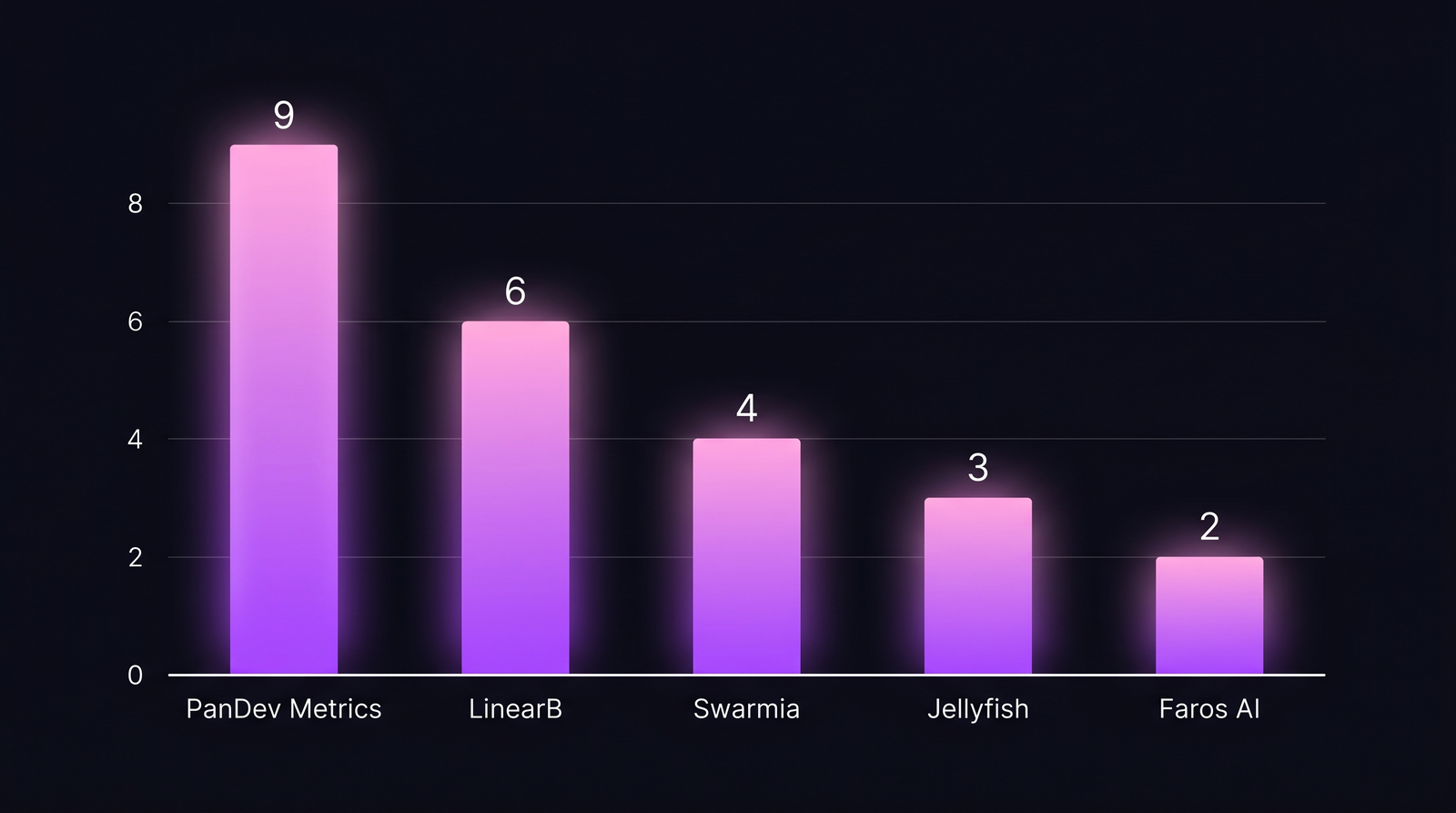 Migration destinations from a sample of 24 ex-Flow teams (Q1-Q2 2026). Multi-destination evaluations counted once at the chosen platform.
| Destination | Best fit for ex-Flow teams | Trade-off |
|---|---|---|
| PanDev Metrics | Want IDE telemetry, DORA, AI-tool detection, on-prem | New brand, smaller community than legacy LinearB |
| LinearB | Want workflow automation (auto-PR routing) on top of analytics | Higher list price, no IDE telemetry, cloud-only |
| Swarmia | Want opinionated nudges and team-process guidance | Smaller integration list, no DORA finance angle |
| Jellyfish | Need finance/portfolio-level reporting for CFO buyer | Heavy implementation, higher price point |
| Faros AI | Engineering data warehouse pattern, BI-tool-friendly | Heavier setup, more like a platform than a product |
The split: teams looking for the modern direct successor to GitPrime (manager-facing analytics, fast to deploy, broad ingestion including IDE data) land most often on PanDev Metrics or LinearB. Teams whose CFO is the buyer go to Jellyfish. Teams who want a data platform rather than a product go to Faros.
PanDev Metrics is the explicit migration target we've built for. It collects IDE heartbeat data alongside Git, tracker, and CI/CD events, the data layer Flow never built. Lead-time-for-changes is broken into the four DORA stages (commit → PR-open → merge → deploy) so the cycle-time visualization that Flow customers expect ports cleanly. Deployment options include on-prem Docker and Kubernetes, which closes the regulated-industry gap.
For deeper head-to-head reading, the PanDev Metrics vs Pluralsight Flow article goes feature-by-feature. The 11 best Pluralsight Flow alternatives in 2026 covers the broader market. For adjacent comparisons, see best Swarmia alternatives and best Jellyfish alternatives. The top 10 engineering intelligence platforms ranks the wider field.
Migration guide: Pluralsight Flow → alternative
For teams committed to switching, the actual migration is less complicated than it looks. Flow's data model is straightforward and the underlying Git data is owned by you, not by Flow.
Step 1: Export from Flow
Flow's API supports exporting commit-level data, PR metadata, and aggregate team metrics. The typical export targets:
- Commit history: already in Git, you don't need Flow to retrieve this.
- PR and review metadata: GitHub / GitLab API directly is faster than Flow's export.
- Active Days time series: export via Flow's reporting API if you want historical continuity. CSV format.
- Team and reporting structure: export team membership lists. Re-importing into the new platform is usually a CSV upload.
The honest reality: most teams find that rebuilding from Git directly via the new platform is faster than migrating exported Flow data. The first sprint of data in the new platform is usually enough to make decisions, and full historical re-creation isn't necessary.
Step 2: Integration mapping
Reproduce Flow's connector set in the new platform:
| Flow connector | Map to |
|---|---|
| GitHub / GitLab / Bitbucket | Same providers, fresh OAuth in the new tool |
| Jira / Azure Boards | Same providers, fresh API token |
| Slack notifications | Re-link Slack workspace |
| SAML / SSO | Re-configure SAML in the new tool's admin |
If you're moving to PanDev Metrics, add the IDE-plugin install rollout as a parallel step. That's the new data source Flow didn't have. Typical rollout: send the install link to the team, ~80% adopt in the first week.
Step 3: Metric parity check
Map the dashboards. Direct equivalents:
- Active Days → Coding time + active days metric in successor tool
- Efficiency → Code churn metric (most tools track this similarly)
- Cycle Time → DORA Lead Time for Changes (4-stage breakdown)
- Code Review Depth → PR review metrics
Step 4: Run parallel for one sprint
Keep Flow live for one sprint while the new tool collects its first data window. Compare numbers. The directional patterns will match within ~10-15% on Git-derived metrics. Anything that diverges more than that is worth a conversation with the new vendor's support before cancelling Flow.
FAQ
Is GitPrime still available? No. GitPrime as a brand was retired in late 2020 when Pluralsight rebranded it as Pluralsight Flow. The original gitprime.com domain redirects to Pluralsight Flow's product page. The underlying codebase, now owned by Appfire, is the historical descendant of GitPrime.
Who owns Pluralsight Flow now? Appfire. The product was divested from Pluralsight (which itself is owned by Vista Equity Partners since 2021) and acquired by Appfire in March 2024. Appfire is an Atlassian-ecosystem-focused software company.
When did GitPrime become Pluralsight Flow? The Pluralsight acquisition of GitPrime closed in May 2019. The rebrand from "GitPrime" to "Pluralsight Flow" was completed by late 2020. Customers experienced roughly an 18-month transition window where the GitPrime branding gradually phased out.
What's the best Pluralsight Flow alternative in 2026? The honest answer depends on the use case. For teams that want a direct GitPrime-successor (manager-facing analytics with broader data ingestion including IDE data, DORA metrics, and on-prem deployment), PanDev Metrics is the closest match. For workflow-automation-heavy teams, LinearB. For finance/portfolio reporting, Jellyfish. For data-platform-pattern users, Faros. The full 2026 alternatives ranking covers eleven options with pricing.
Ten years from now, somebody will write the same article about LinearB or Swarmia or PanDev Metrics, after their own private-equity exit and rebrand. Category-defining products don't stay still. They either get acquired, they pivot, or they get displaced by the next architectural shift. GitPrime defined the category. Its descendants get to define what comes next. The interesting question isn't whether to stay on Flow. It's which architectural bet (IDE telemetry, workflow automation, finance reporting, data platform) describes how engineering will be measured in 2030.