GovTech: Development Transparency for Government Clients

Government clients don't just buy software — they buy accountability. Unlike enterprise B2B deals where a handshake and a Jira board might suffice, government contracts demand documented evidence of progress, process compliance, and resource utilization. The NIST Cybersecurity Framework and FedRAMP authorization process set the bar for what "documented" means — and it's high. For GovTech companies, this creates a unique challenge: how do you provide genuine transparency without drowning your engineering team in reporting overhead?
Engineering metrics, collected automatically, are the answer.
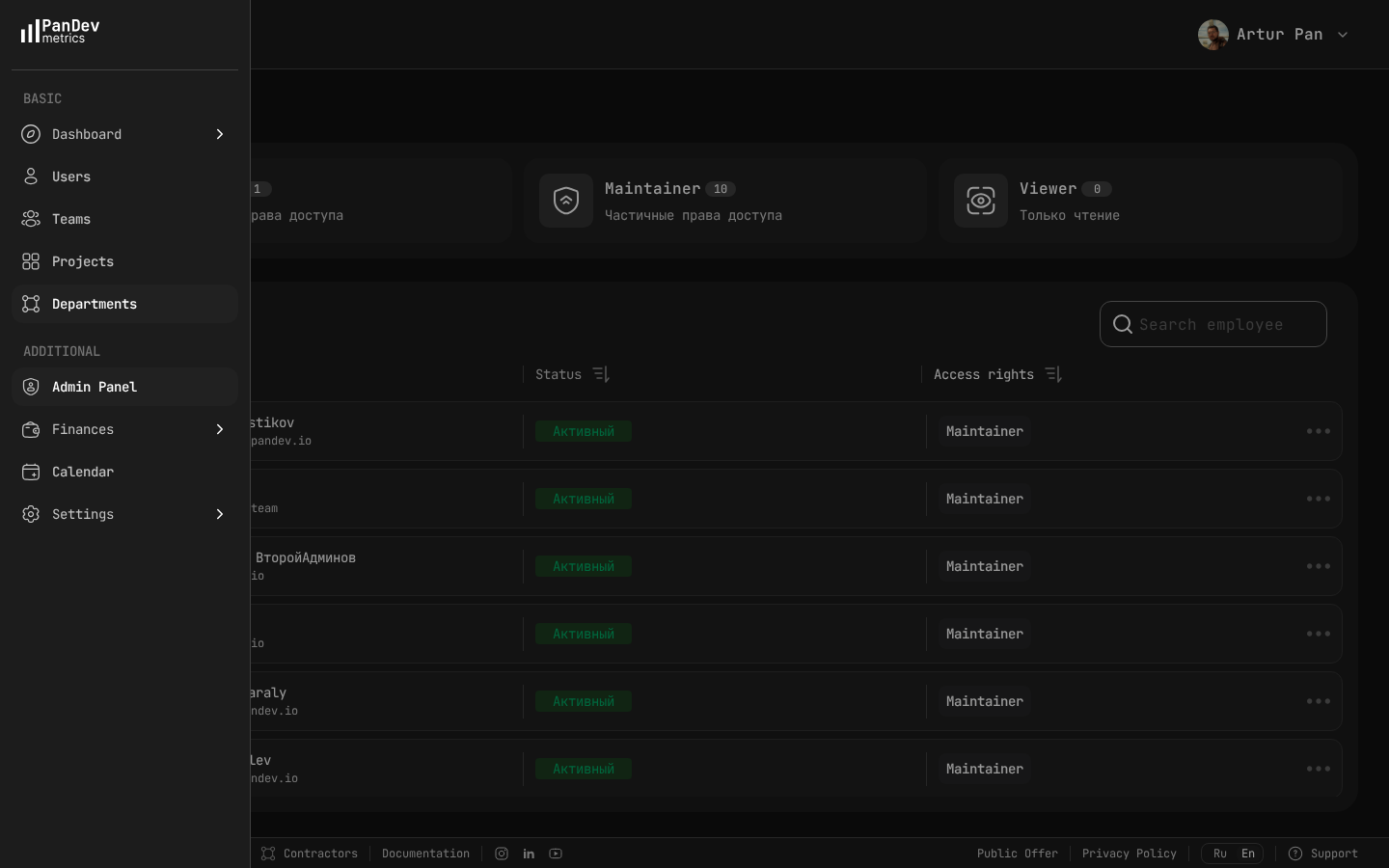
Role-based access control panel — audit-ready permission management.
The GovTech Transparency Problem
Government clients operate under public scrutiny. Every dollar spent on software development can be questioned by oversight bodies, auditors, or the public. This creates a fundamentally different dynamic than private-sector B2B:
Government clients need to prove due diligence. They need documentation that shows they selected the right vendor, that the vendor delivered what was promised, and that taxpayer money was spent effectively.
Progress must be demonstrable, not anecdotal. "The team is making good progress" doesn't satisfy a government project manager who needs to report to an oversight committee. They need quantifiable evidence.
Process compliance is contractual. Many government contracts specify development processes, security practices, and reporting requirements aligned with NIST SP 800-53 controls and the Risk Management Framework (RMF). Failure to comply isn't just a problem — it's a breach of contract.
Timelines are political. Government software projects often tie to legislative deadlines, fiscal year boundaries, or political commitments. Missed deadlines aren't just business problems — they're public embarrassments.
What Government Clients Actually Want to See
Having worked with GovTech companies that serve government clients across multiple jurisdictions, we've identified the key information categories that government stakeholders demand:
1. Development Activity Evidence
Government clients want proof that development is actively happening. This sounds basic, but it's a real concern — there are plenty of cases where vendors took months of payments while making minimal progress.
Engineering metrics provide automatic evidence:
- Deployment frequency shows regular, consistent delivery of new code
- IDE Activity Time aggregated at the team level demonstrates active development effort
- Commit frequency and patterns show consistent work across the reporting period
- Build and CI/CD pipeline activity shows a healthy, active development process
PanDev Metrics captures all of this automatically through Git platform integrations (GitLab, GitHub, Bitbucket, Azure DevOps) and IDE heartbeat tracking.
2. Progress Against Milestones
Government contracts are typically milestone-based. Engineering metrics help you demonstrate progress objectively:
- Lead time for changes shows how quickly work moves from development to delivery
- Deployment frequency trends show whether the team is accelerating, stable, or slowing down
- Feature completion rates correlated with project tracking data from Jira or ClickUp
Instead of subjective status updates ("Feature X is 70% complete"), you can show concrete data: "15 of 22 planned endpoints are deployed and tested. Lead time for the remaining endpoints averages 4 days. We're on track for the milestone."
3. Quality Assurance Evidence
Government software often handles sensitive data — citizen information, financial records, health data. Quality isn't optional.
- Change failure rate demonstrates that your deployment process catches issues before they reach production
- MTTR (Mean Time to Recovery) shows that when issues do occur, they're resolved quickly
- Test coverage trends (correlated with deployment data) show ongoing quality investment
4. Resource Utilization
Government contracts often specify staffing levels or require reporting on how resources are allocated. Engineering metrics provide:
- Activity distribution showing time spent on different project components
- Focus Time metrics demonstrating productive utilization of development resources
- Financial analytics connecting engineering effort to budget line items
PanDev Metrics' financial analytics features are particularly valuable here — they help you demonstrate that engineering resources are being utilized efficiently and allocated appropriately.
5. Security and Compliance Practices
Government clients expect evidence of secure development practices:
- Code review metrics showing that all code goes through mandatory review
- Deployment pipeline data demonstrating that security scanning is part of the process
- Lead time breakdown showing that security gates are respected, not bypassed
Building Automated Transparency Reports
The key to sustainable transparency is automation. If your team spends 20 hours per month preparing reports for government clients, that's 20 hours not spent building software.
The Weekly Development Report
Automate a weekly report that pulls directly from PanDev Metrics:
Development Activity:
- Total deployments this week: [number]
- Deployment frequency trend: [increasing/stable/decreasing]
- Active developers: [number]
- Total Activity Time: [hours]
Quality:
- Change failure rate: [percentage]
- Open issues by severity: [breakdown]
- Issues resolved this week: [number]
Progress:
- Features completed: [list]
- Features in progress: [list with estimated completion based on lead time data]
- Blockers: [any identified blockers]
This report can be generated automatically — no manual data collection needed.
The Monthly Progress Review
Monthly reports for government stakeholders should include:
Milestone Progress:
- Current milestone: [name]
- Planned completion: [date]
- Actual progress: [percentage based on completed vs. planned work items]
- Delivery forecast: [based on current lead time and deployment frequency]
Team Metrics:
- Average deployment frequency: [per week]
- Average lead time: [hours/days]
- Change failure rate: [percentage]
- MTTR: [hours]
Resource Utilization:
- Activity distribution by project component
- Focus Time averages
- Financial summary (if required by contract)
Trends:
- Month-over-month comparison of key metrics
- Identified improvements and their impact
- Risks and mitigation plans
The Quarterly Audit Package
For contracts requiring quarterly audits:
- Complete deployment history with timestamps
- Code review records showing compliance with review policies
- Security scanning results summary
- Incident log with resolution times
- Compliance checklist with evidence links
- Financial reconciliation of engineering resources
On-Premise Deployment: A Government Requirement
Many government contracts require that development tools and data remain within approved infrastructure. PanDev Metrics supports full on-premise deployment, which means:
- No data leaves your network. Engineering metrics, activity data, and reports all stay within your infrastructure or your government client's infrastructure.
- Compliance with data sovereignty requirements. Data can be stored in the jurisdiction required by the contract.
- Integration with government authentication. LDAP/SSO support means the tool fits into existing government identity management systems.
- Air-gapped environments. For high-security contracts, PanDev Metrics can operate in environments without external network access.
This is a critical differentiator. FedRAMP authorization and equivalent national frameworks often require that tools processing government data meet specific deployment and data residency standards. Many engineering analytics tools are SaaS-only, which automatically disqualifies them from most government contracts.
Handling the "Surveillance" Perception
Government clients want transparency. Your engineering team wants autonomy. These can conflict.
The solution: be transparent about transparency.
With your team:
- Explain that metrics are collected for client reporting, not individual performance tracking
- Use team-level aggregates in all client-facing reports
- Let developers see their own data
- Never use activity metrics in performance reviews
With your government client:
- Set expectations about what metrics mean (and don't mean)
- Explain that Activity Time is not the same as "hours worked"
- Frame metrics as process quality indicators, not productivity scores
- Educate stakeholders that lower activity during some periods is normal (architecture planning, design, learning)
GovTech-Specific Metric Considerations
Multi-Vendor Environments
Government projects often involve multiple vendors. Engineering metrics help you demonstrate your team's contribution clearly and avoid blame when other vendors cause delays.
Track lead time carefully: if your team's internal lead time is 3 days but the end-to-end delivery takes 3 weeks, the data shows exactly where the delay occurs.
Security-Cleared Environments
For projects requiring security clearance, engineering metrics need to operate within classified networks. PanDev Metrics' on-premise deployment supports this — the tool runs entirely within the approved environment.
Accessibility and Standards Compliance
Government software must typically meet accessibility standards (WCAG 2.1 AA, Section 508 in the US, EN 301 549 in the EU). Government digital transformation reports, including the UK Government Digital Service playbook and the US Digital Services Playbook, emphasize that accessibility is a first-class requirement, not an afterthought. Track the percentage of development activity going toward accessibility compliance to demonstrate ongoing commitment, not just a checkbox exercise.
Legacy Integration
Government projects frequently require integration with legacy systems. Engineering metrics help you show the cost and complexity of these integrations:
- Lead time for changes involving legacy integration vs. new development
- Change failure rate for legacy-touching code vs. new code
- Activity distribution showing time spent on integration vs. core development
This data helps justify timelines and budgets that might otherwise seem excessive to government stakeholders who don't understand the technical complexity.
Case Example: Structuring Transparency for a Government Contract
Here's how a typical GovTech engagement might structure engineering transparency:
Phase 1: Contract Start (Month 1)
- Deploy PanDev Metrics within approved infrastructure (on-premise)
- Connect Git platform and project tracking tools
- Deploy IDE plugins to the development team
- Establish baseline metrics
- Agree on reporting format and cadence with the government client
Phase 2: Active Development (Months 2-12+)
- Automated weekly reports delivered to the government project manager
- Monthly progress reviews with stakeholder presentation
- Quarterly audit packages for oversight bodies
- Real-time dashboard access for designated government representatives (read-only)
Phase 3: Delivery and Transition
- Complete metrics history available for post-project review
- Documentation of all process improvements driven by metrics
- Final audit package with full project metrics
The Competitive Advantage
In GovTech procurement, transparency is a differentiator. When two vendors bid on a government contract, the one that can demonstrate:
- Automated progress reporting
- Objective quality metrics
- Resource utilization evidence
- Compliance-ready audit trails
...wins the trust of government evaluators who have been burned by opaque vendors before.
Including engineering metrics capability in your proposal signals maturity, accountability, and confidence. You're not just promising transparency — you're showing the mechanism for delivering it.
Getting Started
If you're a GovTech company looking to strengthen your transparency offering:
- Evaluate on-premise deployment requirements for your target government contracts
- Deploy PanDev Metrics within your development infrastructure
- Establish baseline metrics before your next contract begins
- Build report templates that align with common government reporting requirements
- Include metrics capability in your next proposal as a transparency differentiator
Government clients deserve genuine transparency, and your engineering team deserves to provide it without drowning in manual reporting. Automated engineering metrics deliver both.
Building software for government clients? PanDev Metrics — on-premise engineering intelligence that delivers the transparency government contracts demand.