HR + Engineering: Collaboration Playbook for Growing Teams

In 2024, LinkedIn's Workforce Report flagged "HR-Engineering misalignment" as the #2 reason scaling tech teams lose senior engineers, right behind compensation. The usual failure mode: HR designs job ladders on a generic template, Engineering runs calibration as an undocumented side-channel, and two months later the best senior left because their title didn't update with their responsibilities.
This is not an HR problem, and not an Engineering problem. It's a collaboration problem that surfaces every 6-12 months during promotion and compensation cycles. Here's a playbook for making the partnership actually work — who owns what, when, and which data gets shared.
The problem: two functions with overlapping authority and different vocabularies
HR and Engineering Management both influence hiring, leveling, compensation, performance, and retention. The overlap is where things break.
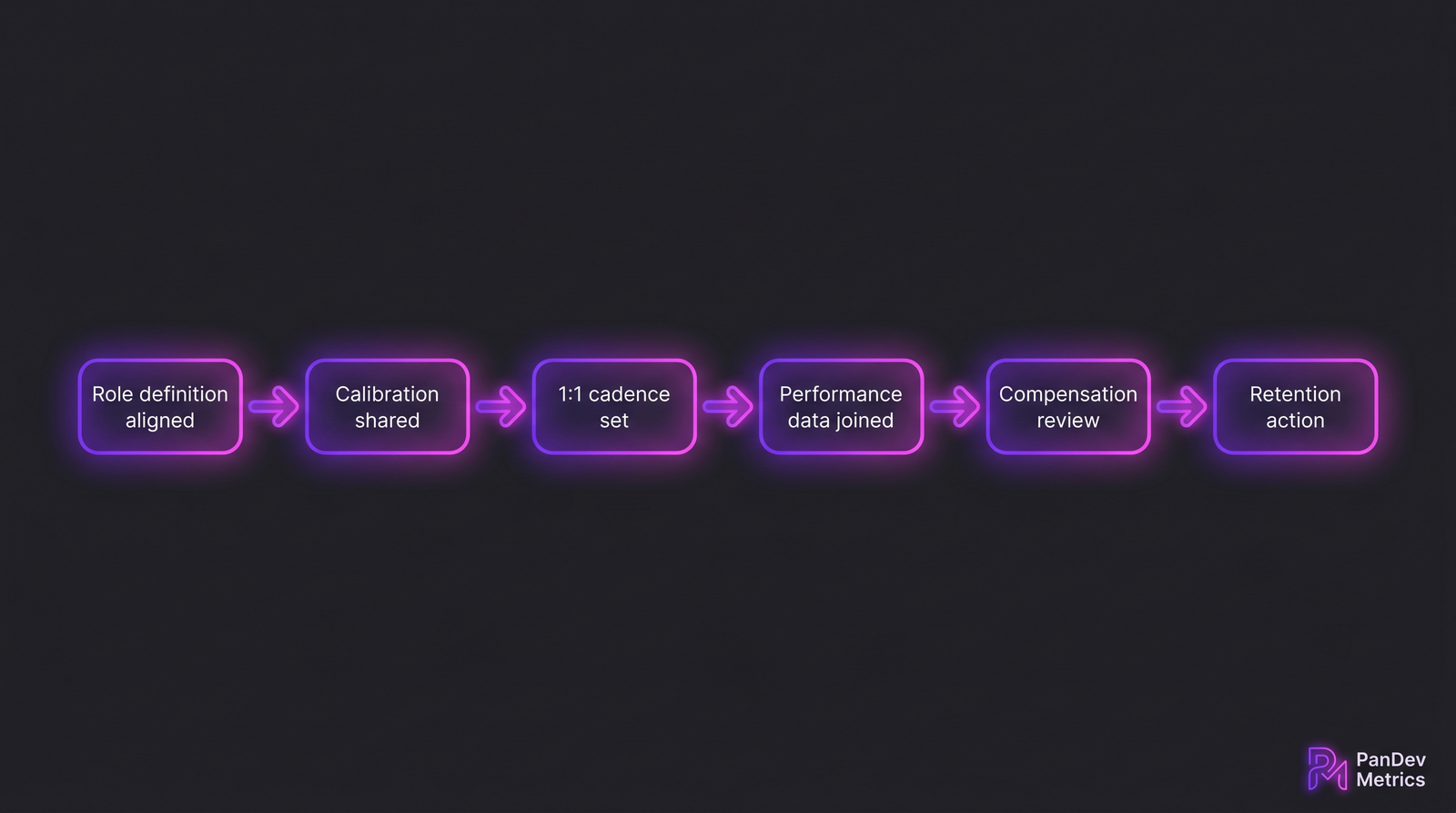 The six-stage HR-Engineering collaboration flow. Each stage has a clear owner and a shared artifact — skipping any stage is where misalignment starts.
A 2023 Deloitte survey of 800 mid-size tech companies (100-1,000 engineers) found:
- 62% had separate level-ups for "HR ladder" and "Engineering ladder" that disagreed for some staff
- 54% of engineering leaders said they didn't know how HR calculated their team's compensation bands
- 48% of HRBPs said engineering leaders never shared 1:1 notes that would have helped with retention conversations
These aren't minor overlaps. They're gaps where senior engineers decide whether to stay.
The framework: who owns what
Role definition — shared artifact, HR owns the document
HR owns the canonical job ladder document. Engineering owns the behavioral expectations at each level. The artifact:
| Level | Title | Years (guide only) | Engineering-owned behaviors | HR-owned compensation band |
|---|---|---|---|---|
| L3 | Mid Engineer | 2-4 | Ships feature w/ guidance; reviews peer PRs | $95k-$125k |
| L4 | Senior Engineer | 4-6 | Owns module; mentors juniors; drives design | $125k-$165k |
| L5 | Staff Engineer | 6-10 | Tech lead for multi-team projects | $160k-$210k |
| L6 | Principal | 10+ | Cross-org impact; architecture ownership | $190k-$260k |
Single source of truth. No "unofficial" ladder in engineering's Notion that disagrees with HR's Workday template.
Calibration — Engineering runs, HR audits
Engineering leads (EMs + Directors) run calibration sessions. HR sits in as process owner — watching for bias patterns, ensuring every engineer gets discussed, checking that the behavioral evidence maps to the ladder document.
The calibration output is a shared artifact: per engineer, current level, proposed level, evidence list, next-cycle plan.
HR should flag (not veto) patterns like:
- Women / URG promoted at lower rates than men in the same cycle
- Senior ICs with 3+ years at level with no path forward
- Engineers whose level stayed flat but scope grew materially
Google's 2024 paper on calibration bias (Anderson et al.) showed that adding an HR observer who only flagged patterns — without vetoing decisions — reduced promotion-bias gaps by 31% over four cycles. The mechanism: engineers don't like defending rationale they wouldn't write down. An auditor changes what gets said out loud.
Compensation — HR runs market data, Engineering runs performance weighting
HR owns the compensation band logic: market data (Radford, Pave, Levels.fyi), geographic adjustments, equity bands. Engineering owns how individuals sit within the band based on performance.
The shared artifact each cycle:
| Engineer | Level | Current comp | Band percentile | Performance rating | Proposed adjustment | Rationale |
|---|---|---|---|---|---|---|
| A. Chen | L4 | $142k | 60th | Exceeds | +$8k | Took over auth module ownership Q2 |
| B. Kim | L4 | $158k | 85th | Meets | +$3k (COL) | Compensation ceiling, retention at risk |
| C. Rao | L5 | $175k | 40th | Exceeds | +$18k | Below-band for current scope, fix |
A comp cycle without this table is HR and Engineering guessing at each other.
1:1 data — Engineering's, but HR sees aggregates
This is the touchiest handoff. Engineering managers' 1:1 notes should stay private to the manager-engineer relationship. But aggregate signal — "three of my senior engineers mentioned interview calls from competitors this quarter" — should flow to HRBP discreetly.
A usable model:
- EM keeps 1:1 notes private
- EM uses a lightweight weekly "retention temperature" score per report (green / yellow / red)
- HRBP sees rolled-up color distribution by team — not individual notes
- Yellow or red triggers a joint conversation (not a surveillance loop)
The contrarian part: do not centralize 1:1 notes into a shared system. Engineers correctly perceive this as surveillance and start to self-censor. Harvard Business Review's 2023 study on psychological safety in tech orgs found that teams with "shared 1:1 repositories" reported 41% lower candor in subsequent quarterly surveys than teams with private 1:1 notes. The management instinct to "have visibility" destroys the signal you're trying to see.
Performance reviews — co-owned, with distinct data inputs
Performance review season is where HR and Engineering data should actually combine. Engineering contributes:
- Project delivery evidence (what shipped, scope, complexity)
- Peer and cross-functional feedback
- Technical depth signals (design docs, code review quality)
HR contributes:
- Goal-setting compliance (were SMART goals filed)
- Calibration-session evidence
- Comp-vs-market context
IDE telemetry does not go into performance reviews. Neither does commit count, PR count, or lines of code. These measure activity, not outcome, and using them in a review is the single most common way engineering orgs lose trust in their review process. We covered this at length in our performance-review-data post — the short version: use delivery evidence, not activity metrics.
Retention — joint ownership, fast trigger
When an engineer gives notice, the conversation isn't "HR owns offboarding." The EM owns the relationship-level recovery attempt; HR owns the structural response (what comp or title levers are available, legal constraints around counter-offers, policy consistency).
Retention conversations should trigger within 24h of notice. Speed matters: a 2024 First Round Review analysis of 200+ tech exits found that counter-offers accepted within 48h had a 60% 12-month stick rate; those accepted after 7+ days had a 12% 12-month stick rate. Late counter-offers rarely work.
Red flags in the partnership
| Signal | What it means | Fix |
|---|---|---|
| Eng leads don't know comp bands | HR not sharing market data | Monthly shared comp review |
| HRBP sees 1:1 notes directly | Psychological safety collapsing | Switch to aggregate temperature |
| Job ladder not updated in 12+ months | Policy drift from reality | Quarterly ladder review |
| Calibration sessions <90 min for 50 engineers | Superficial review | Block 3h minimum |
| Counter-offer decisions take >3 days | Bureaucratic retention loss | Pre-authorize delegated comp levers |
| Performance reviews cite activity metrics | Trust risk | Rewrite rubric around delivery |
How to measure if this is working
Track quarterly:
- Promotion-rate parity across demographic groups (HR owns this analysis)
- Regrettable attrition rate by team (< 8% annual for senior ICs is healthy)
- Comp-band positioning distribution — nobody below the band, few above it
- Time-to-fill for senior engineering roles (> 90 days suggests band / ladder misalignment)
PanDev Metrics contributes team-health signal to the HR partnership — specifically the burnout-pattern detection that surfaces who is over-extended before they start interviewing. The system watches for the 5 patterns we documented (after-hours work clusters, weekend spikes, vacation-gap work, single-dev overload, feature-delivery slowdown) and alerts the EM, not HR, first. EMs then decide whether the signal belongs in a 1:1 or an HR conversation.
Honest limit: our data predicts capacity strain, not resignation intent. An engineer running hot might love their job, and an engineer with calm telemetry might already be interviewing. Treat burnout signals as input to a conversation, not as a verdict.
When this playbook doesn't fit
- Teams under 20 engineers — most of this is overhead; a single founder or VP of Eng can do all of these functions informally
- Outsourcing / staff-aug models — the partnership model here is with the agency PM, not internal HR; see our staff augmentation visibility guide
- Heavily unionized environments — collective bargaining constrains what HR and Engineering can negotiate individually; many of these levers don't exist
The partnership breaks most often at the 40-150 engineer band, where the company is too big to be informal and too small to have full HRBP coverage per engineering group. That's the zone to invest in this deliberately.