Engineering Leaderboards: Motivation or Demotivation? How to Set Them Up Right

You're considering adding a leaderboard to your engineering team. Maybe your platform already has one. The idea sounds straightforward: show who's contributing the most, and everyone will be motivated to contribute more.
In reality, leaderboards are the most polarizing gamification feature in engineering. Self-Determination Theory (Deci & Ryan) warns that extrinsic ranking systems can undermine intrinsic motivation — but research also shows that well-designed recognition systems boost engagement. Done right, they create healthy engagement and visibility. Done wrong, they create anxiety, gaming, and resentment.
Here's how to get them right.
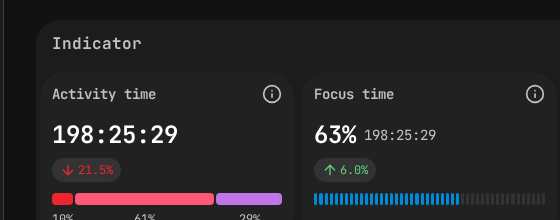
Individual developer metrics — the data that feeds team leaderboards.
Why Leaderboards Are Tempting
The appeal is obvious. Leaderboards provide:
- Visibility: Leadership can see who's active and engaged
- Recognition: Top contributors get acknowledged
- Motivation: Competitive developers push harder
- Benchmarking: Individuals can see where they stand
PanDev Metrics includes ranking features across nearly 1,000 users at 100+ B2B companies. We've seen what works and what doesn't across a wide range of team cultures. The patterns are clear — and the mistakes are predictable.
The Case Studies: When Leaderboards Go Wrong
Before discussing best practices, let's understand the failure modes.
Failure Mode 1: The Activity Arms Race
What happens: The leaderboard ranks developers by total coding hours. Developers start gaming the metric — keeping their IDE open during lunch, making unnecessary file saves, or staying late to inflate numbers.
The result: Hours go up. Actual output doesn't change. Burnout increases. The developers who refuse to game the system feel penalized for being honest.
Root cause: The leaderboard measures the wrong thing (input) rather than something meaningful.
Failure Mode 2: The Demoralization Spiral
What happens: A permanent leaderboard shows the same 3 developers at the top month after month. Everyone else sees they can never catch up. Mid-tier developers feel invisible. Bottom-tier developers feel shamed.
The result: 3 developers are motivated. 20 are demoralized. The leaderboard becomes a tool for the already-motivated to feel good while discouraging everyone else.
Root cause: Permanent cumulative rankings create an unwinnable game for most participants.
Failure Mode 3: The Collaboration Killer
What happens: Individual rankings pit team members against each other. Developer A stops helping Developer B because time spent helping is time not spent coding. Code reviews become perfunctory because reviewing someone else's code helps them, not you.
The result: Individual metrics go up. Team performance degrades. Knowledge silos form.
Root cause: Individual competition undermines team collaboration.
Failure Mode 4: The Quiet Exodus
What happens: Senior developers — often the most valuable — find leaderboards beneath them. They see the feature as "management playing games" and lose respect for the engineering culture. Some start job searching.
The result: The developers you can least afford to lose are the most alienated by the leaderboard.
Root cause: One-size-fits-all gamification that ignores the preferences of different developer personas.
The Principles of Good Leaderboards
Understanding the failure modes points to the principles that make leaderboards work.
Principle 1: Measure What Matters (And Is Hard to Game)
The worst leaderboard metrics:
- Lines of code
- Number of commits
- Hours logged
- Number of PRs opened
These are all gameable and don't correlate well with actual value.
Better leaderboard metrics:
- Consistency: Active coding days in a month (rewards sustained engagement, not spikes)
- Breadth: Number of languages or projects contributed to (rewards versatility)
- Collaboration: Code reviews completed with meaningful feedback
- Learning: New tools or languages explored
- Improvement: Week-over-week coding hour growth (rewards personal progress)
PanDev Metrics tracks actual IDE coding activity via heartbeats — which is harder to game than commit counts — and offers metrics like consistency streaks and language breadth that reward positive behaviors.
Principle 2: Timeboxed, Not Permanent
Permanent leaderboards create "the rich get richer" dynamics. The developer who's been on the team for 3 years will always outrank the one who joined last month.
Better approach: Reset leaderboards regularly.
- Weekly sprints: "This week's most active contributors"
- Monthly challenges: "February consistency challenge"
- Seasonal themes: "Q1 code review champion"
Timeboxed leaderboards give everyone a fresh start regularly. Last month's bottom-ranker can be this month's top contributor. This creates hope and engagement rather than resignation.
Principle 3: Team Leaderboards Over Individual
Instead of ranking Developer A against Developer B, rank Team Alpha against Team Beta. Or rank the whole team against their own previous performance.
Team leaderboards:
- Encourage collaboration (helping a teammate helps your team's score)
- Distribute recognition (the whole team celebrates, not just the top 3)
- Reduce individual anxiety (no one is singled out)
- Build camaraderie (shared goals create shared identity)
Practical example: "Team Alpha logged 250 coding hours this sprint — their best in 3 months!" This celebrates the team without creating individual winners and losers.
Principle 4: Multiple Dimensions, Not One Ranking
A single leaderboard creates one definition of "best." Multiple leaderboards allow different developers to shine in different dimensions:
- The Consistent Contributor: Most active coding days
- The Polyglot: Most programming languages used
- The Reviewer: Most code reviews completed
- The Newcomer: Fastest ramp-up this quarter
- The Mentor: Most pair programming sessions
Different developers value different things. Multiple dimensions mean more people get recognition for the things they're genuinely good at.
Principle 5: Opt-In, Always
This is non-negotiable. Any developer who doesn't want to appear on a leaderboard should be able to opt out without stigma. The leaderboard should be visible to those who enjoy it and invisible to those who don't.
In practice, making leaderboards opt-in doesn't kill engagement. The developers who enjoy competition opt in enthusiastically. The others appreciate being respected.
Principle 6: Celebrate the Middle, Not Just the Top
Most leaderboard designs highlight the top 3 and ignore everyone else. This demotivates the majority. Instead:
- Highlight personal bests: "You had your most productive week since January"
- Celebrate milestones: "You crossed 100 total coding hours"
- Show improvement: "You moved up 5 positions from last month"
- Acknowledge participation: "23 out of 25 team members were active this week"
Recognition for progress and participation is more motivating for most people than recognition for absolute performance.
Implementation Guide
Phase 1: Start Small
Don't launch with a public, individual, permanent leaderboard. Start with:
- A team-level weekly activity summary
- Individual progress dashboards (visible only to each developer)
- One timeboxed challenge (e.g., "February consistency challenge")
Gauge the reaction. If the team engages positively, expand gradually.
Phase 2: Add Dimensions
After 1-2 months, introduce multiple leaderboard dimensions:
- Consistency (active days)
- Breadth (projects/languages)
- Collaboration (reviews)
Let developers choose which dimensions they care about.
Phase 3: Introduce Opt-In Individual Rankings
If — and only if — the team culture is positive about gamification, add opt-in individual rankings. Make them:
- Timeboxed (weekly or monthly resets)
- Multi-dimensional (not just one ranking)
- Positive-framed (celebrate personal bests, not just absolute position)
Phase 4: Iterate Based on Feedback
Run an anonymous survey after 3 months:
- "Do you enjoy the leaderboard features? (Yes / Somewhat / No)"
- "Have leaderboards affected your behavior in any way?"
- "Do you feel the leaderboards are fair?"
- "What would you change?"
Adjust based on the feedback. If a significant portion of the team finds the leaderboards stressful, scale them back. If people want more, expand.
Red Flags to Watch For
Gaming Behavior
If you see unusual activity patterns — sudden spikes in commits, unusually long IDE sessions with no corresponding output, or developers making trivial changes to climb the rankings — the leaderboard is measuring the wrong thing. Redesign the metrics.
Reduced Collaboration
If code review quality drops, pair programming declines, or developers stop helping each other, the leaderboard may be creating perverse individual incentives. Shift to team-level metrics.
Consistent Negative Feedback
If more than 30% of the team reports negative feelings about the leaderboard in surveys, something is wrong. Take it seriously. Scale back or redesign.
Top-Heavy Engagement
If only the top 5 developers are engaged with the leaderboard and everyone else ignores it, the system is rewarding the already-motivated without helping the rest. Add middle-tier recognition and personal progress tracking.
The PanDev Approach
PanDev Metrics implements leaderboards with these principles in mind:
- Employee rankings are available but designed for positive engagement
- Levels and XP provide individual progression without requiring comparison
- Badges and achievements recognize diverse accomplishments
- SVG badges for README let developers showcase achievements on their own terms
- Activity data is based on IDE heartbeats, which are harder to game than commit counts
The goal is always recognition and engagement, not surveillance and competition.
When NOT to Use Leaderboards
Be honest about when leaderboards are inappropriate:
- During layoffs or restructuring: Adding gamification when people fear for their jobs is tone-deaf
- In low-trust environments: If the team doesn't trust management, leaderboards will be seen as surveillance. Fix the trust first. Google's Project Aristotle research found that psychological safety is the #1 predictor of team performance — leaderboards in unsafe environments destroy it.
- For performance evaluation: Never tie leaderboard position to bonuses, promotions, or PIPs
- In very small teams: In a team of 3-4, everyone knows where they stand. A leaderboard adds formality without value.
- When the team explicitly rejects it: If your team says they don't want leaderboards, respect that. Forced gamification is worse than no gamification.
Conclusion
Engineering leaderboards are powerful tools that can go very wrong or very right. The difference lies in the design:
Wrong: Permanent, individual, single-metric, mandatory, tied to evaluation.
Right: Timeboxed, team-oriented, multi-dimensional, opt-in, focused on recognition.
If you're implementing leaderboards for your engineering team, start small, measure the impact, listen to feedback, and be willing to change course. The goal is a team that's energized and engaged — not one that's stressed and gaming metrics.
Leaderboards designed for motivation, not anxiety. PanDev Metrics offers employee rankings, levels, and achievements built around positive engagement — with opt-in design and multi-dimensional recognition.