Monday vs Friday: When Do Developers Write Their Best Code? (Data from 100k Engineers)

Every engineering manager has a gut feeling about their team's weekly rhythm. Monday feels slow. Friday feels like a wind-down. But what does the data actually show?
We analyzed thousands of coding hours from developers across 100+ B2B companies to map developer productivity across the work week — and the results challenge some common assumptions.
The Data
PanDev Metrics tracks IDE heartbeats — timestamped records of active coding sessions. This isn't self-reported time. It's measured, second by second, across every language and IDE. Our dataset includes extensive activity data, giving us granular visibility into when and how much developers code.
We aggregated coding time by day of week across all tracked developers, normalizing for holidays and partial weeks.
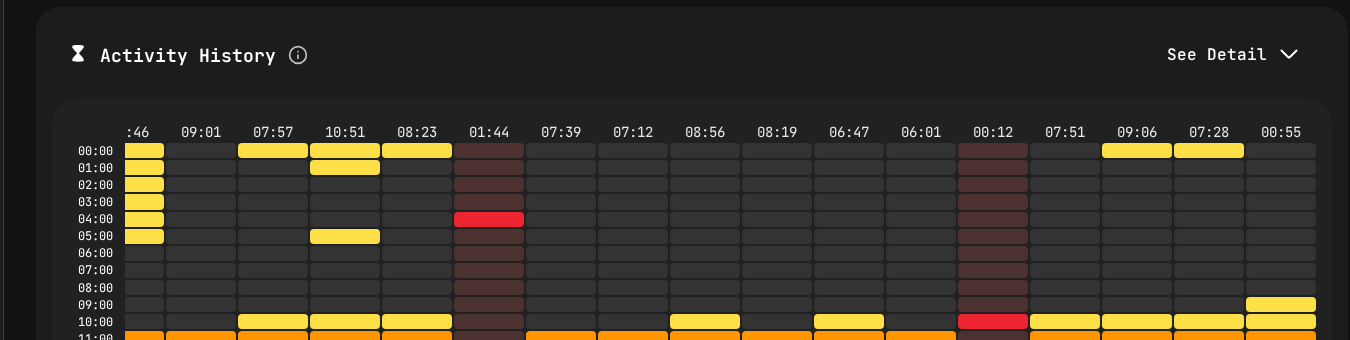 The activity heatmap visualizes the weekly productivity pattern — you can clearly see which days and hours produce the most coding activity.
The Weekly Productivity Curve
Here's what the week looks like, ranked by total coding activity:
| Rank | Day | Relative Activity | Notes |
|---|---|---|---|
| 1 | Tuesday | Highest | Peak productivity day |
| 2 | Wednesday | High | Sustained deep work |
| 3 | Thursday | High | Slight decline begins |
| 4 | Monday | Moderate | Slow start, builds through day |
| 5 | Friday | Lower | Noticeable drop-off |
| 6 | Saturday | Low | Occasional work |
| 7 | Sunday | Lowest | Minimal activity |
The shape is consistent across companies, team sizes, and tech stacks. Tuesday is the peak day. Sunday is the valley.
Monday: The Warm-Up Day
Monday starts slow. The first few hours are consumed by:
- Sprint planning and standups — most teams front-load organizational meetings to Monday
- Context reloading — developers need to remember where they left off Friday
- Email and Slack catch-up — weekend messages, deployment alerts, customer issues
- Pull request reviews — code submitted Friday often waits until Monday for review
By Monday afternoon, coding activity picks up noticeably. Developers have re-established context, cleared their inboxes, and identified their highest-priority tasks.
The Monday Fix
The most productive teams in our dataset minimize Monday organizational overhead. Strategies include:
- Friday context notes: Developers write a 2-3 sentence note before leaving Friday about what they'll pick up Monday
- Async standups on Monday: Replace the synchronous meeting with a Slack thread
- Protected Monday afternoon: No meetings after 1 PM on Mondays
These small changes can recover 1-2 hours of Monday coding time per developer.
Tuesday: The Peak
Tuesday is where the magic happens. By Tuesday morning, developers have:
- Full context from Monday's planning
- Clear priorities for the sprint
- Resolved blockers identified Monday
- A fresh, focused mind after Monday's warm-up
The result is the highest concentration of deep coding sessions in the entire week. Long, uninterrupted stretches of 2+ hours are most common on Tuesdays.
This finding has direct implications for meeting policies. If your Tuesday calendar is full of meetings, you're cutting into your team's single most productive day. Guard it fiercely.
Wednesday and Thursday: The Sustain
Wednesday and Thursday maintain high productivity, though with a slight declining trend. This mid-week block is where the majority of a sprint's coding work gets done.
Wednesday often shows slightly more collaborative activity — code reviews, pair programming, technical discussions — as work started Monday/Tuesday reaches the point where feedback is needed.
Thursday begins the psychological wind-down toward the weekend. Developers start avoiding complex new tasks and focus on finishing in-progress work.
Friday: The Taper
Friday shows a clear productivity drop. But contrary to the "nobody works on Friday" stereotype, it's not a wasted day. The activity that happens on Friday tends to be different in nature:
- Code reviews — finishing the review cycle for the week's work
- Documentation — updating README files, writing ADRs, commenting code
- Small fixes and cleanup — addressing tech debt items that don't require deep focus
- Deployment preparation — staging, testing, and verifying changes for release
Friday isn't unproductive. It's differently productive. Smart engineering managers plan for this by assigning Friday-appropriate work: reviews, documentation, small bug fixes, and refactoring tasks that don't require starting complex new logic.
The Friday Deploy Debate
A common question: should teams deploy on Fridays? Our data doesn't directly answer this, but the lower Friday activity level suggests that if something goes wrong with a Friday deploy, fewer people are in a deep coding flow that would be disrupted by incident response.
That said, most experienced teams still avoid Friday deploys. The cost of a failed Friday deployment (weekend on-call, stressed team, missed family time) outweighs the benefit of shipping one day earlier.
Weekend Work: A Health Check
Weekend coding activity in our dataset is minimal — especially Sunday. But it's not zero, and the pattern is informative.
Saturday occasionally sees activity from:
- Developers working on side features they're passionate about
- On-call engineers addressing production issues
- Teams in crunch mode before a deadline
Sunday is the lowest point. When we do see Sunday activity, it's almost always one of two things: genuine passion projects or a team in trouble.
Weekend Work as a Team Health Metric
We recommend tracking the ratio of weekend coding hours to weekday coding hours at the team level. A ratio below 5% is normal (some people enjoy weekend coding). A ratio consistently above 10% warrants investigation:
- Is the sprint scope realistic?
- Are deadlines externally imposed and unreasonable?
- Is the daytime environment too meeting-heavy for focused work?
- Is the team understaffed?
You don't need to ban weekend work. You need to ensure it's optional, not necessary.
Cross-Company Patterns
One of the advantages of analyzing data from 100+ B2B companies is that we can spot patterns that hold across different contexts.
The Tuesday peak and Sunday valley are universal. GitHub Octoverse commit pattern data confirms a similar mid-week peak across millions of repositories. We see the pattern in:
- Small startups (10-20 developers) and mid-size companies (100+)
- Teams working in Java, TypeScript, Python, and PHP
- Companies across different time zones
- Both remote-first and office-based organizations
The only variation is intensity. Some companies show a sharper Monday-to-Tuesday ramp, suggesting more Monday overhead. Others have a flatter profile, suggesting better async practices that reduce the Monday warm-up penalty.
Practical Recommendations
For Engineering Managers
-
Protect Tuesday and Wednesday for deep work. Minimize meetings on these days. If your team can only have two meeting-free days, make them Tuesday and Wednesday.
-
Redesign Monday. Accept that Monday is a transition day. Front-load your organizational work here so the rest of the week is clear.
-
Plan Friday for completion, not creation. Assign code reviews, documentation, and cleanup tasks for Friday. Don't start new features.
-
Track your team's weekly curve. Use PanDev Metrics to see your specific team's pattern. If your team peaks on Thursday instead of Tuesday, adapt your processes to fit.
For Individual Developers
-
Schedule your hardest problems for Tuesday. That complex algorithm, the tricky refactoring, the architectural decision — do it when your focus is sharpest.
-
Use Monday to set up the week. Review your tickets, ask clarifying questions, set up your branch. Don't feel guilty about low Monday output.
-
Front-load your week. If something can be done Tuesday or Thursday, choose Tuesday. The Thursday version of you will be less focused.
-
Use Friday for debt. Address those TODOs you've been ignoring. Review pull requests. Write the tests you skipped.
Conclusion
The weekly productivity curve — peaking Tuesday, declining through Friday, minimal on weekends — is one of the most consistent patterns in our data. This aligns with Cal Newport's Deep Work thesis: sustained focus requires both cognitive readiness and freedom from organizational overhead. Tuesday delivers both. It's not a bug. It's a feature of how human attention and organizational rhythms interact.
The smartest teams don't fight this pattern. They design around it. They protect the peak, accept the warm-up, and use the taper for work that doesn't require deep focus.
Your team probably follows this pattern too. The question is: are your processes helping or hurting it?
See your team's weekly rhythm. PanDev Metrics visualizes coding activity by day of week — so you can optimize your sprint schedule around real data.