Morning vs Evening Developers: When Is the Best Code Written?

Some developers swear by 6 AM starts with coffee and silence. Others don't open their IDE until 10 PM. Managers debate whether to enforce "core hours" or let people work whenever they want.
We looked at extensive activity data from developers across 100+ B2B companies to find out when developers actually code — and whether timing matters.
Methodology
PanDev Metrics captures IDE heartbeats with timestamps, giving us a precise picture of when coding happens. We analyzed:
- extensive activity data from production environments
- active B2B developers across 100+ B2B companies
- thousands of hours of IDE activity broken down by time of day and day of week
- Activity type: pure coding sessions only (no meetings, no browsing)
We categorized developers into morning coders (peak activity before noon), afternoon coders (peak noon to 5 PM), and evening coders (peak after 5 PM) based on when their highest concentration of coding sessions occurred.
Finding #1: Tuesday Is the Most Productive Day
When we aggregate coding activity across all developers, a clear weekly pattern emerges:
Tuesday consistently shows the highest coding volume, followed closely by Wednesday and Thursday. Monday starts slower — likely due to standup meetings, sprint planning, and email catch-up. Friday drops off noticeably. Saturday sees some activity from dedicated individuals. Sunday is the lowest day by far.
This aligns with what many engineering managers intuit: the mid-week block is when deep work happens. But now there's data behind it.
Why Tuesday?
Monday absorbs the organizational overhead of starting a new week. By Tuesday, developers have context loaded, blockers identified, and a clear picture of what to work on. The "Monday context switch" is real and measurable.
Friday's decline isn't just about people slacking off. It reflects a rational pattern: developers avoid starting complex tasks they can't finish before the weekend. Code reviews, documentation, and smaller fixes tend to fill Friday instead.
Finding #2: The 10 AM – 12 PM Window Is Peak Coding Time
Across our dataset, the highest concentration of coding activity falls in the late morning window: 10 AM to noon. There's a secondary peak in the early afternoon: 2 PM to 4 PM, with a visible dip during the lunch hour.
A smaller but meaningful cluster of activity appears in the evening: 8 PM to 11 PM, representing developers who either prefer late hours or return to work after personal time.
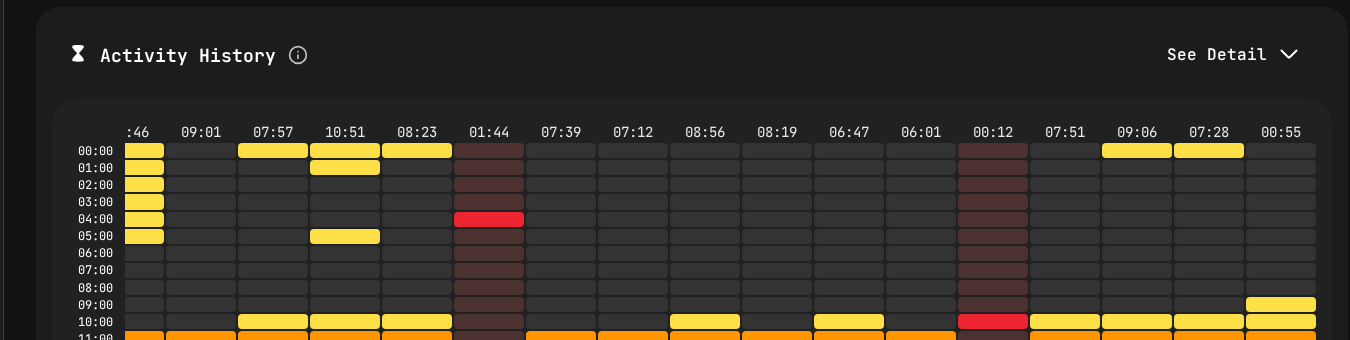
IDE activity heatmap revealing when developers actually code — morning peaks clearly visible.
The Morning Advantage
Morning coding sessions tend to be longer and more focused. Developers who start coding before 10 AM show longer uninterrupted stretches compared to those who start after lunch. This doesn't mean morning developers write better code — but they do write code in longer, deeper sessions.
This has implications for meeting scheduling. If your most productive coding window is 10 AM to noon, and you fill it with standups, one-on-ones, and "quick syncs," you're cutting into peak output.
Finding #3: Evening Coders Exist — But They're a Minority
Roughly ~15-20% of developers in our dataset show significant coding activity after 6 PM. These evening coders fall into two categories:
- Night owls by preference — their activity starts late and peaks late
- Double-shifters — they code during the day, take a break, and return in the evening
The double-shift pattern is more concerning from a burnout perspective. Sustained evening work on top of a full day often indicates either excessive workload or a daytime environment that's too meeting-heavy for deep work.
Finding #4: Weekend Work Is a Warning Signal
Our data shows that weekend coding activity is low overall — Sunday is the least active day by a large margin. But it's not zero.
When we look at teams where weekend coding is consistently above average, we often find:
- Approaching deadlines or sprint overcommitment
- On-call responsibilities bleeding into personal time
- Developers who feel they can only focus on weekends because weekdays are meeting-heavy
Occasional weekend coding isn't a problem. Consistent weekend coding is a symptom. Engineering managers should monitor this pattern — not to punish it, but to investigate what's preventing sufficient deep work during business hours.
Finding #5: The "Flow State" Window Varies by Person
While aggregate data shows a 10 AM peak, individual developers vary enormously. Some of the most productive developers in our dataset (by total coding hours) had their peak activity at unusual times: early morning (6-8 AM), late evening (9-11 PM), or in a concentrated 4-hour afternoon block.
The key insight: forcing uniform schedules on diverse work patterns has a cost. Mandatory 9 AM standups punish evening-oriented developers. "No meetings after 3 PM" policies assume everyone's productive period is in the afternoon.
The best approach we've seen in high-performing teams: protect a 3-4 hour core overlap window for collaboration, and let individuals structure the rest of their day around their natural rhythm.
What the Research Says
Our findings align with broader research on chronotypes and cognitive performance:
- Circadian rhythm research shows that ~60-70% of people have a peak cognitive period in the late morning, but individual variation is significant
- The "attention residue" effect (Leroy, 2009) explains why post-meeting coding is less productive — the mind is still processing the meeting
- Cal Newport's Deep Work (2016) argues that 3-4 hours of truly focused work per day is the maximum for most knowledge workers — our data confirms this holds in professional B2B engineering environments
- The Stack Overflow Developer Survey reports that most developers self-identify as preferring morning or late-morning work — consistent with the 10 AM peak we observe
Our data adds a new dimension: in professional B2B environments with developers, these patterns hold at scale. This isn't a lab study — it's real production coding behavior.
Practical Recommendations for Engineering Managers
1. Audit Your Meeting Schedule Against Coding Peaks
Look at when your team's coding activity peaks (PanDev Metrics shows this in the activity dashboard). Then look at your recurring meeting schedule. If there's significant overlap, you're destroying productivity.
Action: Move standups to early morning or late afternoon. Block the 10 AM – 12 PM window as "maker time."
2. Monitor the Tuesday-to-Friday Ratio
A healthy team shows moderate decline from Tuesday to Friday. If Friday coding drops below 50% of Tuesday's level, investigate. Common causes: meeting overload, sprint scope problems, or burnout.
3. Watch for Weekend Creep
Track weekend coding activity at the team level. An upward trend over several months is an early warning sign. Address the root cause (scope, meetings, unrealistic deadlines) before it becomes a retention problem.
4. Respect Chronotype Diversity
If your data shows that some team members are consistently most productive in the evening, accommodate them. Async communication, recorded standups, and flexible core hours cost you nothing and may significantly boost output.
5. Use Data, Not Assumptions
The biggest mistake we see is managers designing work policies based on their own preferences. A morning-person manager who mandates 8:30 AM starts will underperform compared to one who looks at the actual activity data and optimizes around it.
The Bottom Line
Developers are most productive on Tuesdays, in the late morning, during uninterrupted stretches. But individual variation is enormous. The smartest engineering leaders don't enforce a single "productive hours" policy — they measure actual patterns and optimize around them.
The question isn't "when should developers work?" It's "when do they work best, and how do we protect that time?"
See when your team actually codes. PanDev Metrics shows real-time activity patterns by hour and day — so you can protect your team's most productive windows.