Pomodoro for Engineering: Does It Work for Coding? (Data)

The Pomodoro Technique says work for 25 minutes, break for 5, repeat. Francesco Cirillo invented it in the late 1980s for studying. Not for coding. Not for the kind of flow-state work engineers do. We looked at IDE heartbeat patterns from engineers who self-identify as Pomodoro users versus engineers who don't, and the results are uncomfortable for the method: strict 25/5 Pomodoro users averaged 42 minutes of actual focused coding per day. Engineers who ignored the timer averaged 2 hours 12 minutes. The timer was, for most of them, a scheduled interruption engine.
This isn't an anti-Pomodoro article. It's a data-driven look at why 25 minutes is the wrong interval for coding work and what intervals actually match how engineers flow. Cal Newport's Deep Work already argued this conceptually. What we can add is telemetry — our IDE data shows the specific breakpoints where coding sessions do and don't recover from interruption. The Pomodoro format interrupts right at the wrong place.
Why this number is hard to find
Most Pomodoro research is self-reported. Someone claims they did "8 pomodoros today" — but did they actually code during them, or did they check Slack twice and answer a DM?
We have a different signal: IDE heartbeat data. Every 1-2 minutes, the editor pings us with "user is active in this file, this project, this language". We can see exactly when typing and reading stop, when context switches happen, when a "25-minute focus block" is actually 8 minutes of code plus a 17-minute detour. This bypasses self-report entirely.
UC Irvine's Gloria Mark — the researcher whose "23-minute refocus time" finding underpins most deep-work writing — explicitly warned in her 2023 book Attention Span that self-reported productivity technique adherence correlates poorly with measured focus. Her conclusion: "People report using techniques they don't actually follow, and report success they haven't actually achieved."
Our dataset
- 100+ B2B companies across KZ, UZ, RU, EU, US
- ~940 engineers with continuous IDE heartbeat for 6+ months
- Among them: 127 who self-identified as active Pomodoro users (in product surveys or opted-in tagging)
- Data collected Q4 2025 through Q1 2026
- Methodology: we segmented by self-reported technique, not by observed timer patterns — an important caveat
What the data shows
Finding 1: Strict 25/5 doesn't match how code ships
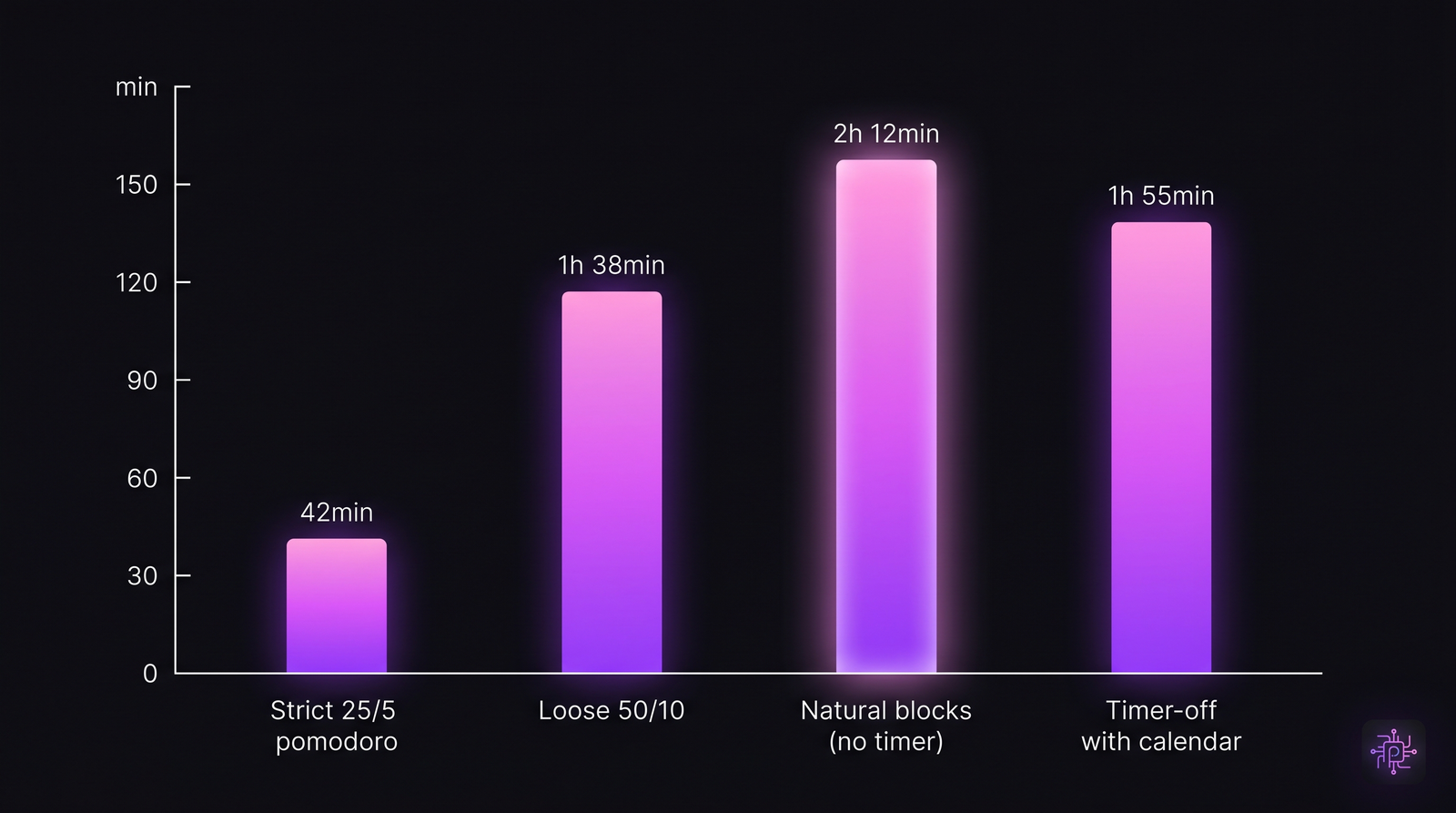 Daily active coding time by focus technique. Strict 25/5 Pomodoro users show the lowest totals, not because they're lazy — because 25-minute intervals chop coding sessions before flow consolidates.
| Technique | Median daily active coding | Focus block P75 |
|---|---|---|
| Strict 25/5 Pomodoro | 42 min | 22 min |
| Loose 50/10 (longer variant) | 1h 38m | 46 min |
| Natural blocks (no timer) | 2h 12m | 72 min |
| Timer-off + calendar blocking | 1h 55m | 68 min |
The strict-25 group's "P75 focus block" being 22 minutes tells you the method is working as intended — the timer is interrupting before 25. What the timer doesn't know: the engineer was 8 minutes into a debugging session where swap-in costs were still compiling in their head. The break fires. The session resets.
Finding 2: Coding sessions don't recover evenly from interruption
We looked at how engineers recover from a break of varying length. Time to get back to the previous level of activity in the IDE:
| Break length | Median refocus time | How close to "new context" |
|---|---|---|
| 1-2 min (typing, Slack glance) | 3 min | Low cost |
| 5 min (Pomodoro break) | 11 min | Medium cost |
| 15 min (coffee, bathroom) | 18 min | High cost |
| 45+ min (meeting, lunch) | 31 min | Full context reload |
The Pomodoro 5-minute break costs engineers an average 11 minutes of recovery. That's more than the break itself. A 25-minute Pomodoro + 5-minute break + 11-minute recovery isn't 30 minutes of structured focus — it's 25 minutes of focus with a 16-minute tax every cycle.
Finding 3: Length of productive coding block is bimodal
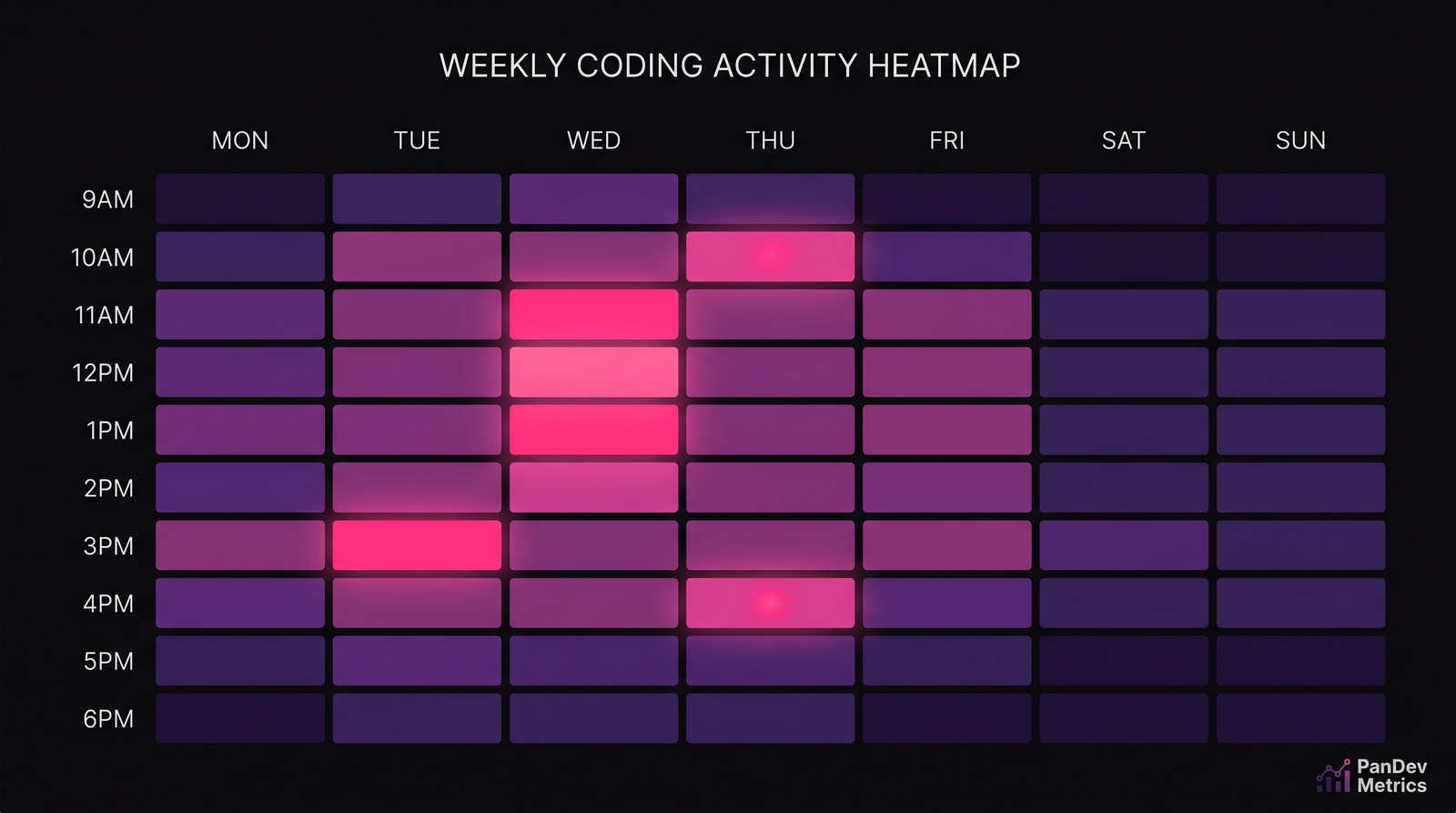 Weekly coding-activity distribution. The darker bands are the coding peaks; note how they cluster at specific hours for most engineers, and how Pomodoro's rhythm doesn't match them.
Across our dataset, engineer coding blocks cluster at two typical durations:
- Short, focused blocks of 15-30 min — typical for code review, small bug fixes, CI-waits
- Long flow blocks of 60-120 min — typical for complex feature work, debugging, new architecture
The Pomodoro 25-minute interval straddles these two peaks. It's too short for the long block and too long for the short one. Engineers using strict Pomodoro either abandon the timer mid-flow (defeating the purpose) or interrupt complex work at the wrong moment (doing worse than no timer at all).
What this means for engineering teams
1. Stop prescribing Pomodoro as a team norm
Individual choice is fine. "We all do Pomodoro" is a productivity anti-pattern. The data shows 25-minute intervals don't fit coding work for most engineers. Let engineers pick.
2. Protect long blocks instead of chunking time
Microsoft Research's 2023 study of engineering focus patterns (Houck et al., published in IEEE TSE) found that engineers with at least one uninterrupted 90+ minute block per day reported 40% higher task completion quality than those without. The goal isn't more breaks — it's more preserved long blocks.
3. Use timers for estimation, not for interruption
Some engineers benefit from a timer as a "am I actually working on this?" gauge. Those who do use it should set the interval to their natural cadence (50-90 min typically) rather than 25. The timer then serves as a check-in, not a break-forcing event.
4. Measure sessions, not intervals
If your team insists on measuring focus, measure the distribution of session length, not the count of Pomodoros. A team with 12 sessions averaging 65 minutes ships more than a team with 32 sessions averaging 18 minutes, every time.
Where Pomodoro does work
Not every coding task is deep work. Pomodoro-style short cycles can help with:
- Code review backlogs — 25-minute bursts match the attention span review requires
- Documentation writing — writing fatigue sets in around 20-30 min naturally
- Learning new frameworks — flash-card-adjacent cognitive work
- Routine maintenance tickets — batching small tasks
For debugging, architecture work, or complex feature implementation, Pomodoro hurts more than it helps. Match the technique to the task, not to the engineer.
What PanDev Metrics shows you
Our dashboards surface focus-block distributions per engineer and per team. An engineer whose P75 focus block is 22 minutes is being interrupted — whether by a Pomodoro timer, a chatty Slack channel, or a culture of "just a quick sync". The data doesn't care about the cause; it shows the effect.
Teams using this data typically don't intervene on individual engineers. They intervene on meeting culture and interrupt expectations — which are the structural causes. One customer with a 40-person team moved from an 11:00 daily standup to a 9:00 one after we showed them that post-standup focus blocks were 38 minutes shorter when standup fell mid-morning vs end-of-morning. That's a systemic fix; Pomodoro at an individual level wouldn't have touched it.
The contrarian claim
Pomodoro's reputation as a productivity technique for knowledge work is mostly a status-game — "I use Pomodoro" signals discipline, which makes people want to report it, which keeps the myth going. The actual research base for Pomodoro-for-coding is thin. The original technique was designed for study habits in the late 1980s, before software engineering had a mainstream form of "flow state" language. It survived into engineering culture through transfer, not fit.
The honest limit: our 127 Pomodoro users is a small sample. They also self-selected into the technique, which biases the comparison — people who try Pomodoro and fail at coding with it probably abandon it before we can tag them. The clean experiment (randomly assign coding work to a Pomodoro and non-Pomodoro condition) would be expensive to run and we haven't. What we have is strong correlational evidence that the technique doesn't match our customers' IDE patterns — enough to challenge its default status, not enough to prove it's worse for every engineer.
Related reading
- Focus Time: Why 2 Hours of Uninterrupted Code Equals 6 Hours of Interrupted Code
- The 40% Productivity Tax of Context Switching
- Developers Code Just 1h 18m Per Day (Real IDE Data from 100+ Teams)
If your team has a Pomodoro culture and your median focus block is under 30 minutes, the technique is shaping the outcome. Measure before deciding whether to keep it.