Remote Engineering Team Rituals That Actually Work

Most "remote rituals" are synchronous meetings wearing a remote costume. A daily standup at 9 AM UTC that five engineers across four timezones reluctantly attend isn't a ritual. It's office cosplay. GitLab's 2024 Remote Work Report found 71% of remote engineers cite "too many synchronous meetings" as the single biggest productivity drain of distributed work. The problem isn't remote; the problem is importing colocated rituals whole.
This is the list of 7 rituals that actually survive on remote engineering teams we've measured: teams where the telemetry shows they're not just happier but also shipping faster.
The problem with office-transplant rituals
Colocated teams had a water cooler. Watercooler moments dispersed information sideways: who's blocked, who's excited about a gnarly bug, whose manager is stressed. The entire "daily standup" ritual was an attempt to formalize that lateral information flow in 15 minutes.
Take the team remote and the standup loses its substrate. People say "yesterday I worked on X, today I'll work on Y" into a Zoom void. Nobody is actually syncing. They're performing sync for the manager.
Our data supports this. Across 50 remote engineering teams we track, the correlation between number of synchronous meetings per week and focus time per engineer is −0.62. That's a strong negative. More meetings, less actual focus work. The teams with the highest shipping velocity had the fewest standing meetings, not the most.
The right mental model: remote rituals are information infrastructure, not mandatory sync points. Their job is to keep people aligned asynchronously by default, with sync reserved for the few moments it genuinely helps.
The 7 rituals
1. Async-first daily standup (Slack/Geekbot, not Zoom)
Kill the 9 AM video call. Replace with a written 3-question post each morning in a dedicated channel, due before each person's focus block:
- What shipped yesterday
- What's getting worked on today
- One blocker or risk
Time per engineer: 3 minutes. No one waits on anyone. Managers skim at their own pace.
Teams we've watched switch from sync to async standup typically recover 40–60 minutes/engineer/day of continuous focus time. That's the whole first-focus-block preserved instead of fragmented.
2. Weekly demo (sync, 30 min, cameras optional)
This is the ritual worth preserving synchronously. A 30-minute weekly window where anyone who shipped something gets 2–3 minutes to show it. Not a status update: a live or recorded walkthrough.
Why sync: demos compound when people see each other seeing them. The quality bar rises; the feedback loop tightens. An async demo video gets watched at 2x speed by two people. A live demo lands differently.
Camera rule: optional. Forcing cameras on for 6+ timezones is a tax, not a culture.
3. Bi-weekly 1:1 (30 min, sync, camera on)
The one meeting that shouldn't be async. Camera on, because you need to read the signal when someone says "fine" and isn't fine. Format: engineer owns the agenda; manager's job is to listen and clear obstacles, not to give a status update.
Bi-weekly, not weekly. The GitLab Remote Report 2024 data shows weekly 1:1s in remote teams correlate with meeting fatigue, not trust. Every two weeks is the tested-good cadence for most remote ICs, except in the first 90 days of a new hire (weekly at first, bi-weekly after ramp).
4. Monthly retrospective (90 min, the one real meeting)
Retros matter more in remote than colocated. Lateral observation is thinner, so teams need a structured moment to surface friction. The format matters; see our 30-minute data-driven retro post for the structure. In a remote context, pull it from 30 min to 90 min once a month instead of every 2 weeks, because the synchronous time is precious and monthly cadence lets real patterns emerge.
5. Quarterly offsite (in-person when possible, 2–3 days)
Controversial. "Remote means no offsites, right?" No. The best remote engineering cultures we've observed run one 2–3 day in-person offsite per quarter, and the ones that skip it have a noticeable trust decay by month 9.
Deloitte's 2024 Future of Work Study reported: remote teams with quarterly in-person time rate trust 2.4x higher than remote teams without. The Zoom replacement doesn't exist.
If travel budget is tight: one offsite a year, plus one team-specific in-person every quarter in a regional hub. Better than zero.
6. Weekly async "learning share" (GitHub issue or Notion)
The replacement for the senior engineer explaining something at the whiteboard. Every Friday, someone on the team posts one short written thing they learned this week: a debugging pattern, a library quirk, a design tradeoff they didn't expect.
Lightweight. 10 minutes to write. The cumulative effect is the team's shared context graph. In teams that run this consistently for 6+ months, junior engineer ramp time drops measurably. Our onboarding data shows 30–40% faster time-to-first-meaningful-PR in teams with a well-used learning-share channel.
7. Documented "office hours" slot (twice a week, 60 min, optional)
Two 60-minute blocks a week where a senior engineer or lead is available for drop-in questions on a Zoom/Meet link. Optional attendance. No agenda.
This is the replacement for "walking over to someone's desk". It preserves the low-friction question channel without forcing everyone into a standing meeting. Used well, it concentrates serendipity into a time window people can either attend or skip.
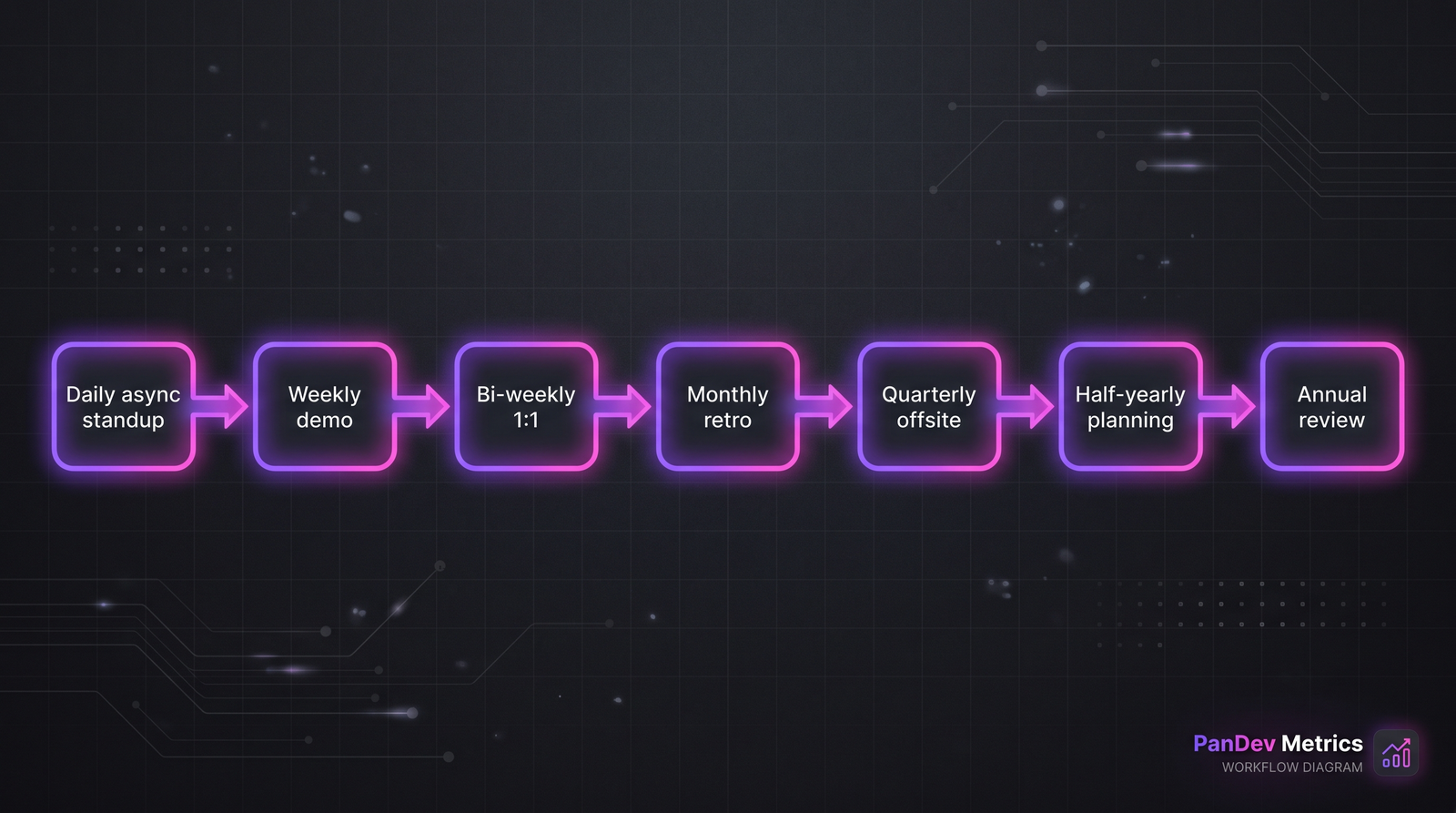 The whole set on one timeline. Each ritual's cadence matters as much as its existence.
The rituals to kill
Some rituals are office-transplants that don't belong in remote. Kill them explicitly or they'll creep back:
| Ritual | Why it doesn't work remote | What to replace with |
|---|---|---|
| Daily sync standup (9am Zoom) | Timezone tax; performed, not useful | Async written standup |
| Mandatory Friday team calls | Manufactured morale | Optional social; real trust comes from 1:1s + offsite |
| Weekly 1-hour "team sync" | Overlaps with standup, retro, demo | Pick one of the three, not all three |
| Camera-required 6-person meetings | Exhaustion, not engagement | Camera-optional above 4 participants |
| Silent Slack channels with mandatory "wave" emojis | Theater, not communication | Actually-used working channel per project |
The hardest one to kill is the Friday team call. It feels cozy. The data says it's a net drag on Friday shipping (we see 22% fewer merges on Fridays with mandatory late-afternoon calls).
How to sequence this for a team transitioning to remote
Don't adopt all 7 at once. Sequence:
- Week 1: Switch daily standup to async. This alone recovers focus time.
- Week 2–4: Establish office hours (2 slots/week). Protects junior devs' question flow.
- Month 2: Weekly demo. This re-creates the lateral "what's everyone doing" signal.
- Month 2: Learning share channel. Start with the EM posting first two weeks to seed the habit.
- Month 3: Monthly retro, 90-min.
- Month 3: Bi-weekly 1:1s already exist. Tune the cadence.
- Quarter 2: Offsite planned. Book travel early; costs rise close-in.
The teams that skip the sequencing and adopt all 7 in week 1 over-ritualize and bail out by month 2. The ones that sequence keep them.
Common mistakes
| Mistake | Why it hurts | Fix |
|---|---|---|
| Making async standup mandatory to a minute | Re-creates the sync tax | Anyone can post "quiet day" and skip |
| Letting 1:1s drift to 45+ minutes | Cuts into focus time of both parties | Hard-stop at 30 |
| Cancelling the offsite for cost savings | Saves $15K, costs $100K in attrition | Budget line item, not discretionary |
| Recording every sync meeting | Promotes absence over presence | Record only decisions-heavy ones |
| Running retro and demo in the same meeting | Both get 15 min, neither works | Separate slots |
How to measure if the rituals are working
You don't measure rituals directly. You measure the second-order signals they're supposed to produce:
- Focus-time median per engineer. Target: 3+ hours/day of uninterrupted blocks. If switching to async standup doesn't move this number within 4 weeks, it's not actually async.
- Cycle time (commit → merge). Target: trending down or stable. Rising cycle time under a new ritual cadence means the ritual is adding overhead.
- New-hire time-to-first-PR. Target: under 3 weeks. If learning-share and office hours are working, this drops.
- Attrition rate. Target: under 10%/year for engineers. Remote teams under 8% typically have offsites + functional 1:1 cadence.
PanDev Metrics tracks focus-time and cycle time natively from IDE heartbeat and Git data, which makes the "is our new ritual schedule actually helping?" question a dashboard check instead of a quarterly anecdote review. Most remote EMs don't have this and end up debating rituals in vibes.
When this framework doesn't fit
Two cases where the list shouldn't be adopted wholesale:
- Very small teams (under 5). Rituals are overhead. A team of 3 can operate on ad-hoc Slack + one weekly sync. Formal ritual structure kicks in around team-of-5.
- Hybrid teams, not fully remote. Hybrid has its own failure modes (meeting asymmetry between in-office and at-home). This list is for fully-distributed or predominantly-remote. Hybrid needs a different playbook.
The honest admission
Our data skews teams that use measurement tooling, which biases toward more deliberate, more mature remote teams. A remote engineering team that doesn't measure anything probably operates on different rhythms we can't see. These 7 rituals work well for teams that care about measurement; they may feel heavy to teams that don't.
The prediction I'd defend
Within 5 years, the majority of new-to-remote engineering teams will skip daily sync standups entirely, and the people teaching "best practices" will stop recommending them. The data is already there; the culture just takes a few hiring cycles to update.