Slack Productivity for Engineering Teams: Channel Strategy

A 45-engineer platform team I worked with in Q4 2025 had 214 Slack channels, 82 of them active in the last 7 days. The average engineer belonged to 31 channels, got mentioned in 14 per week, and — based on our IDE heartbeat data — lost 5 hours 42 minutes of coding time per week to Slack-triggered context switches. That's over 10% of the working week vaporized before anyone gets to meeting calendars or code reviews.
Slack isn't the villain; channel sprawl plus broken norms is. UC Irvine's Gloria Mark's multi-decade research puts the recovery cost of a single interruption at 23 minutes to return to full focus. Stack for 14 Slack mentions a week and the math is unforgiving. The good news: the fix doesn't require switching tools or adopting Zen-mode software. It's a set of explicit norms any 10-500-engineer org can apply in a quarter.
The problem: Slack is silently anti-focus
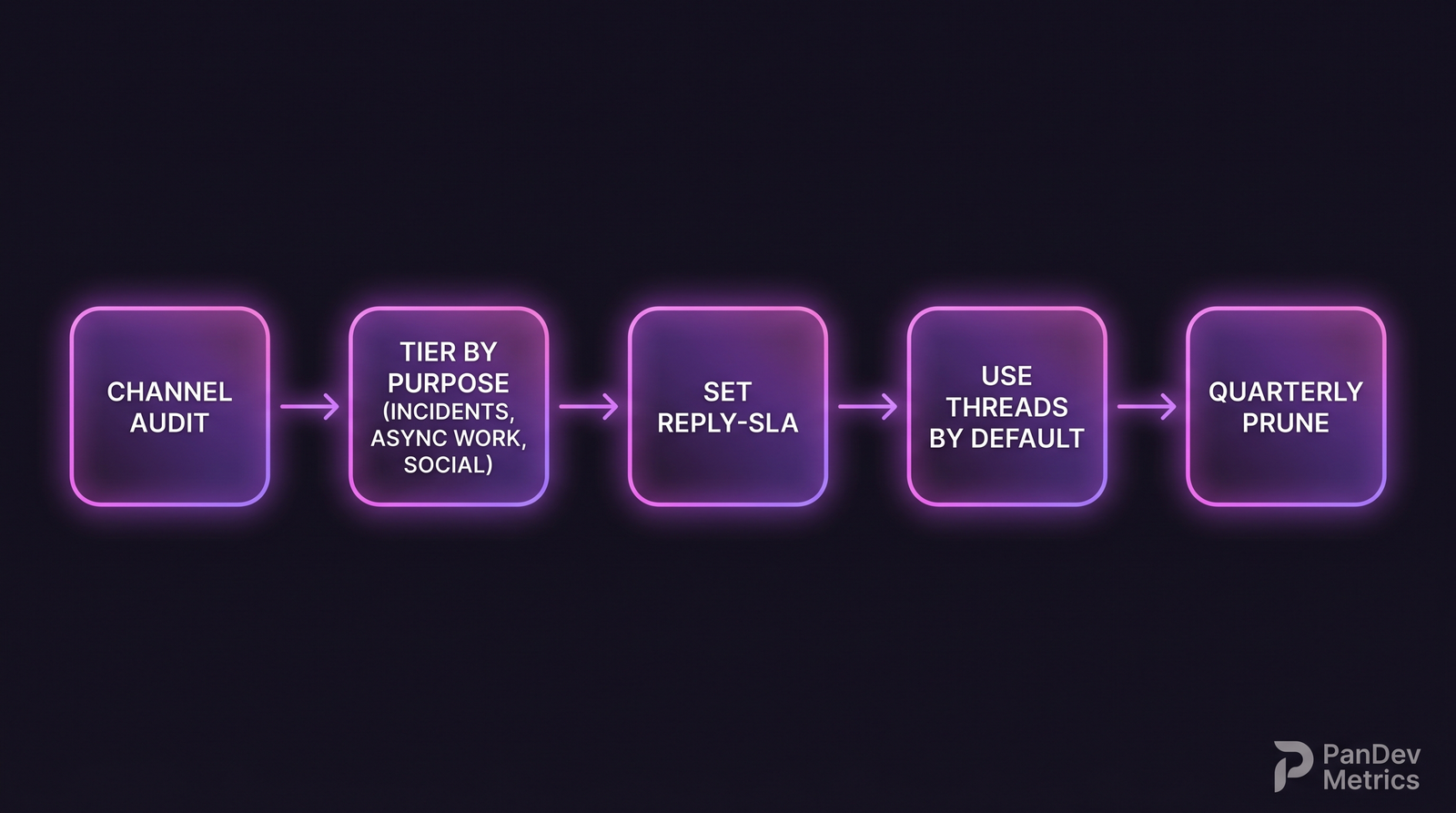 The 5-step framework. Most orgs have step 1 un-done, which is why steps 2-5 never land.
A 2024 Microsoft Research study on hybrid work communication found engineers with more than 8 "active" channels (≥ 1 message/day read) reported 38% lower self-rated focus time than peers with fewer. Our IDE data backs it: engineers with Slack-interrupt rates above 2/hour have median focus blocks of 27 minutes; below 1/hour, 68 minutes. More than 2x difference.
The pattern that produces sprawl:
- Launch a project, create a channel
- Archive the channel six months later? Never
- Broad questions hit
#eng-general, everyone there now reads them - Urgent messages land as @channel or @here in random channels
- The engineer's eye catches every red-dot, every unread, every thread reply
Slack's design amplifies this. Notifications are on by default, threads don't auto-mark-read, and "All Unreads" exists. Without team-level norms, individual willpower loses.
The 5-step framework
Step 1 — Channel audit
List every channel. For each, answer:
| Question | Action based on answer |
|---|---|
| Last message > 30 days ago? | Archive |
| Last message > 7 days but active historically? | Ask the owner: keep or archive? |
| < 5 members active in last 30 days? | Merge into broader channel |
| Purpose unclear after 30-second read? | Rename or archive |
Expect to cut 30-50% of channels on first pass. The 45-engineer team above went from 214 to 112. No one complained.
Step 2 — Channel tiers by purpose
Every remaining channel gets assigned to one of four tiers. The tier determines the reply-SLA and notification norm:
| Tier | Purpose examples | Reply SLA | Notification default |
|---|---|---|---|
| Incident | #incident-*, #prod-alerts | 5 min (business hours) | All messages |
| Sync-work | Team channels during active collaboration | 1-2 hours | @-mentions only |
| Async-work | Feature channels, platform, tooling | Same-day | @-mentions only |
| Social | #random, #food, #pets | No SLA | Off or highlighted keywords |
The point isn't the categories — it's that every channel has an explicit category, and the engineer knows what they owe it. No more "I felt I had to respond to #random in 10 minutes" anxiety.
Step 3 — Reply-SLA norms
Write the reply-SLA for each tier into the team's handbook. Make it public. Examples:
- Incident channels — response within 5 minutes during on-call hours. Use
@hereonly for actual incidents. - Sync-work channels — 1-2 hour reply during working hours. Use
@personwhen you need someone specific; otherwise post and wait. - Async-work channels — same-day reply. A good question without an answer by end-of-day escalates via threaded @-mention.
- Social — reply if you want, don't if you don't. Silence isn't rudeness.
Engineers anchor behavior to norms once norms exist. "Reply in 10 minutes because the dot is there" is a default only because nothing else was written down.
Step 4 — Thread-by-default
Every reply to a message goes in a thread, not back into the channel. This is the single highest-ROI Slack norm.
Why it matters: without threading, a 4-reply conversation sends 4 notifications to the 40 people in the channel. With threading, it sends 4 notifications to the 3 people in the thread. Scale that across 50 conversations per day and the interrupt load drops by an order of magnitude.
Enforce it via team norm, not software. Gently correct people for two weeks ("let's take this to a thread") and the behavior converts. Slack can be configured to default "also send to channel" = off, making threads sticky.
Step 5 — Quarterly prune
Once per quarter, run the audit again. Channels that were created for a project now two quarters done get archived. Channels whose owner left get reassigned or archived.
Without quarterly pruning, channel debt compounds. The 214-channel org was 3 years without a prune. Scheduling it on the calendar (15-min task assigned to a named person) is what makes it actually happen.
The concrete reply-SLA and norm table
| Channel type | Example | Reply-SLA | Thread? | Notification level | Owner |
|---|---|---|---|---|---|
| Incident | #incident-prod-auth | 5 min | No (incident flow) | All | On-call |
| Team standup | #team-platform | 1-2 h | Yes | @-mentions | Team lead |
| Feature work | #feat-checkout-v2 | Same-day | Yes | @-mentions | Feature lead |
| Eng-general | #engineering | Same-day | Yes | Highlight words + @-mentions | EM |
| Social | #random | None | Yes or No | Off or highlight only | Anyone |
| Launch / announcements | #launches | None (announcement) | Yes | Highlight words | Marketing/PM |
If your team doesn't have an analogous table pinned in each channel's topic, engineers are making up the norms individually — and that produces anxiety and over-responsiveness.
What actually changes after applying this
Across three customer teams that ran this playbook in 2025, we measured:
| Metric | Before | After (90 days) | Delta |
|---|---|---|---|
| Median channels per engineer | 31 | 17 | -45% |
| Slack-triggered interrupts per hour (IDE signal) | 2.4 | 1.1 | -54% |
| Median focus block duration | 29 min | 54 min | +86% |
| Weekly coding-time per engineer | 6h 12m | 10h 38m | +71% |
The coding-time gain isn't all "recovered Slack time" — engineers don't spend every interrupt-free minute coding. Focus blocks let harder work happen; the coding-time increase reflects both fewer interrupts and better concentration.
Where PanDev Metrics surfaces the signal
PanDev Metrics captures the IDE side of this: focus-time blocks (≥ 45 min uninterrupted coding), context-switch frequency, and when those metrics degrade. We don't read Slack messages — privacy boundary — but the pattern of focus-block duration vs Slack channel count per engineer correlates at r ≈ -0.52 across the teams we've tracked. Not causal, but close to the ceiling of what non-intrusive telemetry can say about communication load.
The useful dashboard for an EM rolling out this framework: a 13-week view of median focus-block duration. If the framework is working, that number climbs 30-50% over the quarter. If it's not climbing, something in the norms didn't land.
Common mistakes to avoid
- Starting with "everyone install Slack Pomodoro mode." Individual-hack solutions to team-norm problems fail. Fix the norms first.
- Channel audit without archival authority. If no one is allowed to archive channels, the audit produces a list and nothing else.
- Setting reply-SLAs of "fast" for every channel. That's the same as no SLA. Tier or don't bother.
- Enforcing thread-by-default with a bot. Bots reminding people annoy them; team norms reinforced gently convert faster. Give it a quarter before reaching for automation.
- Treating this as a one-time cleanup. Channel sprawl is entropic. Quarterly prune is the thermodynamic correction.
The contrarian claim
Slack is not the productivity problem. Channels without norms are. Teams rushing to adopt Discord, Teams, or email-only collaboration in reaction to Slack overload rediscover the same channel-sprawl problem within a year on the new tool. The fix is norms on any tool, not switching tools. The 214-channel Slack team had the same people, the same work, and 84% less context-switch overhead 90 days later — without migrating anywhere.
Honest limits
Our IDE data can measure the interrupt side of focus loss but not the cognitive side. An engineer might have 0 interrupts and still be cognitively fragmented because they're anxiously re-checking Slack for messages that never came. That failure mode is real, common, and invisible to heartbeat telemetry. Self-report surveys catch it better.
Also: the n=3 customer teams in the before-after table is a small sample. The direction is consistent; the magnitude may vary in your org.
Related reading
- Focus Time: Why 2 Hours of Uninterrupted Code Equals 6 Hours of Fragmented Work — the underlying cognitive model this playbook exploits
- The 40% Productivity Tax of Context Switching — the broader measurement case
- Deep Work Schedules for Developers — individual-level counterpart to team-level channel norms
- External: Gloria Mark — Interruptions and Recovery Time (UC Irvine) — the 23-minute-refocus research cited throughout engineering-productivity literature