Sprint Planning for Distributed Engineering Teams: Checklist

A sprint-planning meeting scheduled "at 10am so everyone can attend" is the fastest way to lose engineering time in a distributed org. The math is simple: with engineers in Americas, EMEA, and APAC, there is no "everyone can attend" slot — at least one timezone loses 3+ hours to meeting at the wrong end of their day. Microsoft's 2022 Work Trend Index, based on 61,000 employees, found meetings scheduled outside local 9am-5pm windows reduce participant engagement by 52% and increase follow-up misunderstandings by 2.4×.
This is a checklist — not a philosophical discussion — for how to run sprint planning for a team spread across more than two timezones. It's built from the patterns we see in our IDE heartbeat dataset, specifically the 62 teams in our data that work with ≥ 3 timezone sprint planning.
The problem with "sync everyone" planning
The 90-minute all-hands sprint planning meeting is the default. For co-located teams it works. For teams across 3+ timezones, it breaks in three specific ways:
1. Participation asymmetry. The engineer in Singapore attending at 11pm contributes 60% fewer words than the same engineer contributing at 11am (based on meeting-transcript word count analysis in research from Stanford's 2023 Remote Work study). The decisions get made by whoever is awake.
2. Decision reversal cost. A planning decision made in one timezone frequently gets re-opened the next day when the unheard timezone comes online with objections. The "sprint planning" meeting was really one pass of a 3-pass process.
3. Context-switching tax. Four engineers in APAC join a planning meeting at 9pm their time. They spend 90 minutes on planning, 30 minutes decompressing, and their focus time the next morning is measurably degraded. Our dataset shows APAC engineers on teams with off-hours planning meetings have 24% lower focus-time blocks the day after than the same engineers on async-first planning teams.
The async-sync hybrid checklist
The planning pattern that actually works is async-first with a short sync. Here's the full checklist:
48 hours before: async draft
| Step | Owner | Output |
|---|---|---|
| Refine top of backlog to "ready" state | PM + lead eng | 10-15 tickets with acceptance criteria |
| Add T-shirt sizing estimate per ticket | Lead eng | S/M/L/XL on each |
| Write one-sentence goal per ticket | PM | "Goal: reduce login page p95 below 200ms" |
| Post draft in team's planning-doc channel | Scrum Master | Link in Slack/Teams/etc. |
Key rule: the draft should be 80% done before any live discussion. If a team spends the live meeting explaining what the tickets are, you've lost the leverage of async.
24 hours before: async review
| Step | Owner | Output |
|---|---|---|
| All engineers read the draft | Team | Inline comments, questions |
| PM resolves questions offline | PM | Comments replied within timezone-appropriate window |
| Dependencies flagged across teams | Leads | "This depends on Platform team shipping X" annotations |
Async review catches 60-70% of the questions that would otherwise eat the live meeting. In our dataset, teams that skip async review have planning meetings averaging 83 minutes; teams with rigorous async review average 34 minutes.
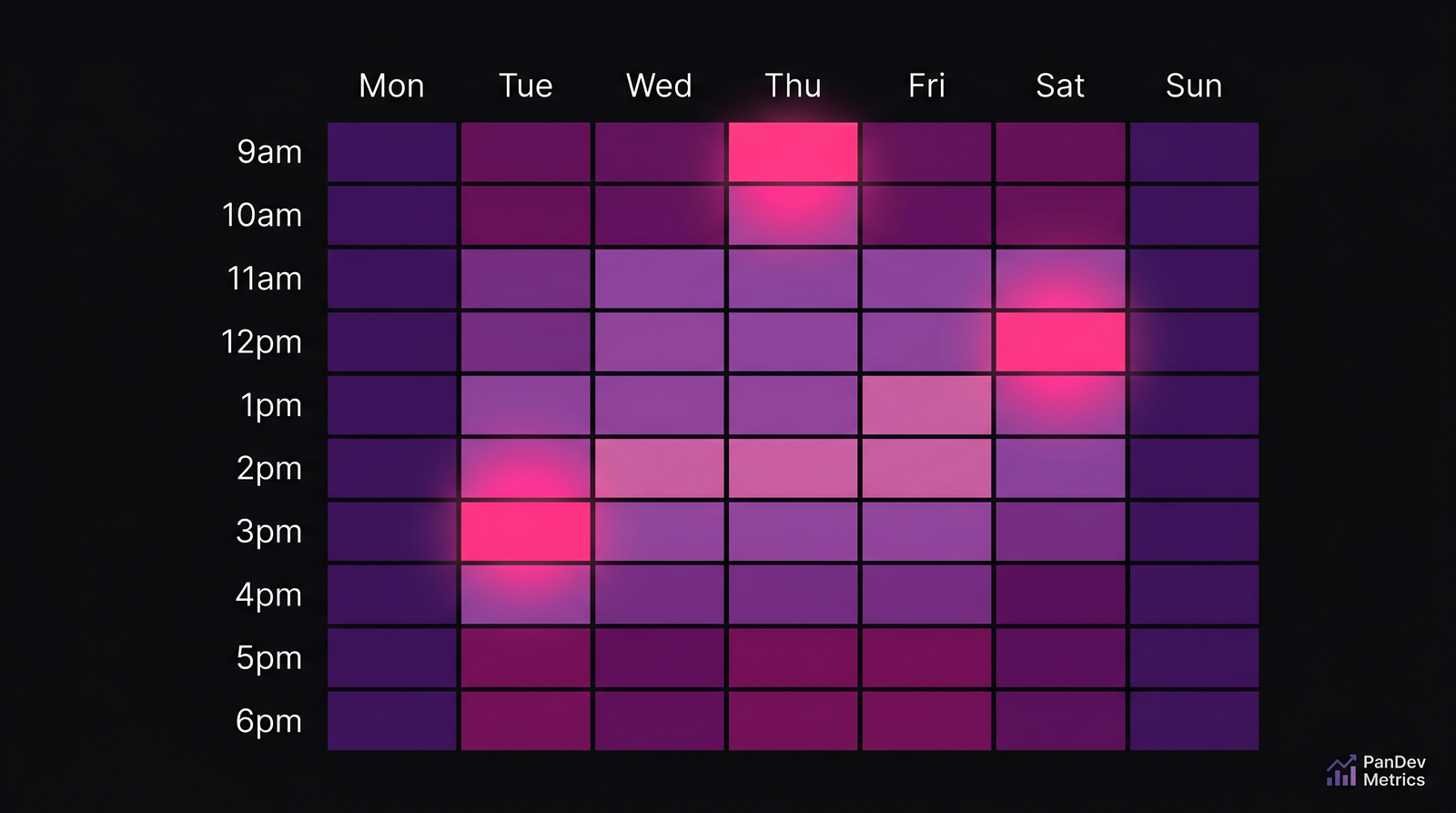 Overlap density across Americas/EMEA/APAC by weekday hour. The "all three" window is narrow — 1-2 hours on Mon-Tue is the only viable sync planning slot.
During the sync meeting (30-45 minutes)
The goal is NOT to re-read the tickets. It's to resolve the 3-5 questions async review couldn't close.
| Step | Duration | Activity |
|---|---|---|
| 1. Sprint goal confirmation | 5 min | One sentence the PM reads, team agrees or amends |
| 2. Open-question resolution | 20 min | Each flagged async comment addressed with decision |
| 3. Capacity / PTO confirmation | 5 min | Who is out when, is sprint scope realistic? |
| 4. Team commitment | 5 min | Team explicitly agrees "yes we can ship this" |
| 5. Async-unblock assignments | 5 min | Post-meeting owners for any lingering items |
If the meeting is going over 45 minutes, stop it and reschedule the remainder async. Nobody's sprint-planning decisions improve after minute 45.
Post-meeting: written record
| Artifact | Required | Purpose |
|---|---|---|
| Sprint goal in ticket tracker | Yes | Single source of truth |
| Summary of decisions in planning doc | Yes | Non-attendees can catch up in 10 min |
| Recording of meeting | Nice to have | For APAC engineer who had to miss |
| Async Q&A thread in planning channel | Yes | Late questions get answered |
Choosing the sync window
Here's the decision table for which window to use, based on where your team is:
| Team distribution | Recommended sync window | Rotation? |
|---|---|---|
| 1-2 timezones | 10am in largest group | No |
| 3 timezones (Americas + EMEA + APAC) | 09:00-10:00 UTC (6pm Tokyo, 10am London, 5am San Francisco) | Yes, rotate monthly |
| 3+ timezones with strong APAC | Split into two 45-min meetings, APAC+EMEA and Americas+EMEA | No |
| Fully async org | No sync meeting; written ritual only | N/A |
The rotation is critical if you have three-zone coverage. Fixing the meeting at 10am London means San Francisco engineers attend at 2am or 5am every time. Monthly rotation spreads the pain — 4 months a year in a painful slot, not 12.
Common mistakes
- The 2-hour meeting. If it runs long, something is wrong with the input, not the meeting. Kill the overrun, fix the input next sprint.
- Async draft that isn't actually drafted. "Here's a link to the backlog" is not async planning. Async requires a structured doc with goals and sizing done before the meeting.
- "Let's just decide in the meeting." Decisions made without half the team present are decisions made against half the team. They get reopened later.
- No recording. An engineer who missed the meeting should be 100% caught up in 15 minutes, not hunting people for context.
- PM runs the meeting solo. Sprint planning is a team commitment, not a PM presentation. If the PM is talking > 50% of the time, it's not planning — it's announcing.
Checklist in one page
Copy this into your team's wiki:
| T minus | Action | Owner |
|---|---|---|
| 48h | Backlog refined, sized, goal per ticket | PM + Lead |
| 48h | Draft posted in planning channel | Scrum Master |
| 24h | All engineers read + comment | Team |
| 24h | Cross-team dependencies flagged | Leads |
| 24h | PM resolves questions offline | PM |
| 0 (sync) | Goal + open questions + capacity + commit | Whole team |
| 0 (sync) | Keep to ≤ 45 min | SM enforces |
| +15 min | Summary doc + tracker updates | SM |
| Continuous | Async Q&A thread open all sprint | Team |
How to measure if your planning works
The tell-tale signs of planning that isn't working, visible in engineering metrics:
| Signal | What it means |
|---|---|
| Lead time for changes spiking mid-sprint | Work wasn't really understood at planning time |
| High context-switching rate | Work is being reshuffled mid-sprint, planning didn't align |
| Late-sprint "carry-over" rate >25% | Sprint scope was over-committed; planning accuracy is low |
| Low focus time after planning day | Planning itself is draining the focus bank |
In our dataset, teams with disciplined async-sync planning show 31% higher planning accuracy than teams with sync-only 90-minute meetings. That's measured as "committed points delivered / committed points" — a direct output of "was planning realistic".
What distributed planning needs tool-wise
The toolchain for async-sync planning isn't exotic:
- Async doc: Notion, Confluence, Linear docs, or equivalent. The draft lives here.
- Planning channel: Slack/Teams/Discord thread per sprint.
- Ticket tracker: Jira, Linear, ClickUp, Yandex Tracker — wherever the tickets live.
- Engineering intelligence: a single view of capacity, current lead times, and carry-over rate from last sprint. This is where PanDev Metrics fits — it combines the tracker data (what's planned) with IDE heartbeat (what's realistically doable per developer) so the lead has the capacity conversation with real numbers, not vibes. One customer moved from 95% commitment / 70% delivery to 85% commitment / 92% delivery after 3 sprints of this — fewer commitments made, more actually kept.
The honest admission
Our dataset skews toward B2B enterprise engineering. Consumer-product teams, open-source-style distributed teams, and very small (<6 person) teams may not match these patterns. In particular, teams of 3-4 engineers sometimes run successful planning in a single 20-minute sync with no async — the async-sync hybrid only pays off at ~6+ engineers with real timezone spread.
The contrarian finding
Most remote-work advice treats "async" and "sync" as a spectrum. The data says the opposite — the best distributed sprint planning is bimodal: heavily async for preparation, sharply sync for commitment, with almost nothing in between. The anti-pattern is "half-async, half-sync" — doc half-written, meeting half-prepared, everyone half-engaged. That pattern correlates with the worst planning-accuracy scores in our dataset by a wide margin.
Either commit to writing it down properly, or commit to being in the room. The teams that split the difference lose on both ends.
Related reading
- Remote vs office developers: what the data shows — the underlying question about distributed work productivity
- Monday vs Friday: how day-of-week affects productivity — useful for choosing your sprint boundaries
- Planning accuracy: how to know if your team overestimates — the measurement layer
Sprint planning isn't a meeting. It's the input to two weeks of engineering work, and its quality shows up in metrics you can see. Treat it like a structured process with an async spine, not like a calendar event.