Engineering Manager vs Tech Lead vs Engineering Lead in 2026

Your best senior engineer just got promoted to "lead." Nobody wrote down whether that means Tech Lead or Engineering Manager, so now she does both. She's reviewing every PR, running every 1:1, planning every sprint, and still expected to ship her own code. Three months in, her output collapsed and so did team delivery. A 2024 Stack Overflow Developer Survey found that engineers in hybrid "lead" roles report 1.6× higher burnout than those on either a pure IC or pure management path. Merging the roles is the single most common — and most expensive — leadership mistake we see.
Tech Lead and Engineering Manager are different jobs with different success metrics, different time allocations, and different failure modes. Pick one per person, or pick both and hire two people.
Positioning
Tech Lead (TL): Senior IC with architectural ownership. Still writes code. Owns technical direction, cross-team alignment on architecture, mentorship of engineers on technical craft, and the codebase's long-term health.
Engineering Manager (EM): People leader with delivery accountability. Rarely writes code. Owns hiring, growth conversations, performance, sprint-level delivery, cross-functional coordination, and the team's organizational health.
Neither is "above" the other. Most career ladders (Camille Fournier's The Manager's Path, Rent the Runway/LinkedIn/Stripe public ladders) run TL and EM as parallel tracks from the senior level up, not as sequential steps.
Feature-by-feature comparison
Daily time allocation
| Activity | Tech Lead (typical %) | Engineering Manager (typical %) |
|---|---|---|
| Writing code | 40-60% | 0-10% |
| Code review | 15-25% | 0-5% |
| 1:1s with reports | 0-5% | 25-35% |
| Hiring + interviews | 5-10% | 15-20% |
| Cross-team meetings | 10-15% | 20-30% |
| Architecture + design | 15-25% | 5% |
| Performance / growth convos | 0% | 10-15% |
| Roadmap / planning | 5-10% | 10-15% |
The numbers come from consistent patterns across 100+ B2B engineering teams we measure through IDE heartbeat data. The striking observation: the median Tech Lead we track codes ~3h 12m per day; the median Engineering Manager codes 18 minutes per day (usually prototype code or to unblock a critical bug).
Primary success metrics
| Dimension | Tech Lead measured by | Engineering Manager measured by |
|---|---|---|
| Technical outcome | System reliability, architectural debt reduction, critical design reviews completed | Delivery predictability, team velocity stability |
| People outcome | Mentored engineers' growth in technical depth | Retention, promotion velocity, hiring quality |
| Business outcome | Technical strategy alignment with product roadmap | On-time delivery, quarterly OKR attainment |
| Failure mode | Silo: strong code, team can't ship | Silo: team ships but technical debt spirals |
Decision authority
| Decision | TL authority | EM authority |
|---|---|---|
| Architectural approach | Owns | Consulted |
| Hiring decision | Consulted | Owns |
| Performance rating | Consulted | Owns |
| Tech stack choice | Owns | Consulted |
| Sprint scope | Co-owned | Co-owned |
| On-call rotation design | Consulted | Owns |
| Promotion packet | Input | Writes |
| Priority when conflict between roadmap + tech debt | Escalates | Decides or escalates |
The co-owned rows are where bad TL/EM partnerships fail. If the two can't agree on sprint scope without escalation, you have a management problem, not a process problem.
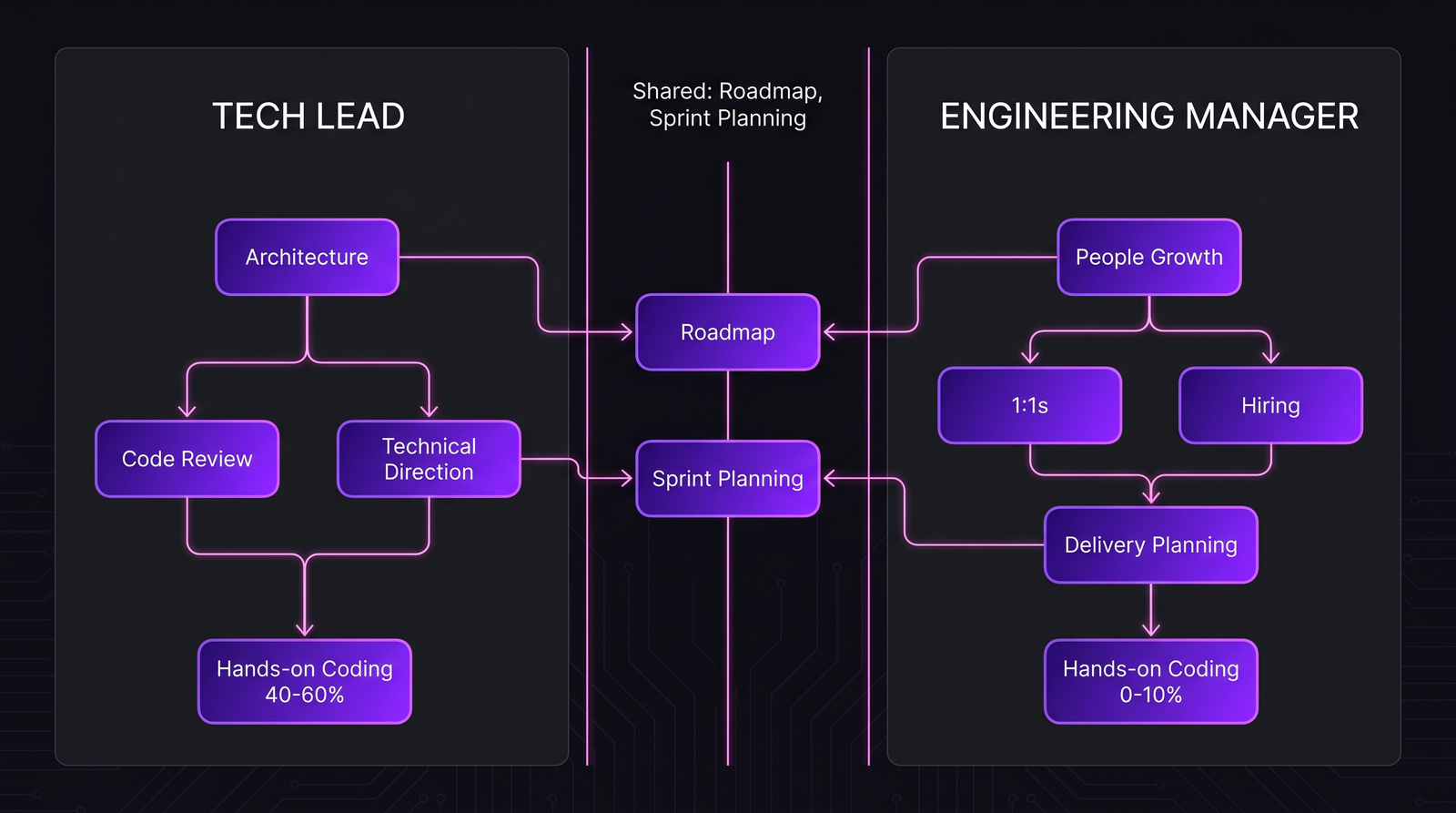 The split: code-heavy technical leadership vs people-heavy delivery leadership. The thin middle band — roadmap and sprint planning — is where the partnership lives or dies.
The pricing reality (compensation)
Teams hiring for these roles often pay them the same, and that's a signal the org hasn't separated them intentionally. Levels.fyi 2025 median data for senior-level roles in US mid-market companies:
| Role | Median total comp (US mid-market) | Hours actively coding/week |
|---|---|---|
| Senior Engineer | $205K | ~18-22h |
| Tech Lead (L6 / Staff-equivalent) | $260-290K | ~15-20h |
| Engineering Manager | $270-320K | ~2-4h |
| Sr EM / Dir Eng | $310-380K | ~0-2h |
Tech Leads usually cost a bit less than EMs at the same scope, which reflects the broader-responsibility premium EMs carry on people matters. But the gap is small compared to the productivity difference if you merge the roles into one title.
Decision framework
Choose a Tech Lead if:
- The team is 3-6 engineers, cohesive, and the main risk is technical (system complexity, migration, reliability)
- There's already an EM covering the team, or an EM one level up covers 2-3 teams
- The biggest unsolved problems are architectural, not interpersonal
- The senior engineer you're promoting loves code and dislikes meetings
- The team needs technical direction more than scheduling discipline
Choose an Engineering Manager if:
- The team is 5-9 engineers (above 6-7, one person can't reasonably do both roles)
- Delivery predictability is the primary issue, not technical complexity
- There's attrition, hiring need, or performance-management work that's being neglected
- The person you're promoting is energized by enabling others and comfortable without daily code output
- Cross-functional coordination (product, design, security, sales) takes > 10 hours/week
Choose both if:
- The team is 8+ engineers
- The product has non-trivial architecture decisions AND significant cross-functional coordination
- You have the budget for two senior leadership slots
- You've seen the hybrid-lead pattern fail before on this team
The 80/20 analysis
Most teams under 7 engineers don't need both. They need one excellent EM with a strong senior engineer acting as informal TL, or one excellent TL with an EM covering multiple teams. Hiring both for a 5-person team creates coordination overhead that cancels the benefit.
The inflection point we see most consistently is around team size 7-8, where the EM's people-load alone (1:1s, growth, hiring) crosses 20 hours/week and the technical-direction work starts getting neglected. That's where adding a dedicated TL (or promoting internally) pays back within a quarter in delivery and retention.
Common confusion patterns
"Lead engineer" ambiguity
If the title is "Lead Engineer," nobody knows which job the person is signed up for. We've seen this cost a team a senior hire who turned down the offer because the scope was unclear. Fix: write the job description with explicit time allocation ("you'll code 40%, review 20%, etc.") before posting.
"Player-coach" as an excuse
The player-coach archetype (pure 50/50 TL + EM) works for ~6 months during a transition, or for small teams at specific startup stages. It does NOT work as a permanent role for a sustained 8+ person team. The coaching hours crowd out the coding, or vice versa, and the person quietly drops one half.
Treating EM as "senior engineer who doesn't code anymore"
EM is a different skill, not an extension of IC. Coaching, performance management, conflict resolution, hiring funnel management — these are learned skills. First Round Review's State of Engineering Leadership (2023) found only 34% of newly-promoted EMs received formal manager training, and that cohort had 2× higher rate of stepping back to IC within 18 months.
Splitting them on paper but not in practice
The roles are listed separately on an org chart, but sprint planning happens where the TL makes the decisions and the EM takes notes. Or vice versa. The partnership has to be ritualized: weekly TL+EM sync, explicit RACI on the co-owned decisions, transparent escalation paths.
How to know it's working
Three signals show the split is healthy:
- Engineering Manager coding time trends toward 0-10% — if the EM is still coding 30% of the week, they're either avoiding people work or carrying both jobs
- Tech Lead 1:1 time stays under 20% — if the TL is spending 8 hours/week on 1:1s, the EM isn't pulling their weight or the team is asking the TL for things the EM should handle
- Delivery predictability AND technical-debt trend both improving — one without the other means one role is suffering
Our dataset shows this pattern: teams with clean TL/EM separation hit DORA metrics improvements 1.8× faster in the 12 months after the split than teams running the hybrid-lead pattern. The signal is visible in IDE heartbeat telemetry — when one person's coding time collapses to near-zero and another person's stabilizes around 50%, the org just separated the jobs, whether or not they updated the titles.
Summary table
| Dimension | Tech Lead | Engineering Manager | Winner for team < 7 | Winner for team 8+ |
|---|---|---|---|---|
| Architecture ownership | TL | Consulted | TL role (or strong senior) | Dedicated TL |
| People growth | Mentor | Owns | EM | Dedicated EM |
| Delivery predictability | Contributes | Owns | EM | EM |
| Hiring | Interviews | Runs the funnel | EM | EM |
| Technical strategy | Owns | Contributes | TL | TL |
| Cross-functional coord | Tactical | Strategic | EM | EM |
| Preferred for team < 7 | ✓ (with external EM) | ✓ (with senior eng) | one of the two | — |
| Preferred for team 8+ | — | — | — | both |
The contrarian claim
Hiring a pure EM first (before a TL) is usually the right move, even though most founder-led startups do the opposite. An EM with no TL can coach a senior IC into acting-TL duties for a year; the reverse — a TL with no EM — leaves the people work uncovered and retention suffers first. Our data shows teams that hired an EM before a TL had higher 18-month retention than teams that hired a TL first. The retention difference compounds faster than the technical-direction gap.
Where PanDev Metrics fits
For an EM, the CTO Dashboard view shows team-level delivery, burnout signals, and cross-project load. For a TL, the project-level coding time and context-switching metrics show where architectural work is actually happening vs where it was promised. Using the same data source means TL and EM are arguing from the same facts, not from two competing narratives.
An honest limit
Our dataset is IDE-weighted — we see coding time well, we see Git activity well, but we don't see 1:1 quality or coaching depth directly. An EM who codes 0% and runs great 1:1s looks identical in our data to an EM who codes 0% and runs bad 1:1s. Team retention and engagement surveys close that gap; our telemetry doesn't.