Top 15 Engineering Intelligence Platforms in 2026

Forrester named "Engineering Intelligence" a distinct software category for the first time in 2024. Eighteen months later, we count at least 40 vendors competing for the same buying committee — VP Engineering, CTO, CFO, sometimes a Chief of Staff. The pitch is identical across all of them. The data quality, deployment model, and pricing transparency are not.
We tested 15 of them. Some are excellent. Some are expensive wrappers around git log. This is the buyer's guide we wish we had when we built our own platform.
What is engineering intelligence (and why 2026 is different)
Engineering Intelligence (EI) platforms aggregate signals from the software development lifecycle — Git events, CI/CD pipelines, task trackers, and (less often) IDE telemetry — and turn them into metrics engineering leaders can act on. Think DORA metrics, lead time breakdowns, deployment frequency, cycle time, and the financial layer on top: cost per feature, developer utilization, engineering ROI.
The category isn't new. GitPrime (now Pluralsight Flow) launched in 2015. LinearB raised its Series A in 2020. What changed in 2026 are three things:
- AI features became table stakes. Every vendor now ships a "natural-language assistant" — ask "what was our deployment frequency last month?" and get an answer. The execution quality varies wildly.
- On-prem deployment is back. EU and Middle East regulators (DORA regulation for finance, NIS2 for critical infrastructure) made cloud-only EI unworkable for many enterprises. Vendors that already shipped on-prem won the renewal cycle.
- The DORA report stopped publishing in 2024. Google's State of DevOps Report — the canonical reference for delivery metrics — went on indefinite hiatus. EI vendors became the de facto source of DORA benchmarks. That gave them more authority and more responsibility.
A note on terminology before we go further. "Engineering analytics" and "engineering intelligence" are used interchangeably in vendor marketing. The honest distinction: analytics shows you the past, intelligence claims to recommend the future. Most platforms still do mostly analytics with an AI layer on top.
How we evaluated
Six criteria. Equal weighting. No 5-star aggregate score because the right tool depends on what you need.
- DORA support: does the platform compute all four DORA metrics (deployment frequency, lead time, MTTR, change failure rate) without manual configuration?
- Integration breadth: Git providers, task trackers, CI/CD, observability, IDEs.
- Pricing transparency: is the price listed, or do you need a sales call to find out?
- On-prem availability: Docker or Kubernetes deployment, air-gapped option, data residency control.
- AI features: natural-language queries, anomaly detection, automated insights. Honest assessment of whether they're useful or marketing fluff (see contrarian section below).
- Time to first value: how long from signup/install to a dashboard a CTO would show in a board meeting.
A seventh criterion we considered and rejected: "ease of setup." It's too subjective. A platform that takes 4 hours to configure but never breaks is better than one that's running in 10 minutes and produces wrong numbers for a quarter. We folded reliability into the integration-breadth and time-to-first-value criteria instead.
The 15 platforms
1. PanDev Metrics
Built for B2B companies that need IDE-level telemetry plus the full DORA stack, available both as cloud SaaS and as a self-hosted on-prem package. The differentiator from most of the list: we collect IDE heartbeat data (JetBrains, VS Code, Eclipse, Xcode, Visual Studio) every 1-2 minutes, so productivity metrics come from the editor — not from PR counts or self-report surveys.
- IDE heartbeat data across JetBrains, VS Code, Eclipse, Xcode, Visual Studio
- DORA metrics with 4-stage lead time breakdown (commit → PR open → merge → deploy)
- On-prem Docker and Kubernetes (Helm chart), air-gapped supported
- Cost per feature, developer utilization, AI Assistant for natural-language queries
Pricing: cloud tiers plus enterprise terms for on-prem. Available on request.
Best for: mid-market engineering organizations that want IDE-level data and on-prem deployment without enterprise pricing. Heavy adoption in fintech and outsourcing where time tracking and compliance both matter.
Honest limit: if your stack is GitHub + Linear + Slack and you don't care about IDE telemetry, you can get 70% of this value from a lighter tool.
2. LinearB
The category leader in marketing reach. Strong Git workflow automation, gitStream policy engine, and a clean Slack-first UX. DORA metrics are well-implemented. AI insights ("WorkerB") have been around longest in the category.
- gitStream policy automation (auto-merge, auto-review-assignment)
- DORA metrics, cycle time breakdown, project allocation
- Workflow automation via Slack and Teams
- Native integrations with GitHub, GitLab, Bitbucket, Jira
Pricing: Free tier (up to 9 contributors), paid tier not publicly disclosed — sales contact required for organizations larger than that.
Best for: mid-to-large cloud-native engineering teams already heavy on GitHub + Slack who want workflow automation, not just dashboards.
Honest limit: no IDE telemetry, no real on-prem option. Pricing famously becomes a sticking point at the 50+ engineer mark.
See our detailed PanDev Metrics vs LinearB comparison for the feature-by-feature breakdown.
3. Jellyfish
The enterprise heavyweight. Originally built around "Investment Allocation" — showing executives what % of engineering hours went to new features vs. tech debt vs. KTLO. Strong reporting, large customer logos, sales-led motion. Acquired Salt Lake-based DX competitor in 2024 to add survey-based DevEx.
- Engineering investment allocation, capitalization reports, financial layer
- DORA metrics, deliverable tracking, OKR alignment
- Survey-based DevEx (post-DX acquisition)
- SOC 2 Type II, GDPR, enterprise SSO
Pricing: not publicly disclosed. Industry reports place enterprise contracts in the $150-300k/year range, often with multi-year commitments.
Best for: 200+ engineer organizations where the CFO is in the buying committee and capitalization reporting is a real requirement.
Honest limit: overkill for sub-100-engineer teams. Long implementation cycles. See our PanDev Metrics vs Jellyfish comparison on when this is and isn't worth it.
4. Swarmia
The thoughtful one. Founded by ex-Smartly.io engineers, Swarmia has built a reputation for being opinionated about what metrics matter and what shouldn't be tracked. Strong on focus time, working agreements, and team-level health signals.
- Working agreements with automated tracking
- DORA metrics, investment categories
- Focus-time insights, team health checks
- Slack-first notifications
Pricing: publicly listed — $20/contributor/month (Business), custom for Enterprise.
Best for: Nordic/European mid-size product teams with strong engineering culture that want help operationalizing it.
Honest limit: US enterprise sales motion is younger. No IDE telemetry. See PanDev Metrics vs Swarmia for the granular comparison.
5. Faros AI
Data-platform play. Faros doesn't try to replace your tools — it ingests them all into a graph database and lets you query/visualize. Open-source core (Faros CE) plus a commercial cloud. Strong technically; longer ramp to first useful dashboard.
- Open-source graph data model (Faros CE on GitHub)
- 100+ pre-built integrations via Airbyte connectors
- Custom dashboards via SQL or visual query builder
- Recently added LLM-powered "Faros AI" natural-language layer
Pricing: open source free; commercial pricing not publicly disclosed.
Best for: organizations with a data team that wants to OWN their engineering data model, not consume someone else's.
Honest limit: more "platform" than "product." If you don't have a data engineer to dedicate, the time-to-value is months, not weeks.
6. Haystack
Lightweight, dashboard-first, fast to set up. Strong on DORA and cycle time visualizations. Smaller team, narrower scope, more affordable.
- DORA metrics, cycle time, PR throughput
- Slack digests
- GitHub, GitLab, Bitbucket native
- Lightweight Jira integration
Pricing: not publicly listed; reports suggest $10-15/seat/month tier.
Best for: small-to-mid teams (10-50 engineers) that want DORA dashboards without buying a platform.
Honest limit: thin on financial analytics and resource allocation. See PanDev Metrics vs Haystack.
7. Pluralsight Flow (ex-GitPrime)
The original. Acquired by Pluralsight in 2019, then sold/spun to Appfire in 2024. The "Flow" rebrand kept the IDE plugin tradition (one of the few EI platforms that still tracks IDE activity). Legacy UI, mature data, slower release cadence.
- IDE plugin (Flow Editor Extension)
- "Code Fundamentals" metrics — impact, churn, throughput
- Project- and team-level dashboards
- 100+ enterprise integrations
Pricing: not publicly listed; enterprise tier reportedly starts around $20-25/seat/month with annual commitment.
Best for: existing Pluralsight Skills customers; teams already invested in the GitPrime metric vocabulary.
Honest limit: UI feels dated. Innovation pace slowed post-Appfire acquisition. See our best Pluralsight Flow alternative guide.
8. DX (getdx.com)
The DevEx framework, productized. Founded by Abi Noda, who co-authored the SPACE and DevEx academic papers with Microsoft Research and GitHub. Survey-driven; combines self-report with system data. Strong research credibility.
- Quarterly DevEx surveys with benchmarking against 500+ companies
- Developer-reported friction, sentiment, ease metrics
- DORA metrics from Git/CI signals
- Now part of the Jellyfish portfolio (acquired 2024)
Pricing: enterprise sales-led. Not publicly disclosed.
Best for: organizations 100+ engineers running formal DevEx programs; companies where the people analytics team owns metrics.
Honest limit: survey fatigue is real — and survey data is not the same as behavioral data. See PanDev Metrics vs DX.
9. Sleuth
DORA-first. Sleuth's whole pitch is: track the four DORA metrics, get accurate deployment frequency by instrumenting your actual deploy pipeline (not just merges to main). Acquired by Buildkite in 2024.
- DORA metrics, deployment tracking via CI/CD hooks
- Change source attribution (which PR caused this incident)
- Service-level dashboards
- Slack integration for deployment notifications
Pricing: publicly listed — Free tier (up to 5 services), Pro $20/dev/month, Enterprise custom.
Best for: teams that want DORA done right and don't need allocation/cost/IDE features.
Honest limit: scope is narrow by design. If you also need engineering investment reports, you'll need a second tool. See PanDev Metrics vs Sleuth.
10. Code Climate Velocity
Code Climate is best known for code quality (the Code Climate Quality product). Velocity is the engineering analytics arm — activity metrics, DORA, throughput. Strong GitHub integration.
- Activity metrics (PR throughput, review time)
- DORA metrics
- Goals and trend tracking
- Tight GitHub integration
Pricing: not publicly disclosed; enterprise sales.
Best for: teams already on Code Climate Quality who want adjacent analytics from one vendor.
Honest limit: less depth than the dedicated EI platforms. See PanDev Metrics vs Code Climate.
11. Plandek
UK-based. Strong in regulated industries (financial services, healthcare). Configurable dashboards, lots of pre-built reports, sales-led motion.
- DORA metrics, cycle time
- Configurable dashboards and reports
- Jira/Azure DevOps strong support
- Compliance-friendly architecture (data residency options)
Pricing: not publicly disclosed.
Best for: UK/EU enterprises with compliance teams in the buying loop.
Honest limit: less brand reach outside Europe. Implementation can be heavy.
12. Athenian (open-source)
Open-source engineering analytics, primarily GitHub-focused. Founded in Madrid. Lost momentum in 2024 — the commercial product wound down, but the open-source repo (athenianco/athenian-api) remains active.
- Open-source under MIT license
- DORA metrics, lead time analytics
- GitHub native, partial GitLab
- Self-hostable
Pricing: free (open source). Commercial cloud is no longer accepting new signups.
Best for: teams that want a free baseline and have the infra capacity to host it.
Honest limit: community-supported now, not vendor-backed. Be ready to read code.
13. Logilica
Australian player. Strong on lead time decomposition and "flow efficiency" — the percentage of work-in-progress time that's active vs. waiting.
- Flow efficiency analysis
- DORA metrics, lead time
- Jira, Azure DevOps, GitHub
- Customizable dashboards
Pricing: not publicly disclosed.
Best for: APAC enterprises, teams obsessed with reducing wait time in their workflow.
Honest limit: smaller integration ecosystem than the US-based competitors.
14. Hatica
India-based. Solid DORA support, work allocation features, and a "developer experience" survey module. Competitive pricing for the APAC market.
- DORA metrics, cycle time
- Work allocation across projects
- Developer experience surveys
- Slack/Teams notifications
Pricing: publicly listed — starting at $19/seat/month.
Best for: APAC teams, mid-market companies looking for price-competitive alternatives to LinearB.
Honest limit: integration depth varies by tool — Jira excellent, others less so.
15. Allstacks
Predictive analytics angle. Allstacks pitches "predict delivery risk before it happens" — using ML on top of the standard DORA inputs. Roadmap-aware reporting.
- Predictive risk scoring on epics/releases
- DORA metrics
- Roadmap and capacity planning
- Strong Jira/Azure DevOps integration
Pricing: not publicly disclosed.
Best for: organizations where engineering delivery commitments tie directly to product launch dates and missed dates are expensive.
Honest limit: the ML predictions are only as good as your task hygiene. Garbage in, confident-looking garbage out.
Side-by-side comparison
| Platform | DORA | IDE telemetry | On-prem | AI/NL queries | Pricing transparency |
|---|---|---|---|---|---|
| PanDev Metrics | Full | Yes | Docker + K8s | Yes (AI Assistant) | On request |
| LinearB | Full | No | No | Yes (WorkerB) | Free tier public; paid sales |
| Jellyfish | Full | No | Limited | Yes | Sales only |
| Swarmia | Full | No | No | Limited | Public |
| Faros AI | Full | No | Self-host (OSS) | Yes (new) | OSS free; commercial sales |
| Haystack | Full | No | No | Limited | Sales only |
| Pluralsight Flow | Partial | Yes | Limited | Limited | Sales only |
| DX | Partial | No | No | Limited | Sales only |
| Sleuth | Full | No | No | No | Public |
| Code Climate Velocity | Full | No | No | Limited | Sales only |
| Plandek | Full | No | Yes (EU) | Limited | Sales only |
| Athenian | Partial | No | Self-host (OSS) | No | Free (OSS) |
| Logilica | Full | No | No | No | Sales only |
| Hatica | Full | No | No | Limited | Public |
| Allstacks | Full | No | No | Yes (predictive) | Sales only |
A few notes on the table. "Full DORA" means all four metrics computed without manual configuration. "Limited" on AI means the feature exists but is not a primary use case. "Self-host (OSS)" means you can run it but with community-level support, not vendor SLA. Pricing transparency is a stronger signal than most buyers think — vendors who hide their pricing often charge whatever the market will bear, and "the market" is whoever the CFO will sign for.
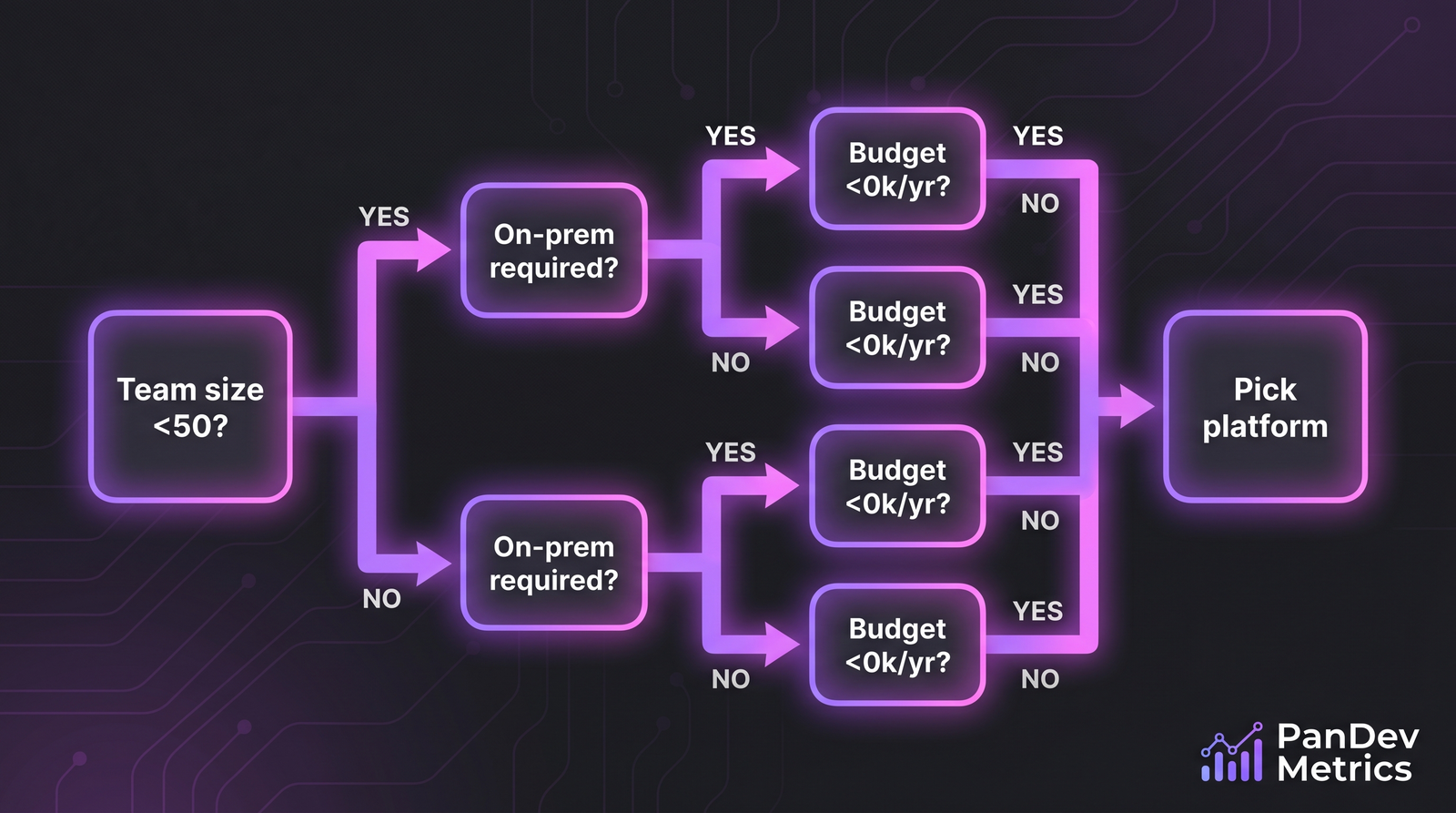 Three questions get you to a shortlist of two or three vendors. Everything else is differentiation between very similar tools.
How to choose: three questions, one decision tree
Most evaluation processes fail because they try to score 15 vendors on 40 criteria. Don't. Answer three questions in order.
Question 1: What's your engineering org size?
- Under 30 engineers: you don't need an enterprise EI platform yet. Open-source (Athenian), a transparent-pricing tier (Swarmia, Sleuth, PanDev Metrics cloud), or even a well-built dbt project on top of GitHub APIs is enough. Don't buy what you can't fully use.
- 30-150: the sweet spot for the category. Most platforms here will work. The differentiation is pricing transparency and integration depth.
- 150+: enterprise tier. Jellyfish, LinearB, and PanDev Metrics on-prem are the realistic shortlist. DX if you have a formal DevEx program.
Question 2: Do you need on-prem?
If you're in fintech, defense, healthcare with PHI, or any EU regulated industry, the answer is increasingly yes. That shrinks the list to: PanDev Metrics, Plandek, Faros AI (self-hosted), Athenian. Jellyfish has a limited on-prem offering for very large customers.
Question 3: What's your annual budget for this category?
- Under $30k/year: Swarmia ($20/seat × 100 seats × 12 months ≈ $24k), Hatica, Sleuth.
- $30-100k: any of the mid-tier vendors.
- $100k+: Jellyfish, DX, LinearB enterprise.
When you've answered these three, you have at most three candidates. Run pilots in parallel for 4-6 weeks. Pick the one your team actually opened daily.
A contrarian claim about AI features
Every vendor on this list now ships "AI insights." For most of them, the AI layer is one of: anomaly detection on a time series (a 1980s technique), natural-language SQL generation (which works when the underlying schema is clean), or LLM summarization of trends ("deployments are down 12% this week"). These are useful. They are not transformative.
The reason: the value of an EI platform is in the data, not the AI layer. If the underlying dataset doesn't capture the right signals — IDE-level activity, accurate deploy-pipeline events, correct task-to-commit linkage — no LLM will save you. We've seen demo dashboards generate plausible-sounding insights from incomplete data, and we've seen engineering leaders almost make staffing decisions on those insights. Don't.
A 2023 Stack Overflow Developer Survey found that 70% of developers were already using or planning to use AI tools, but only 42% trusted the output. The same skepticism should apply to AI insights in EI platforms. Trust the data layer; treat the AI layer as a search interface, not an oracle.
An honest limit nobody in this category will tell you
No engineering intelligence platform — ours included — will solve a cultural problem. If your team doesn't trust each other, EI metrics become surveillance. If your incentives are wrong, EI dashboards become Goodhart's Law in motion (every metric that becomes a target stops being a good metric). If your engineering org doesn't already have honest conversations about delivery, putting dashboards on top of dishonest conversations produces prettier dishonesty.
EI data is navigation, not a performance review input. We say this in writing because our own customers occasionally try to use the data as a KPI for individuals and we push back every time. The DORA report itself, before it went on hiatus in 2024, made this point in nearly every annual edition: high-performing teams use metrics for system improvement, low-performing teams use metrics to rank individuals. The platform doesn't decide which path you take. You do.
FAQ
What's the difference between engineering intelligence and engineering analytics?
Marketing aside, the practical difference: analytics shows you the past (last week's deployment frequency, last quarter's lead time), intelligence layer claims to recommend or predict (this PR is likely to cause an incident, this epic is at risk). In practice most "intelligence" platforms are 80% analytics + 20% AI feature.
Are there open-source engineering intelligence platforms?
Yes. Athenian (athenianco/athenian-api) is MIT-licensed and self-hostable. Faros CE is the open core of Faros AI. Both require a data engineer's attention to keep running. For most teams the math favors paying a vendor unless data sovereignty is a hard requirement.
What's the cheapest engineering intelligence platform?
For zero dollars: Athenian or Faros CE (open source). For a vendor-supported tool: Sleuth has a free tier up to 5 services; LinearB has a free tier up to 9 contributors. For paid plans with public pricing, Hatica and Swarmia start in the $19-20/seat/month range.
Which engineering intelligence platforms support on-prem?
As of 2026: PanDev Metrics (Docker + Kubernetes, air-gapped), Plandek (EU data residency), Faros AI (Faros CE self-hosted), Athenian (open source). Jellyfish has a managed-on-prem option for very large enterprise contracts. Everyone else is cloud-only.
Are AI features actually useful or marketing fluff?
The natural-language query interfaces are useful — they reduce time-to-insight for non-technical stakeholders (CFO, COO). The predictive features are mostly aspirational right now: they work when the input data is high quality, and the input data usually isn't. Anomaly detection is fine but rarely the reason to buy.
Related reading
- Top 10 Engineering Intelligence Tools in 2026: Market Overview — sister post with shorter platform list and more market context
- DORA Metrics: The Complete Guide for Engineering Leaders (2026) — full background on the four DORA metrics every EI platform claims to support
- PanDev Metrics vs LinearB, vs Jellyfish, vs Swarmia — head-to-head feature breakdowns
- Best Pluralsight Flow Alternative 2026 — for teams migrating off the legacy GitPrime line
Sources
- Forrester, The Software Development Lifecycle Analytics Landscape (2024) — first formal recognition of "engineering intelligence" as a market category
- Google, DORA State of DevOps Report (2023, final edition before hiatus) — canonical reference for delivery metrics frameworks
- Microsoft Research / GitHub / University of Victoria, DevEx: What Actually Drives Productivity (Noda, Storey, Forsgren, Greiler, 2023) — foundation paper for the survey-based DevEx approach
- Stack Overflow Developer Survey (2023) — adoption and trust data for AI tools in engineering
Pricing data current as of May 2026. Tier comparisons reflect what vendors publish; "not publicly disclosed" means we declined to estimate.