Top 10 Programming Languages 2026: Real Coding Time Ranking (Beyond GitHub Stars)

Every "top programming languages" list you've seen is based on GitHub stars, Stack Overflow surveys, or job postings. None of them measure what developers actually spend their time writing.
We do. Here's the ranking based on thousands of hours of real IDE coding time across 200+ programming languages, tracked from active B2B developers at 100+ B2B companies.
Why Existing Rankings Are Misleading
The TIOBE Index counts search engine mentions. The PYPL Index counts tutorial searches. GitHub's Octoverse report counts repository counts and pull requests. The Stack Overflow Developer Survey asks developers what they say they use. The JetBrains Developer Ecosystem Survey adds another layer of self-reported data.
None of these answer a simple question: which languages do professional developers actually spend their working hours writing?
Search popularity reflects curiosity, not production use. GitHub stars reflect open-source hype, not enterprise reality. Survey responses reflect identity ("I'm a Python developer") more than daily activity.
We wanted to fix that.
Methodology
PanDev Metrics collects IDE heartbeat data — timestamped activity records that show exactly which language a developer is writing in, at any given moment. This isn't self-reported. It's measured.
Our dataset:
- 100+ B2B companies — enterprise and mid-market, not hobby projects
- active B2B developers — real professional engineers
- extensive activity data — granular IDE heartbeat data
- 200+ languages tracked — from Java to YAML to Dockerfile
- thousands of hours of IDE activity — the denominator for all percentages below
We filtered to active coding sessions only (no idle time, no browsing) and aggregated total hours per language.
The Top 10 Languages by Actual Coding Time
| Rank | Language | Coding Hours | Share of Total | Users |
|---|---|---|---|---|
| 1 | Java | 2,107h | 15.6% | High |
| 2 | TypeScript | 1,627h | 12.0% | High |
| 3 | Python | 1,350h | 10.0% | High |
| 4 | TSX | 1,021h | 7.5% | Medium |
| 5 | PHP | 712h | 5.3% | Medium |
| 6–10 | Other languages | Varies | — | — |
Let's break down what this tells us.
Finding #1: Java Is Still King in Enterprise B2B
Java dominates with 2,107 hours — over 15% of all coding time. This surprises exactly zero enterprise architects, but it surprises a lot of people on Twitter.
Java doesn't trend on Hacker News. It doesn't win "language of the year" awards. But in B2B companies — the ones that pay salaries and ship products — Java is where developers spend the most hours.
Why? Enterprise backends, microservices, Android development, and decades of existing codebases that aren't going anywhere. Java isn't exciting. It's profitable.
Finding #2: TypeScript + TSX Combined Outpaces Everything
If you combine TypeScript (1,627h) and TSX (1,021h), you get 2,648 hours — making the TypeScript ecosystem the single largest consumer of developer time in our dataset.
This makes sense. Modern B2B products need web frontends. React with TypeScript has become the default choice for serious applications. TSX is just TypeScript inside React components, so the combined number reflects the true footprint of the TypeScript ecosystem.
For hiring managers: if you're building a B2B product, TypeScript proficiency is non-negotiable.
Finding #3: Python Is Third — But Growing Fast
Python sits at 1,350 hours (10% of total). Its position reflects the growing importance of data pipelines, ML/AI tooling, internal automation, and backend services in B2B companies.
What's interesting is that Python's share has been climbing. GitHub Octoverse data confirms Python as the fastest-growing language by contributor count. As companies adopt AI features — and as AI-assisted coding tools themselves are often configured and extended in Python — the language is eating into traditional backend territory.
Finding #4: PHP Refuses to Die
PHP at 712 hours (5.3%) will upset the "PHP is dead" crowd. In B2B, there are massive codebases running on Laravel, Symfony, and legacy custom frameworks. These companies generate revenue. Their developers write PHP every day.
The "PHP is dead" narrative is a social media phenomenon. In actual working codebases, PHP is alive and well.
Finding #5: The Long Tail Is Enormous
We track 200+ languages. The top 5 account for roughly half of all coding time. The other 231 languages share the rest.
This long tail includes:
- Infrastructure languages: YAML, Dockerfile, HCL (Terraform), JSON
- Data languages: SQL, R, Julia
- Systems languages: Go, Rust, C, C++
- Scripting: Bash, PowerShell, Ruby
- Mobile: Kotlin, Swift, Dart
Every company's language mix is different. The top 10 gives you a market view, but your team's profile might look nothing like the average.
How This Compares to Popular Rankings
| Language | Our Rank (by coding time) | TIOBE (search) | Stack Overflow (survey) |
|---|---|---|---|
| Java | 1 | Top 5 | Declining |
| TypeScript | 2 | Rising | Top 5 |
| Python | 3 | 1 | 1 |
| PHP | 5 | Top 10 | "Dreaded" |
The biggest discrepancy is Python. It's #1 in almost every popularity index but #3 in actual B2B coding time. The reason: Python is enormously popular in education, data science notebooks, and personal projects — contexts that inflate survey numbers but don't reflect enterprise development proportionally. The Stack Overflow Developer Survey confirms Python as the "most wanted" language, but our data shows that wanting and daily professional use are different things.
Java, conversely, is underrepresented in popularity rankings because enterprise Java developers don't typically evangelize their stack on social media. The JetBrains Developer Ecosystem Survey paints a more balanced picture — showing Java consistently in the top 3 for professional use — which aligns more closely with our findings.
What This Means for Engineering Leaders
For hiring: Align your recruiting with what your team actually writes, not what's trending. If 40% of your codebase is Java, hire Java developers — even if candidates all list Python on their resumes.
For tooling decisions: Invest in developer experience for your dominant languages. If TypeScript is your primary language, optimized linting, type-checking pipelines, and editor configurations pay outsized dividends.
For technology strategy: The TypeScript ecosystem's dominance suggests that full-stack TypeScript (Node.js backend + React frontend) is the path of least resistance for new B2B products. You'll find more developers and more tooling.
For training: If you're investing in upskilling, focus on languages that consume the most coding time in your organization — not the ones with the most hype.
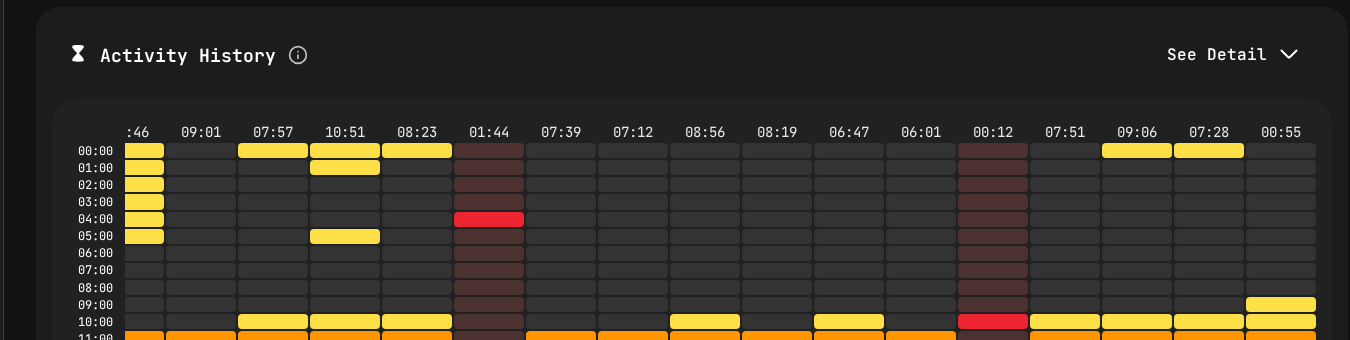 PanDev's activity heatmap shows when your developers code most intensely — and the same data powers the language-level breakdown.
How to Measure Your Own Language Distribution
PanDev Metrics tracks language usage automatically through IDE plugins. Every coding session is tagged with the language, so you can see your team's actual distribution without surveys or guesswork.
This matters because language distribution shifts over time. A team that was 80% Java two years ago might be 50% Java / 30% TypeScript today — and leadership often doesn't know until it's measured.
Conclusion
The most popular programming languages by actual coding time look different from what popularity indexes suggest. Java leads enterprise B2B development. TypeScript (including TSX) dominates when you count the full ecosystem. Python is growing but isn't #1 in professional settings. And PHP is far from dead.
Stop relying on GitHub stars and survey hype to make technology decisions. Measure what your team actually writes.
Measure your team's real language distribution. PanDev Metrics tracks coding time by language automatically — no surveys, no guesswork.