VP of Engineering: The First 90 Days Playbook

A newly hired VP of Engineering has three things the org watches closely: what they cut, who they keep, and how fast they announce a plan. Get the sequence wrong and credibility is gone by week 4 — the org decides you're either a reorganiser or a lame duck before you understand the codebase. Michael Watkins' The First 90 Days is the foundational reference, but it's written for general executives. Engineering orgs have specific traps.
The counter-intuitive move: announce less in the first 30 days than you think you should. Not "listening tour" theatre — an actual measured pause while you read the org's calendar, incident history, and deploy pipeline.
What VP of Engineering really needs to know
A VP of Engineering is not a super-senior IC. The job is predominantly system design applied to people, not code. Three things the role owns that nothing else does:
- Span of control — who reports to whom, where the load is uneven, where the single points of failure live
- Delivery cadence — whether the org can ship, predictably, without heroics
- Talent density — not headcount, but the ratio of senior-to-mid-to-junior across teams
The First Round Review survey of 83 engineering executives (2024) found VPs who succeeded long-term diagnosed the talent-density problem in months 1-2 and acted on it in months 3-4. VPs who failed either diagnosed it too late or acted without diagnosis.
The 90-day plan, by phase
Divide 90 days into three 30-day phases. Don't skip phases — a VP who starts cutting in week 2 hasn't earned the data to cut on.
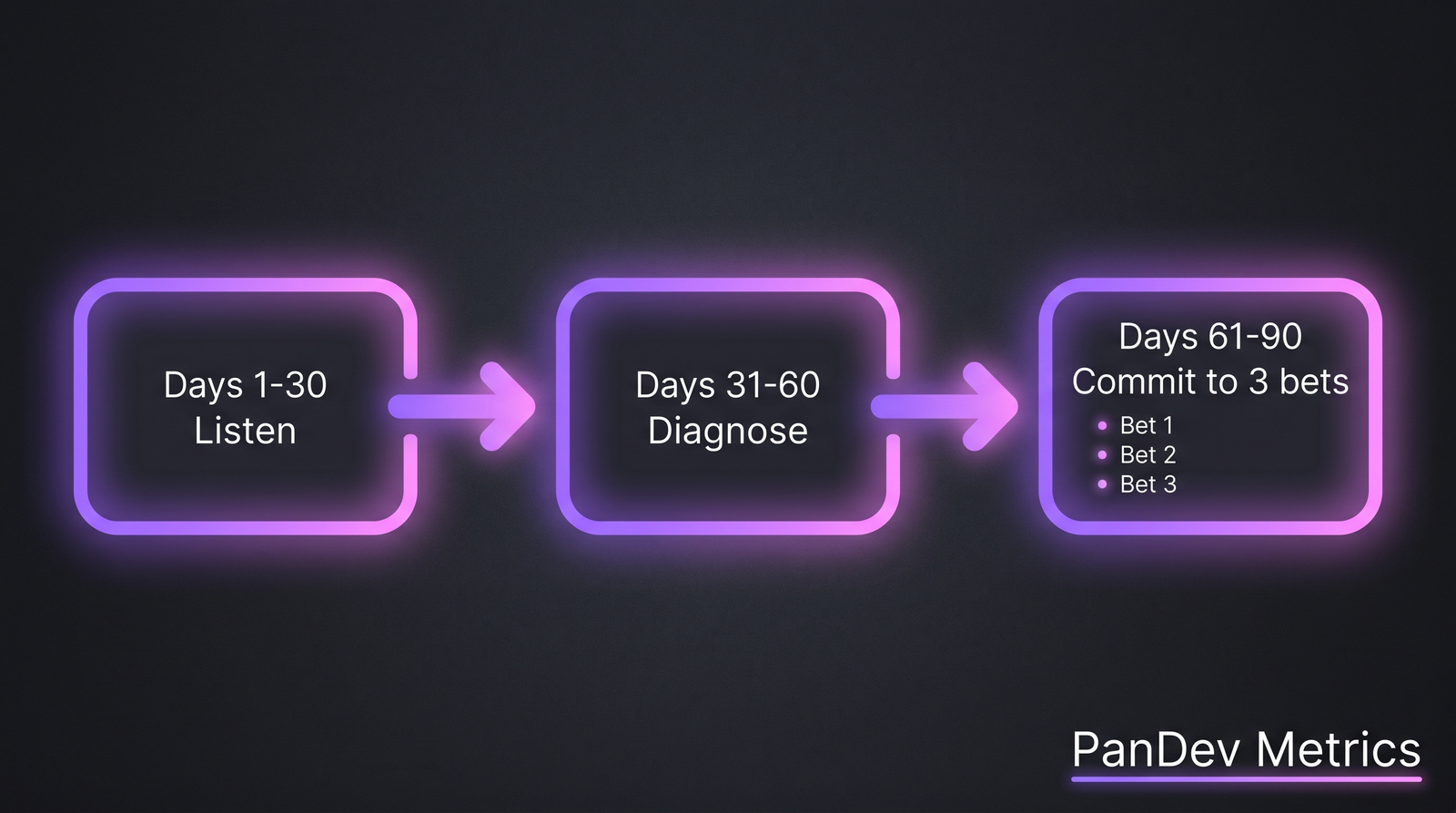 Three phases, one job each. Mixing them — diagnosing while still listening, committing while still diagnosing — is the most common failure mode.
Days 1-30 — Listen (and measure silently)
Goal: build the data set you'll use to diagnose. Don't publish findings yet.
| Activity | Frequency | Output |
|---|---|---|
| 1:1 with every direct report | Weekly | Notes file per person |
| 1:1 with every skip-level EM | Twice in month | Notes + trust score 1-5 |
| Shadow 2-3 on-call rotations | Per week | What breaks + how team reacts |
| Attend every recurring eng meeting | First 2 weeks | Kill list (meetings to cut) |
| Read last 10 post-mortems | Week 1 | Recurring root-cause list |
| Read last 90 days of deploys | Week 2 | Deploy cadence per team |
Questions you ask in every 1:1 (same questions, everyone):
- What's the hardest problem you're working on right now?
- What would you change if you had a magic wand?
- Who on the team do you learn the most from?
- What have I not asked that I should have?
Question 3 is the one that matters. The same 3-4 names will surface across 20+ 1:1s. Those are your talent nodes — the people whose departure would break teams. You need their honest read before you publish anything.
The Drucker question ("If we weren't already doing X, would we start?") applied to every recurring meeting, every status report, and every dashboard you inherit. It's the fastest way to surface legacy debt in the management layer. Usually 30-40% of what you inherit fails the question.
Days 31-60 — Diagnose (and share tentatively)
Goal: build a thesis about what's working, what's broken, what's unknown. Share privately before publishing.
By day 45, you should have answers to:
| Question | Your answer |
|---|---|
| What's the team's DORA baseline? | Deployment freq, lead time, MTTR, CFR |
| Which team is the bottleneck? | Usually 1-2 teams gate everything |
| Who are the 3 people who hold the org together? | If any one quits, what breaks? |
| What's the single biggest unknown? | The thing you don't yet have data on |
| What's the 2-year architectural bet? | Are we making the right one? |
Share the thesis — not conclusions — with 3 groups: your CEO/CTO, your direct reports, and 2-3 skip-level ICs you trust. Use the language "this is my current read, what am I missing?" You get more signal as tentative thesis than as announced plan.
The Harvard Business Review 2023 study on executive transitions (Watkins et al., n=215) found that leaders who shared their diagnosis before their plan had 40% higher 2-year retention of direct reports than those who arrived with a plan. Listen-then-plan compounds.
Days 61-90 — Commit (and act on 3 bets, not 10)
Goal: publish the 12-month plan. 3 bets, not 10.
A VP of Engineering 90-day plan that lists 10 priorities doesn't have 10 priorities — it has none. Pick three. An example structure from a VPE we worked with at a Series B fintech:
| Bet | Commitment | Measurable by month |
|---|---|---|
| Cut deploy lead time by 40% | Invest in CI + staging parity | Month 6 |
| Fix talent density in Platform team | Hire 2 seniors, promote 1, move 1 | Month 9 |
| Retire the monorepo strangler | Archive 4 legacy services, absorb 2 | Month 12 |
Three bets. Every 1:1, every quarterly review, every dashboard anchors to these. Anything else is noise or future planning.
Red flags in your first 90 days
- Every meeting you're in starts with you — you're the bottleneck, not the leader. By week 6 your meetings should mostly be ones you could skip.
- You know what needs to change by week 2 — you don't. You know what sounds wrong. Wait.
- The same name keeps coming up as "difficult" — either they're a hidden cost, or they're the person calling out a real problem nobody else wants to name. Find out which.
- Your CEO is pushing you to "make changes fast" — push back calmly. Explain the 30-30-30. A CEO who understands engineering will respect it. A CEO who doesn't is a different red flag.
- You find yourself drafting a reorg in month 1 — the reorg is always premature in month 1. Org design is the last intervention, not the first.
How to act on it — the concrete tools
Four artefacts every new VP of Engineering should produce and maintain:
1. The Person Doc
One file per direct report. What they care about, what they're good at, what they want to learn, what they said in 1:1s, what promises you made to them. You cannot carry 12 direct reports in your head. VPs who try, forget promises. Broken promises in months 3-6 are credibility-killers.
2. The Team Health Matrix
Score every team (1-5) on five dimensions: delivery, talent, tech debt, team mood, leadership. Update monthly. Anything scoring 2 or below gets management attention. Keeps you from missing the team that's going sideways while you fight the loudest fire.
3. The 90-Day Doc
Your own living diagnosis doc. Updated weekly. Your CEO asks "so what are you seeing?" in month 2 — you open this doc, don't wing it.
4. The First-Year Plan
The output of day 90. One page. 3 bets. What success looks like at 12 months. Shared broadly — this is how the org knows you've landed.
Measure as you go — the metrics that matter for you
Four metrics for your own performance as VP:
| Metric | Month 3 | Month 6 | Month 12 |
|---|---|---|---|
| Time spent in 1:1s | 30-40% | 20-30% | 15-20% |
| Direct reports' promise-keeping score | ≥ 4/5 | ≥ 4.2/5 | ≥ 4.5/5 |
| Own calendar: unscheduled/thinking time | 10-15% | 20% | 25% |
| % of decisions you made that teams reversed within 30 days | ≤ 20% | ≤ 15% | ≤ 10% |
The last row is the quiet one — a VPE whose decisions get reversed means the decisions were made too fast or with too little org buy-in.
PanDev Metrics gives new VPEs a baseline read on the org in week 1 — per-team deploy cadence, DORA numbers, coding-time distribution, who's code-reviewing whom. We've seen incoming VPEs use the AI Assistant to ask "who does the most PR reviews for team X?" and land on the hidden load-bearing engineer faster than 20 1:1s would surface them. See our CTO Weekly Dashboard post for the leader-view shape.
Our dataset skews to companies of 25-500 engineers. For VPEs at 1000+ eng orgs, the playbook stretches — you spend more time on skip-level managers and less on individual ICs. The 30-30-30 phasing still holds, but the activities inside each phase scale differently.
The first-90-days mistake nobody flags
The one failure mode that kills more new VPEs than any other: treating onboarding as linear.
Real onboarding is three nested loops. Daily 1:1s feed weekly team observations feed monthly org thesis. A VPE who tries to go linear — "week 1 is learning, week 12 is doing" — misses the compounding. The compounding is the job.
At 90 days you're not done onboarding. You're done establishing the loop you'll run for 3 years.