Features
TL;DR. PanDev Metrics collects engineering signals from four layers (IDE, Git, task tracker, CLI/browser), normalizes them into one timeline per person, and turns that timeline into DORA metrics, real coding hours, and the only cost-of-a-feature calculation on the market. Everything below is available in both Cloud and on-prem — same product.
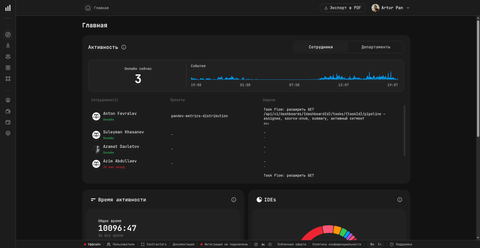
Data collection
This is the layer competitors skip. PanDev Metrics emits activity events directly from where engineers actually work.
IDE plugins
Native plugins across the full IDE landscape:
- JetBrains family (10 IDEs) — IntelliJ IDEA, PyCharm, WebStorm, PhpStorm, GoLand, Rider, CLion, RustRover, RubyMine, Android Studio.
- Microsoft — Visual Studio (all versions; 2024+ in theory works, not officially tested), VS Code.
- VS Code forks — Cursor and Windsurf use the VS Code plugin directly.
- Xcode — for iOS/macOS teams.
- Eclipse family — Eclipse and Eclipse-based IDEs.
Plugins update automatically if the IDE supports it, otherwise manually. Offline? The plugin queues events locally and flushes when the engineer is back online.
What the plugin captures: file names, activity events (file changes, scroll, open/close), foreground app. What it never captures: source code, screenshots. AI-tool usage is tracked as two distinct signals — engineer prompting (counts as developer activity) and AI auto-generating (counts as AI activity).
Git platforms
Connectors for every mainstream hosting:
- GitHub — both GitHub App (recommended, easier) and OAuth. Minimum permissions: Repository Read, Pull Request Read/Write.
- GitLab — Cloud and Self-Managed. Minimum scopes:
api,write_repository. - Bitbucket — Cloud, Server, Data Center.
- Azure DevOps — Repos, Pipelines, Boards.
Task trackers
Linking code to business work:
- Jira — Cloud and Server/Data Center (on-prem). Requires an Administrator account because PanDev creates webhooks on connect.
- Yandex Tracker — production-ready, OAuth.
- ClickUp — production-ready.
- Azure Boards — supported.
- Coming up: Monday, Trello, Asana.
- Not supported: Linear.
If you don't want any tracker integration at all, run the platform in no-integrations mode and rely on IDE + Git signals alone.
CLI and browser
- CLI plugins for Mac and Linux (Windows in development). Captures only the command name and the fact of execution — a heartbeat of activity. Codex CLI and Claude Code are first-class citizens.
- Browser extensions for 10 browsers (Chrome, Brave, Edge, Firefox, Opera, Arc, Vivaldi, Yandex, Whale, Sidekick). Org-level whitelist controls what gets tracked; each user keeps a personal blacklist for what to never track.
Engineering analytics
Once events land in PanDev, they roll up into dashboards.
DORA metrics
The industry-standard delivery indicators, with performance bands (Elite / High / Medium / Low):
- Deployment frequency
- Lead time for changes
- Change failure rate
- Mean time to restore
Each metric is drillable down to the underlying events.
Productivity and engagement
A broader set of indicators tracked at the engineer, team, role and department level. The most distinctive ones:
- Real coding hours. A gap shorter than 15 minutes between IDE events counts as active time. A longer gap doesn't. This calibration is the foundation of every "hours" number you'll see.
- Overtime. Any work outside business hours on a weekday. Reflects burnout risk honestly, without manual logging.
- Delivery Index. Ratio of research time to development time in code — surfaces engineers and teams where the balance has drifted.
- Focus and deep work. Long uninterrupted IDE blocks, separated from short scattered ones.
- AI-assisted vs hand-written work. Two distinct signals so AI tooling doesn't inflate or deflate productivity by accident.
Custom metrics are not supported — the indicator set is curated and consistent across tenants.
People and projects
- Employee card — profile, activity, work history, projects, time distribution. Everything you need for a Performance Review in one place.
- Project page — repository as the unit, with contributors, activity, timeline.
- Org structure — teams nested inside departments, all of it inside a tenant. Roles map to the UI labels: Admin, Maintainer, Viewer at tenant level, plus department-level Owner / Maintainer / Viewer / Finance (Financier).
Cost per feature — our unique edge
This is the single feature you won't find elsewhere on the market.
PanDev Metrics calculates the direct cost of a task as:
time logged against the task × the engineer's hourly rate + a proportional share of that engineer's unattributed time.
What that buys you:
- A real dollar number against every Jira/Tracker issue you ship.
- Aggregated costs by project, team, department, or quarter.
- A rate change applied retroactively — flip a hourly rate and historical costs recalculate across the entire timeline.
The finance layer supports hourly and monthly salary types, in USD only, with manual public holidays and per-employee working calendars (which override the tenant-level calendar). Reports export to XLSX.
The finance area is gated behind the dedicated Finance (Financier) role — assigned from the admin panel by an Owner.
Cloud vs on-premises
The product is identical in both modes — same features, same UI, same dashboards. Two differences:
| Capability | Cloud | On-prem |
|---|---|---|
| Multi-tenant orgs | yes | no — single tenant per install |
| Google sign-in | yes | no (LDAP supported) |
| Everything else | yes | yes |
On-premises deployment
- Targets: Docker (Compose v2.0+, Engine ≥ 20.10) or Kubernetes (≥ 1.28).
- Hardware: 8 CPU / 16 GB RAM / 50 GB SSD for app, 16 CPU / 24 GB RAM / 100 GB SSD for the dedicated PostgreSQL host.
- Database: PostgreSQL 17.
- Auth: LDAP only for SSO (no SAML/OIDC).
- Backups:
pg_dumpis enough. - Upgrades: swap image tags in
docker-compose.ymlor the Helm chart. - Ports:
8080app,9090actuator. - Self-signed TLS: supported, including the option to disable SSL validation on the client side.
- Air-gapped installs: not supported.
There is a small amount of outbound traffic on on-prem; it cannot be turned off entirely.
What's coming
Items the team is actively working on (not described in depth elsewhere yet):
- Built-in task tracker (Task Flow / Kanban) — our own lightweight tracker so the loop doesn't depend on Jira. In development; the route exists in the navigation but the screen is not yet live in production.
- Datavisor — a more open data-exploration surface on top of the engineering warehouse.
- Expanded exports — additional formats and destinations beyond the current XLSX payment report.
Related
- Product overview — the wider context and competitive position.
- Use cases — role-by-role stories.
- On-prem deployment — the operator's view.
- Setup → IDE plugins — installation guides.